(Preprint) CMML: Contextual Modulation Meta Learning for Cold-Start Recommendation
Xidong Feng ¹, Chen Chen ², Dong Li ², Mengchen Zhao ², Jianye Hao 郝建业 ², Jun Wang 汪军 ¹
¹ University College London
² Noah’s Ark Lab, Huawei
华为诺亚方舟实验室
arXiv
, 2021-08-24
Abstract
Practical recommender systems experience a cold-start problem when observed user-item interactions in the history are insufficient. Meta learning, especially gradient based one, can be adopted to tackle this problem by learning initial parameters of the model and thus allowing fast adaptation to a specific task from limited data examples.
Though with significant performance improvement, it commonly suffers from two critical issues: the non-compatibility with mainstream industrial deployment and the heavy computational burdens, both due to the inner-loop gradient operation. These two issues make them hard to be applied in practical recommender systems. To enjoy the benefits of meta learning framework and mitigate these problems, we propose a recommendation framework called Contextual Modulation Meta Learning (CMML).
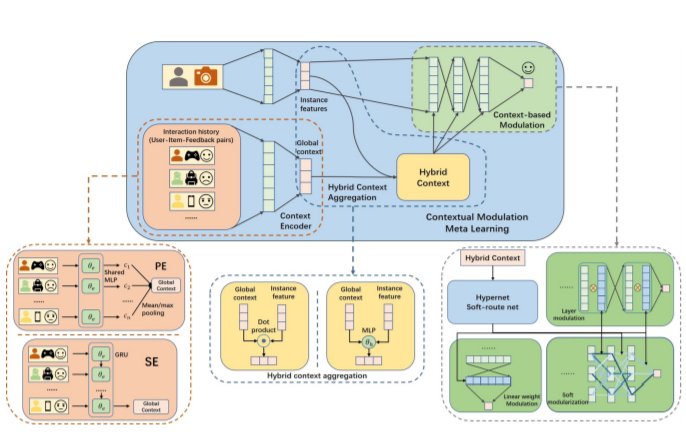
CMML is composed of fully feed-forward operations so it is computationally efficient and completely compatible with the mainstream industrial deployment. CMML consists of three components, including a context encoder that can generate context embedding to represent a specific task, a hybrid context generator that aggregates specific user-item features with task-level context, and a contextual modulation network, which can modulate the recommendation model to adapt effectively.
We validate our approach on both scenario-specific and user-specific cold-start setting on various real-world datasets, showing CMML can achieve comparable or even better performance with gradient based methods yet with much higher computational efficiency and better interpretability.
Ultrafast all-optical modulation of wide-bandwidth pulses enabled by silicon-metasurfaces
Kaloyan Georgiev, Khosro Zangeneh Kamali, Anton A. Trifonov, Giulia Crotti, Lyuben Petrov, Stefan Georgiev, Hristo Iliev, Lei Xu, Unai Arregui Leon, Mohsen Rahmani, Giuseppe Della Valle, Ivan Buchvarov, Dragomir Neshev
Opto-Electronic Advances
2026-09-15
Physics-informed neural fields enable blind aberration correction for partially coherent quantitative phase imaging
Shun Zhou, Xingyu Huang, Linpeng Lu, Habib Ullah, Kaiyu Du, Maciej Trusiak, Malgorzata Kujawinska, Yuzhen Zhang, Yao Fan, Qian Chen, Qinrong Zhang, Chao Zuo
Opto-Electronic Science
2026-08-26
Heterogeneously integrated micro-ring with SnS₂ for dual-functional optical modulation and photodetection
Jinyi Du, Lidan Lu, Xu Zhang, Bofei Zhu, Wenbo Bo, Yingjie Xu, Guang Chen, Yanlin He, Guanghui Ren, Xiaoping Lou, Zheng You, Lianqing Zhu
Opto-Electronic Advances
2026-08-25
Hardware-aware lightweight photonic spiking neural network for pattern classification
Shuiying Xiang, Yahui Zhang, Shangxuan Shi, Haowen Zhao, Dianzhuang Zheng, Xingxing Guo, Yanan Han, Ye Tian, Liyue Zhang, Yuechun Shi, Yue Hao
Opto-Electronic Advances
2026-08-25
PhyspeNet: An empirical physics-aware network for adaptive speckle reconstructive spectrometry
Junrui Liang, Min Jiang, Jun Li, Zhongming Huang, Junhong He, Yanting Guo, Yanzhao Ke, Jun Ye, Jiangming Xu, Jinyong Leng, Pu Zhou
Opto-Electronic Advances
2026-08-25
A 36 × 240 Gbps hybrid mode/wavelength division multiplexing transmitter using lithium niobate on insulator
Mingyu Zhu, Weihan Wang, Ruitao Ma, Aoyun Gao, Chun Gao, Zexu Wang, Fei Huang, Zhenyuan Bao, Dajian Liu, Jiaxuan Gan, Zejie Yu, Huan Li, Weike Zhao, Daoxin Dai
Opto-Electronic Advances
2026-08-25