(Peer-Reviewed) Digital twin optical computing system
Run Sun 孙润 ¹ ², Yuemin Li 李悦旻 ¹ ², Tingzhao Fu 符庭钊 ³, Wencan Liu 刘文灿 ¹ ², Sigang Yang 杨四刚 ¹ ², Hongwei Chen 陈宏伟 ¹ ²
¹ Department of Electronic Engineering, Tsinghua University, Beijing 100084, China
中国 北京 清华大学电子工程系
² Beijing National Research Center for Information Science and Technology, Beijing 100084, China
中国 北京 北京信息科学与技术国家研究中心
³ College of Advanced Interdisciplinary Studies & Hunan Provincial Key Laboratory of Novel Nano-Optoelectronic Information Materials and Devices, National University of Defense Technology, Changsha 410073, China
中国 长沙 国防科技大学前沿交叉学科学院 新型纳米光电信息材料与器件湖南省重点实验室
Opto-Electronic Advances
, 2026-07-10
Abstract
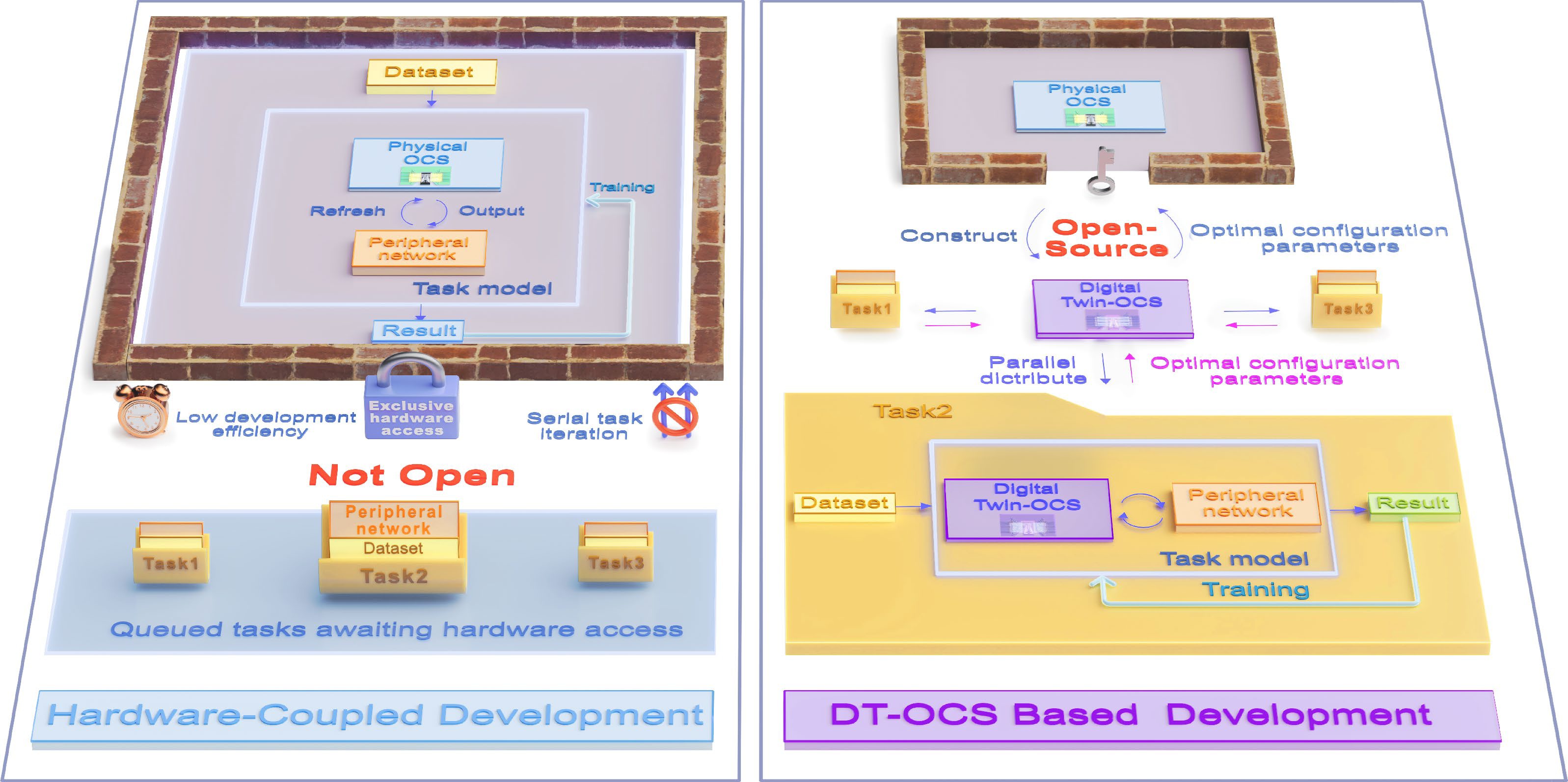
Optical computing systems (OCS) are promising accelerators for artificial intelligence due to their high bandwidth, low latency, and inherent parallelism. However, in existing OCS implementations, task development often requires direct participation of physical hardware during training and optimization, tightly coupling development workflows to device access and limiting offline design, reproducible benchmarking, and parallel exploration.
Here, we propose a Digital Twin Optical Computing System (DT-OCS), a system-level, measurement-driven digital surrogate that emulates the end-to-end input-output behavior of a specific physical OCS under different operating configurations. DT-OCS is implemented as a differentiable software module, enabling fully offline task training and configuration optimization. The optimized configuration parameters can be directly transferred to the physical OCS without hardware-in-the-loop retraining. We validate DT-OCS on a high-speed optical computing system operating at 10 GHz and equipped with a silicon-based integrated computing chip. Representative tasks, including image classification and temporal strategy generation, are evaluated.
Across all tasks, the transferred models closely match the performance of their digital-twin counterparts after direct parameter transfer. These results demonstrate that DT-OCS enables a hardware-decoupled and fully offline development paradigm for optical computing systems. The DT-OCS implementation is released as open-source code to facilitate reuse and further development.
Ultrafast all-optical modulation of wide-bandwidth pulses enabled by silicon-metasurfaces
Kaloyan Georgiev, Khosro Zangeneh Kamali, Anton A. Trifonov, Giulia Crotti, Lyuben Petrov, Stefan Georgiev, Hristo Iliev, Lei Xu, Unai Arregui Leon, Mohsen Rahmani, Giuseppe Della Valle, Ivan Buchvarov, Dragomir Neshev
Opto-Electronic Advances
2026-09-15
Physics-informed neural fields enable blind aberration correction for partially coherent quantitative phase imaging
Shun Zhou, Xingyu Huang, Linpeng Lu, Habib Ullah, Kaiyu Du, Maciej Trusiak, Malgorzata Kujawinska, Yuzhen Zhang, Yao Fan, Qian Chen, Qinrong Zhang, Chao Zuo
Opto-Electronic Science
2026-08-26
Heterogeneously integrated micro-ring with SnS₂ for dual-functional optical modulation and photodetection
Jinyi Du, Lidan Lu, Xu Zhang, Bofei Zhu, Wenbo Bo, Yingjie Xu, Guang Chen, Yanlin He, Guanghui Ren, Xiaoping Lou, Zheng You, Lianqing Zhu
Opto-Electronic Advances
2026-08-25
Hardware-aware lightweight photonic spiking neural network for pattern classification
Shuiying Xiang, Yahui Zhang, Shangxuan Shi, Haowen Zhao, Dianzhuang Zheng, Xingxing Guo, Yanan Han, Ye Tian, Liyue Zhang, Yuechun Shi, Yue Hao
Opto-Electronic Advances
2026-08-25
PhyspeNet: An empirical physics-aware network for adaptive speckle reconstructive spectrometry
Junrui Liang, Min Jiang, Jun Li, Zhongming Huang, Junhong He, Yanting Guo, Yanzhao Ke, Jun Ye, Jiangming Xu, Jinyong Leng, Pu Zhou
Opto-Electronic Advances
2026-08-25
A 36 × 240 Gbps hybrid mode/wavelength division multiplexing transmitter using lithium niobate on insulator
Mingyu Zhu, Weihan Wang, Ruitao Ma, Aoyun Gao, Chun Gao, Zexu Wang, Fei Huang, Zhenyuan Bao, Dajian Liu, Jiaxuan Gan, Zejie Yu, Huan Li, Weike Zhao, Daoxin Dai
Opto-Electronic Advances
2026-08-25