(Peer-Reviewed) Decay rate of Larix gmelinii coarse woody debris on burned patches in the Greater Khingan Mountains
Shubo Huang 黄书博 ¹, Lixiang Wen 温理想 ¹, Shuai Yin ², Meng Guo 郭蒙 ¹, Fangbing Yu 于方冰 ¹
¹ Key Laboratory of Geographical Processes and Ecological Security in Changbai Mountains, School of Geographical Sciences, Northeast Normal University, Ministry of Education, Changchun, 130024, People's Republic of China
中国 长春 东北师范大学地理科学学院 长白山地理过程与生态安全教育部重点实验室
² Center for Global Environmental Research, National Institute for Environmental Studies, Tsukuba, 3058506, Japan
Abstract
The decomposition of coarse woody debris (CWD) affects the energy flow and nutrient cycling in forest ecosystems. Previous studies on CWD have focused on the input, decomposition, reserve dynamics, and CWD functions, but coarse woody debris decomposition is complex and the results from different regions vary considerably. It is not clear which factors affect decay rate (k), especially at different decomposition stages.
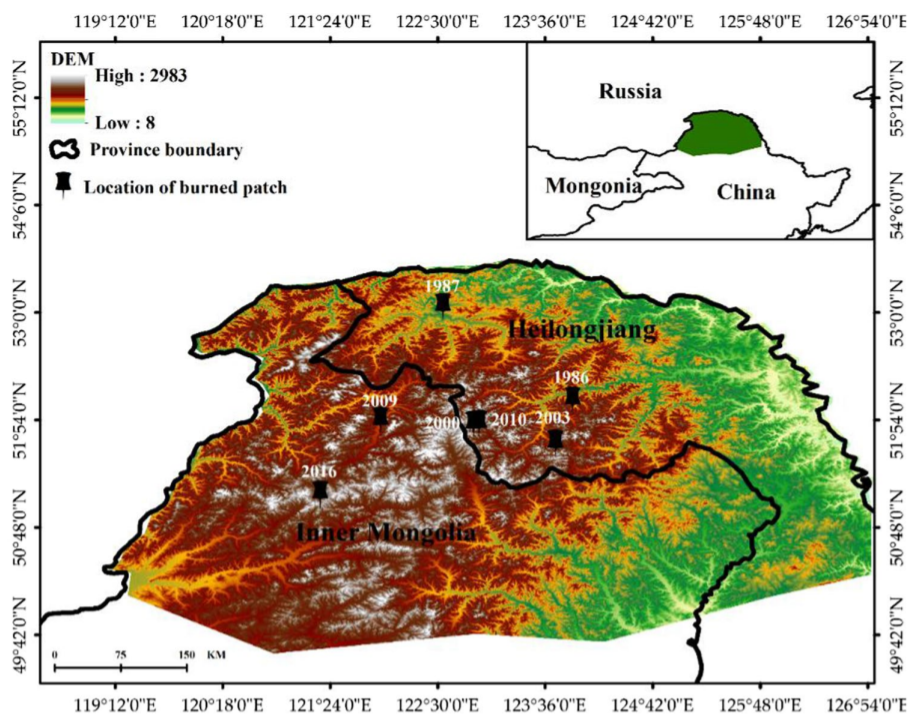
In this study, a single-exponential decay model was used to analyze the characteristics of CWD decomposition in Larix gmelinii forests over the 33 years following a fire in the Greater Khingan Mountains. The results show that the decay rate of coarse woody debris was positively correlated to decay class. The average decomposition rate was 0.019, and 41 years and 176 years are needed for a 50% and 95% mass loss, respectively. CWD nutrient content, density, and water content could explain the variance in the decay rate (~ 42%) of the decay factors such as amount of leaching, degree of fragmentation, respiration of the debris, and biotransformation, and varied significantly between different decay classes.
Using the space–time substitution method, this study arranged the coarse woody debris of different mortality times to form a 33 year chronosequence which revealed the decomposition process. It was concluded that the decay rate was mainly explained by structural component of the debris and its nitrogen and water contents. This paper quantifies the indicators affecting CWD decay to explain the decomposition process.
Ultrafast all-optical modulation of wide-bandwidth pulses enabled by silicon-metasurfaces
Kaloyan Georgiev, Khosro Zangeneh Kamali, Anton A. Trifonov, Giulia Crotti, Lyuben Petrov, Stefan Georgiev, Hristo Iliev, Lei Xu, Unai Arregui Leon, Mohsen Rahmani, Giuseppe Della Valle, Ivan Buchvarov, Dragomir Neshev
Opto-Electronic Advances
2026-09-15
Physics-informed neural fields enable blind aberration correction for partially coherent quantitative phase imaging
Shun Zhou, Xingyu Huang, Linpeng Lu, Habib Ullah, Kaiyu Du, Maciej Trusiak, Malgorzata Kujawinska, Yuzhen Zhang, Yao Fan, Qian Chen, Qinrong Zhang, Chao Zuo
Opto-Electronic Science
2026-08-26
Heterogeneously integrated micro-ring with SnS₂ for dual-functional optical modulation and photodetection
Jinyi Du, Lidan Lu, Xu Zhang, Bofei Zhu, Wenbo Bo, Yingjie Xu, Guang Chen, Yanlin He, Guanghui Ren, Xiaoping Lou, Zheng You, Lianqing Zhu
Opto-Electronic Advances
2026-08-25
Hardware-aware lightweight photonic spiking neural network for pattern classification
Shuiying Xiang, Yahui Zhang, Shangxuan Shi, Haowen Zhao, Dianzhuang Zheng, Xingxing Guo, Yanan Han, Ye Tian, Liyue Zhang, Yuechun Shi, Yue Hao
Opto-Electronic Advances
2026-08-25
PhyspeNet: An empirical physics-aware network for adaptive speckle reconstructive spectrometry
Junrui Liang, Min Jiang, Jun Li, Zhongming Huang, Junhong He, Yanting Guo, Yanzhao Ke, Jun Ye, Jiangming Xu, Jinyong Leng, Pu Zhou
Opto-Electronic Advances
2026-08-25
A 36 × 240 Gbps hybrid mode/wavelength division multiplexing transmitter using lithium niobate on insulator
Mingyu Zhu, Weihan Wang, Ruitao Ma, Aoyun Gao, Chun Gao, Zexu Wang, Fei Huang, Zhenyuan Bao, Dajian Liu, Jiaxuan Gan, Zejie Yu, Huan Li, Weike Zhao, Daoxin Dai
Opto-Electronic Advances
2026-08-25