(Peer-Reviewed) Scientific Aspiration of the Chinese Space Station Program: an Interview with Ming Gao
Weijie Zhao 赵维杰
News editor at National Science Review (NSR)
《国家科学评论》新闻编辑
National Science Review
, 2021-08-26
Interview
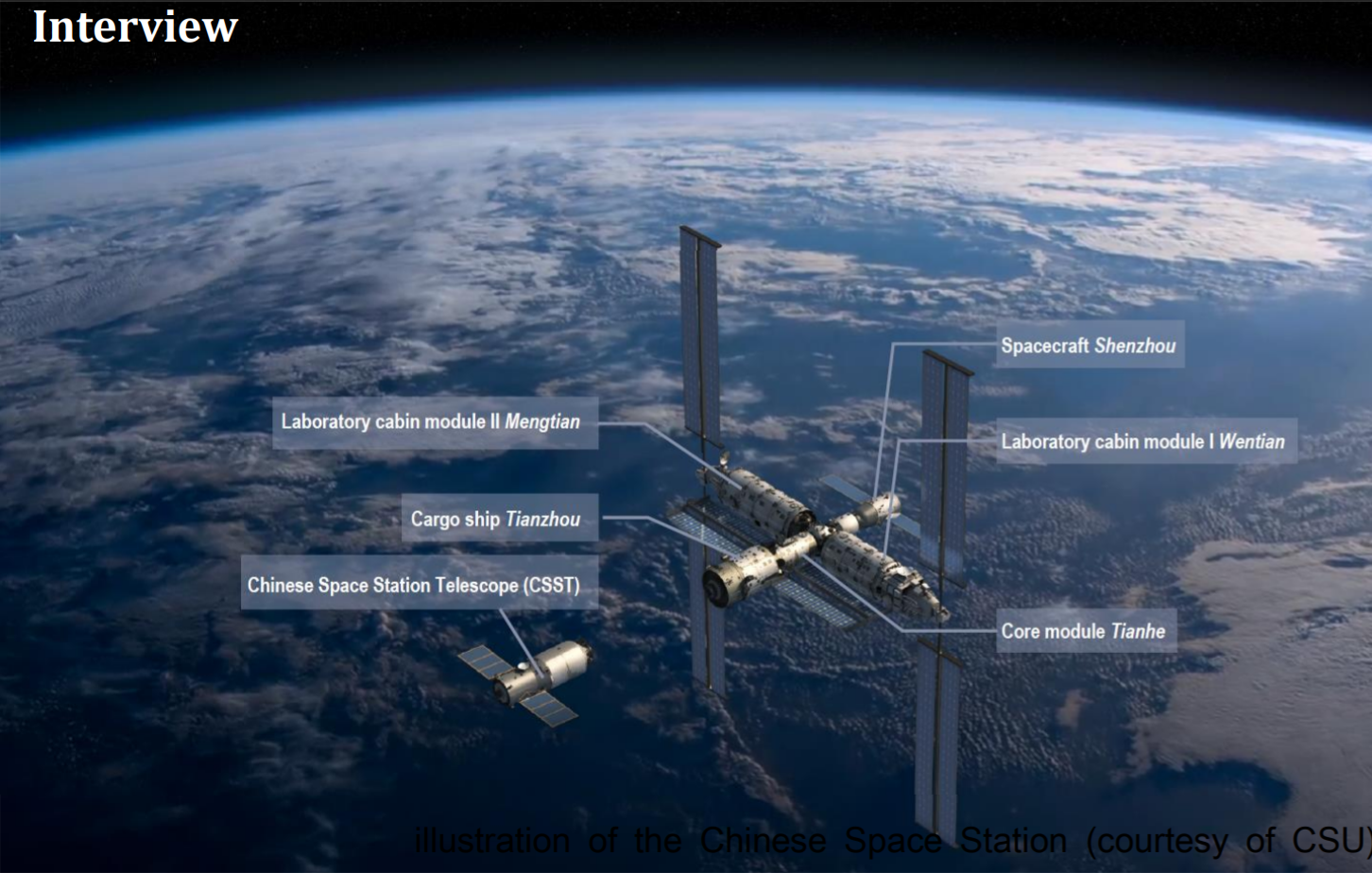
June 17th 2021, China’s spacecraft Shenzhou 12 took three Chinese astronauts onto the Earth’s orbit and docked with the assembly of Tianhe and Tianzhou, the core module and the cargo ship of the Chinese Space Station (CSS) respectively that had been launched and assembled on-orbit earlier this year. The three astronauts became the first visitors of CSS and would stay on orbit for about three months. In 2022, two laboratory cabin modules, Wentian and Mengtian, will be launched and assembled into Tianhe, completing the basic structure of CSS. The CSS is designed to be used for at least 10 years, and will provide an outer space experimental platform for researchers from multiple disciplines.
On July 23rd of 2021, National Science Review (NSR) interviewed Professor Ming GAO (高铭), the Commander-in-Chief of the Space Application System of the China Manned Space Project, Director General of the Technology and Engineering Center for Space Utilization of Chinese Academy of Sciences (CSU), and an Academician of the International Academy of Astronautics. The Space Application System is the scientific part of the CSS project, responsible for the design and organization of the onboard research programs. Gao has been involved in China's Manned Space Project since 1994, experienced the whole development process from the Shenzhou spacecraft to the CSS. In this interview, she introduced the scientific goals, plans and aspirations of CSS.
Ultrafast all-optical modulation of wide-bandwidth pulses enabled by silicon-metasurfaces
Kaloyan Georgiev, Khosro Zangeneh Kamali, Anton A. Trifonov, Giulia Crotti, Lyuben Petrov, Stefan Georgiev, Hristo Iliev, Lei Xu, Unai Arregui Leon, Mohsen Rahmani, Giuseppe Della Valle, Ivan Buchvarov, Dragomir Neshev
Opto-Electronic Advances
2026-09-15
Physics-informed neural fields enable blind aberration correction for partially coherent quantitative phase imaging
Shun Zhou, Xingyu Huang, Linpeng Lu, Habib Ullah, Kaiyu Du, Maciej Trusiak, Malgorzata Kujawinska, Yuzhen Zhang, Yao Fan, Qian Chen, Qinrong Zhang, Chao Zuo
Opto-Electronic Science
2026-08-26
Heterogeneously integrated micro-ring with SnS₂ for dual-functional optical modulation and photodetection
Jinyi Du, Lidan Lu, Xu Zhang, Bofei Zhu, Wenbo Bo, Yingjie Xu, Guang Chen, Yanlin He, Guanghui Ren, Xiaoping Lou, Zheng You, Lianqing Zhu
Opto-Electronic Advances
2026-08-25
Hardware-aware lightweight photonic spiking neural network for pattern classification
Shuiying Xiang, Yahui Zhang, Shangxuan Shi, Haowen Zhao, Dianzhuang Zheng, Xingxing Guo, Yanan Han, Ye Tian, Liyue Zhang, Yuechun Shi, Yue Hao
Opto-Electronic Advances
2026-08-25
PhyspeNet: An empirical physics-aware network for adaptive speckle reconstructive spectrometry
Junrui Liang, Min Jiang, Jun Li, Zhongming Huang, Junhong He, Yanting Guo, Yanzhao Ke, Jun Ye, Jiangming Xu, Jinyong Leng, Pu Zhou
Opto-Electronic Advances
2026-08-25
A 36 × 240 Gbps hybrid mode/wavelength division multiplexing transmitter using lithium niobate on insulator
Mingyu Zhu, Weihan Wang, Ruitao Ma, Aoyun Gao, Chun Gao, Zexu Wang, Fei Huang, Zhenyuan Bao, Dajian Liu, Jiaxuan Gan, Zejie Yu, Huan Li, Weike Zhao, Daoxin Dai
Opto-Electronic Advances
2026-08-25