(Peer-Reviewed) High-speed visible light communication based on micro-LED: A technology with wide applications in next generation communication
Tingwei Lu 卢霆威 ¹, Xiangshu Lin 林祥枢 ¹, Wenan Guo 郭文安 ¹, Chang-Ching Tu 杜长庆 ³ ⁴, Shibiao Liu 刘时彪 ¹, Chun-Jung Lin 林俊荣 ⁵, Zhong Chen 陈忠 ¹ ², Hao-Chung Kuo 郭浩中 ³ ⁴, Tingzhu Wu 吴挺竹 ¹ ²
¹ School of Electronic Science and Engineering, Fujian Engineering Research Center for Solid-State Lighting, Xiamen University, Xiamen 361005, China
中国 厦门 厦门大学电子科学与技术学院 福建省固态照明工程研究中心
² Innovation Laboratory for Sciences and Technologies of Energy Materials of Fujian Province (IKKEM), Xiamen 361005, China
中国 厦门 福建能源材料科学与技术创新实验室(嘉庚创新实验室)
³ Department of Photonics and Graduate Institute of Electro-Optical Engineering, College of Electrical and Computer Engineering, Yang Ming Chiao Tung University, Hsinchu 30010, Taiwan, China
中国 台湾 新竹 台湾阳明交通大学 电机学院 光子学系 光电工程研究所
⁴ Semiconductor Research Center, Hon Hai Research Institute, Taipei 11492, Taiwan, China
中国 台湾 台北 鸿海研究院半导体研究中心
⁵ Guangdong Visible Light Communication Technology Co., LTD., Foshan 528000, China
中国 佛山 广东可见光通信科技有限公司
Opto-Electronic Science
, 2022-12-29
Abstract
The evolution of next-generation cellular networks is aimed at creating faster, more reliable solutions. Both the next-generation 6G network and the metaverse require high transmission speeds. Visible light communication (VLC) is deemed an important ancillary technology to wireless communication. It has shown potential for a wide range of applications in next-generation communication.
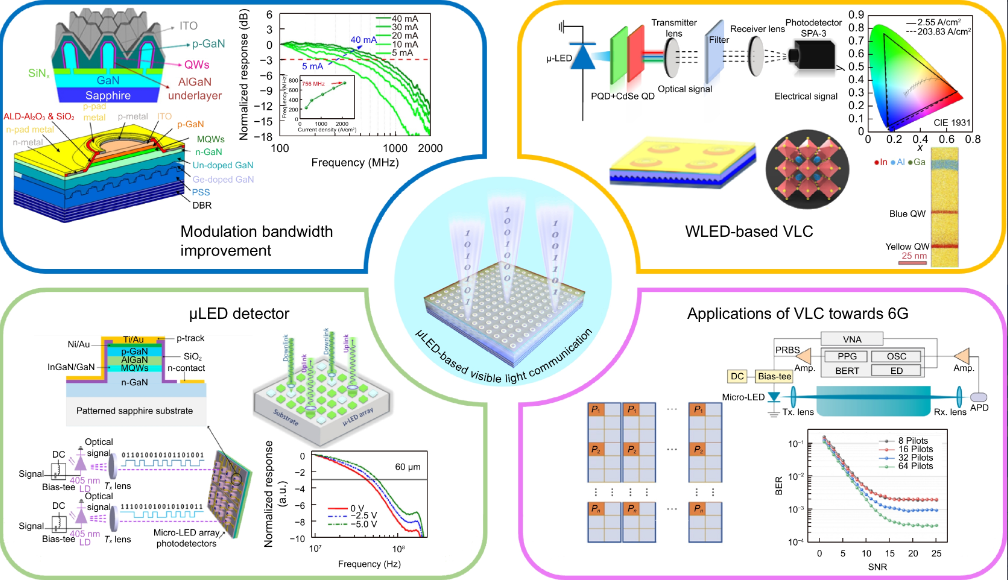
Micro light-emitting diodes (μLEDs) are ideal light sources for high-speed VLC, owing to their high modulation bandwidths. In this review, an overview of μLEDs for VLC is presented. Methods to improve the modulation bandwidth are discussed in terms of epitaxy optimization, crystal orientation, and active region structure. Moreover, electroluminescent white LEDs, photoluminescent white LEDs based on phosphor or quantum-dot color conversion, and μLED-based detectors for VLC are introduced.
Finally, the latest high-speed VLC applications and the application prospects of VLC in 6G are introduced, including underwater VLC and artificial intelligence-based VLC systems.
Ultrafast all-optical modulation of wide-bandwidth pulses enabled by silicon-metasurfaces
Kaloyan Georgiev, Khosro Zangeneh Kamali, Anton A. Trifonov, Giulia Crotti, Lyuben Petrov, Stefan Georgiev, Hristo Iliev, Lei Xu, Unai Arregui Leon, Mohsen Rahmani, Giuseppe Della Valle, Ivan Buchvarov, Dragomir Neshev
Opto-Electronic Advances
2026-09-15
Physics-informed neural fields enable blind aberration correction for partially coherent quantitative phase imaging
Shun Zhou, Xingyu Huang, Linpeng Lu, Habib Ullah, Kaiyu Du, Maciej Trusiak, Malgorzata Kujawinska, Yuzhen Zhang, Yao Fan, Qian Chen, Qinrong Zhang, Chao Zuo
Opto-Electronic Science
2026-08-26
Heterogeneously integrated micro-ring with SnS₂ for dual-functional optical modulation and photodetection
Jinyi Du, Lidan Lu, Xu Zhang, Bofei Zhu, Wenbo Bo, Yingjie Xu, Guang Chen, Yanlin He, Guanghui Ren, Xiaoping Lou, Zheng You, Lianqing Zhu
Opto-Electronic Advances
2026-08-25
Hardware-aware lightweight photonic spiking neural network for pattern classification
Shuiying Xiang, Yahui Zhang, Shangxuan Shi, Haowen Zhao, Dianzhuang Zheng, Xingxing Guo, Yanan Han, Ye Tian, Liyue Zhang, Yuechun Shi, Yue Hao
Opto-Electronic Advances
2026-08-25
PhyspeNet: An empirical physics-aware network for adaptive speckle reconstructive spectrometry
Junrui Liang, Min Jiang, Jun Li, Zhongming Huang, Junhong He, Yanting Guo, Yanzhao Ke, Jun Ye, Jiangming Xu, Jinyong Leng, Pu Zhou
Opto-Electronic Advances
2026-08-25
A 36 × 240 Gbps hybrid mode/wavelength division multiplexing transmitter using lithium niobate on insulator
Mingyu Zhu, Weihan Wang, Ruitao Ma, Aoyun Gao, Chun Gao, Zexu Wang, Fei Huang, Zhenyuan Bao, Dajian Liu, Jiaxuan Gan, Zejie Yu, Huan Li, Weike Zhao, Daoxin Dai
Opto-Electronic Advances
2026-08-25