(Peer-Reviewed) A flexible wireless system for prospective photodynamic therapy applications
Rolan Mansour ¹, Bhavani Yalagala ¹, Vikas Vikas ⁴, Nikolas Bruce ¹, Fawziye Tarhini ¹, Georgios N. Arvanitakis ², Mohammed Mughal ¹, Jamie Blanche ¹, Ahmad Taha ¹, Jonathan Copper ⁵, Muhammad Imran ¹, Karin Williams ³, Karin Oien ³, Mahmoud Wagih ¹, Hadi Heidari ¹, Robert Hadfield ⁴, David Flynn ¹
¹ James Watt School of Engineering, University of Glasgow, Glasgow G12 8QQ, UK
² Edinburgh Instruments Ltd, 2 Bain Square, Kirkton Campus, Livingston EH54 7DQ, UK
³ School of Cancer Sciences, University of Glasgow, Glasgow G61 1QH, UK
⁴ Quantum Sensors Group, Advanced Research Centre, University of Glasgow, Glasgow G11 6EW, UK
⁵ Biomedical Engineering, Advanced Research Centre, University of Glasgow, Glasgow G12 8QQ, UK
Opto-Electronic Advances
, 2026-07-10
Abstract
Cancer treatments, dependent on several factors, deliver varying degrees of treatment effectiveness. Photodynamic therapy (PDT) is a treatment modality that selectively targets and destroys cancer cells using a light-sensitive drug with a specific optical wavelength. However, PDT encounters several constraints, mainly, limited penetration of light into deep tumors.
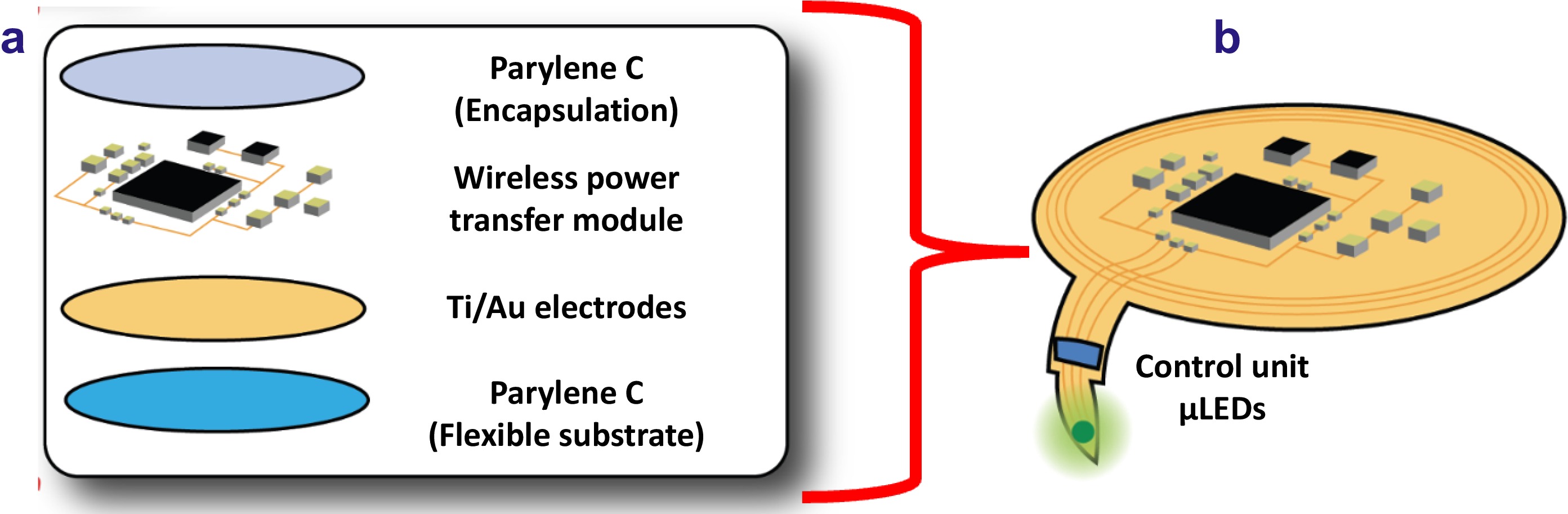
In this paper, we present a new wireless implantable PDT system towards overcoming the constraints of current PDT treatments. The wireless-powered prototype was evaluated showing resonant inductive power delivery in a tissue phantom, emulating the bladder, providing the necessary power level for PDT treatment. The production of singlet oxygen (1O2) using a multi-LED system was studied by utilizing a 1,3-diphenylisobenzofuran (DPBF) in a Rose Bengal (RB) and Dimethyl sulfoxide (DMSO) solution, under both DC and AC excitations, for direct wireless powering. The photosensitizer solution is illuminated with over 5 mW of optical power generated by the four-LED array to generate 1O2.
Our measurements confirm the production of 1O2 emissions as well as lifetime performance. The optical, electrical, and mechanical studies are presented on the resultant optoelectronic system, verifying the efficiency and mechanical robustness of our prototype. A fabrication flow for bio-compatible devices using laser ablation is also introduced towards large area manufacturability, scalability, and repeatability. Our manufacturing process is versatile to a variety of materials including polymeric substrates, metallic electrodes and offers design flexibility ranging from 30 microns to mm. This research advances the development of wirelessly powered implantable device for PDT, optimized for in-vivo use through careful LED selection and biocompatible design.
Our results evidence the potential of a new emergent technology that addresses the limitations of PDT as a potential future therapy to enhance the curative efficiency of cancer treatment and demonstrates promising preliminary potential for in vivo application, which requires further validation before therapeutic implementation can be established.
Ultrafast all-optical modulation of wide-bandwidth pulses enabled by silicon-metasurfaces
Kaloyan Georgiev, Khosro Zangeneh Kamali, Anton A. Trifonov, Giulia Crotti, Lyuben Petrov, Stefan Georgiev, Hristo Iliev, Lei Xu, Unai Arregui Leon, Mohsen Rahmani, Giuseppe Della Valle, Ivan Buchvarov, Dragomir Neshev
Opto-Electronic Advances
2026-09-15
Physics-informed neural fields enable blind aberration correction for partially coherent quantitative phase imaging
Shun Zhou, Xingyu Huang, Linpeng Lu, Habib Ullah, Kaiyu Du, Maciej Trusiak, Malgorzata Kujawinska, Yuzhen Zhang, Yao Fan, Qian Chen, Qinrong Zhang, Chao Zuo
Opto-Electronic Science
2026-08-26
Heterogeneously integrated micro-ring with SnS₂ for dual-functional optical modulation and photodetection
Jinyi Du, Lidan Lu, Xu Zhang, Bofei Zhu, Wenbo Bo, Yingjie Xu, Guang Chen, Yanlin He, Guanghui Ren, Xiaoping Lou, Zheng You, Lianqing Zhu
Opto-Electronic Advances
2026-08-25
Hardware-aware lightweight photonic spiking neural network for pattern classification
Shuiying Xiang, Yahui Zhang, Shangxuan Shi, Haowen Zhao, Dianzhuang Zheng, Xingxing Guo, Yanan Han, Ye Tian, Liyue Zhang, Yuechun Shi, Yue Hao
Opto-Electronic Advances
2026-08-25
PhyspeNet: An empirical physics-aware network for adaptive speckle reconstructive spectrometry
Junrui Liang, Min Jiang, Jun Li, Zhongming Huang, Junhong He, Yanting Guo, Yanzhao Ke, Jun Ye, Jiangming Xu, Jinyong Leng, Pu Zhou
Opto-Electronic Advances
2026-08-25
A 36 × 240 Gbps hybrid mode/wavelength division multiplexing transmitter using lithium niobate on insulator
Mingyu Zhu, Weihan Wang, Ruitao Ma, Aoyun Gao, Chun Gao, Zexu Wang, Fei Huang, Zhenyuan Bao, Dajian Liu, Jiaxuan Gan, Zejie Yu, Huan Li, Weike Zhao, Daoxin Dai
Opto-Electronic Advances
2026-08-25