(Peer-Reviewed) Effects on the emission discrepancy between two-dimensional Sn-based and Pb-based perovskites
Zhang Tianju 张天举 ¹ ², Zhou Chaocheng 周超成 ³ ⁴, Lin Jia 林佳 ³, Wang Jun 王俊 ¹ ² ⁵
¹ Laboratory of Micro-Nano Optoelectronic Materials and Devices, Shanghai Institute of Optics and Fine Mechanics, Chinese Academy of Sciences, Shanghai 201800, China
中国 上海 中国科学院上海光学精密机械研究所 微纳光电子功能材料实验室
² Center of Materials Science and Optoelectronic Engineering, University of Chinese Academy of Sciences, Beijing 100049, China
中国 北京 中国科学院大学材料科学与光电技术学院
³ Department of Physics, Shanghai Key Laboratory of Materials Protection and Advanced Materials in Electric Power, Shanghai University of Electric Power, Shanghai 200090, China
中国 上海 上海市电力材料防护与新材料重点实验室 上海电力大学物理系
⁴ State Key Laboratory of Advanced Optical Communication Systems and Networks, School of Physics and Astronomy, Shanghai Jiao Tong University, Shanghai 200240, China
中国 上海 上海交通大学物理与天文学院 区域光纤通信网与新型光通信系统国家重点实验室
⁵ CAS Center for Excellence in Ultra-intense Laser Science, Shanghai 201800, China
中国 上海 中国科学院 超强激光科学卓越创新中心
Abstract
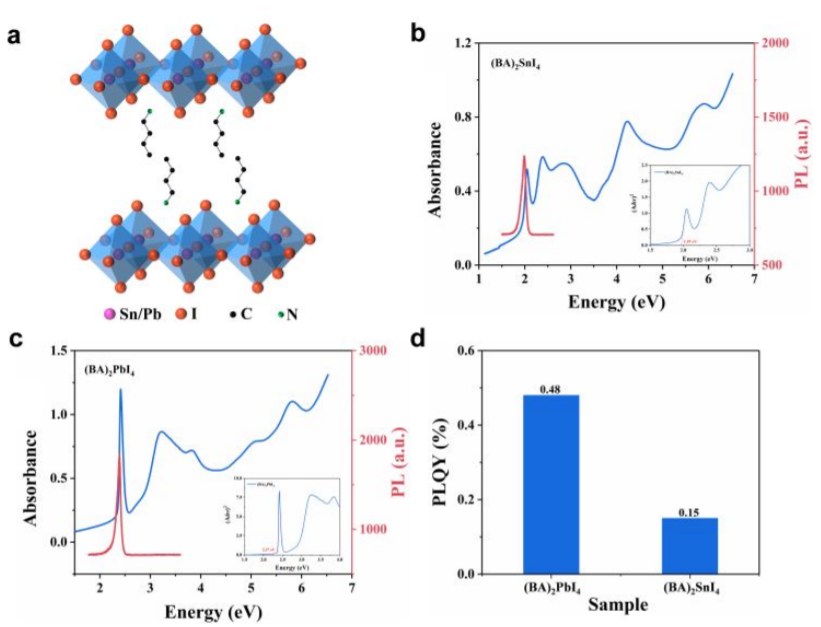
Two-dimensional (2D) Sn-based perovskites are a kind of non-toxic environment-friendly emission material with low photoluminescence quantum yields (PLQY) and enhanced emission linewidths compared to that of 2D Pb-based perovskites. However, there is no work systematically elucidating the reasons for the differences in the emission properties.
We fabricate (BA)₂SnI₄ and (BA)₂PbI₄ having different defect densities and different exciton-phonon scattering intensities. We also reveal that 2D Sn-based perovskites have stronger exciton-phonon scattering intensity and higher defects density, making significantly broadening the emission linewidth and accelerating the exciton relaxation process, which significantly reduces the PLQY of 2D Sn-based perovskites.
Ultrafast all-optical modulation of wide-bandwidth pulses enabled by silicon-metasurfaces
Kaloyan Georgiev, Khosro Zangeneh Kamali, Anton A. Trifonov, Giulia Crotti, Lyuben Petrov, Stefan Georgiev, Hristo Iliev, Lei Xu, Unai Arregui Leon, Mohsen Rahmani, Giuseppe Della Valle, Ivan Buchvarov, Dragomir Neshev
Opto-Electronic Advances
2026-09-15
Physics-informed neural fields enable blind aberration correction for partially coherent quantitative phase imaging
Shun Zhou, Xingyu Huang, Linpeng Lu, Habib Ullah, Kaiyu Du, Maciej Trusiak, Malgorzata Kujawinska, Yuzhen Zhang, Yao Fan, Qian Chen, Qinrong Zhang, Chao Zuo
Opto-Electronic Science
2026-08-26
Heterogeneously integrated micro-ring with SnS₂ for dual-functional optical modulation and photodetection
Jinyi Du, Lidan Lu, Xu Zhang, Bofei Zhu, Wenbo Bo, Yingjie Xu, Guang Chen, Yanlin He, Guanghui Ren, Xiaoping Lou, Zheng You, Lianqing Zhu
Opto-Electronic Advances
2026-08-25
Hardware-aware lightweight photonic spiking neural network for pattern classification
Shuiying Xiang, Yahui Zhang, Shangxuan Shi, Haowen Zhao, Dianzhuang Zheng, Xingxing Guo, Yanan Han, Ye Tian, Liyue Zhang, Yuechun Shi, Yue Hao
Opto-Electronic Advances
2026-08-25
PhyspeNet: An empirical physics-aware network for adaptive speckle reconstructive spectrometry
Junrui Liang, Min Jiang, Jun Li, Zhongming Huang, Junhong He, Yanting Guo, Yanzhao Ke, Jun Ye, Jiangming Xu, Jinyong Leng, Pu Zhou
Opto-Electronic Advances
2026-08-25
A 36 × 240 Gbps hybrid mode/wavelength division multiplexing transmitter using lithium niobate on insulator
Mingyu Zhu, Weihan Wang, Ruitao Ma, Aoyun Gao, Chun Gao, Zexu Wang, Fei Huang, Zhenyuan Bao, Dajian Liu, Jiaxuan Gan, Zejie Yu, Huan Li, Weike Zhao, Daoxin Dai
Opto-Electronic Advances
2026-08-25