(Peer-Reviewed) Integral imaging-based tabletop light field 3D display with large viewing angle
Yan Xing 邢妍 ¹, Xing-Yu Lin 林星雨 ¹, Lin-Bo Zhang 张林博 ¹, Yun-Peng Xia 夏云鹏 ², Han-Le Zhang 张汉乐 ¹, Hong-Yu Cui 崔宏宇 ¹, Shuang Li 李爽 ², Tong-Yu Wang 王童语 ¹, Hui Ren 任慧 ², Di Wang 王迪 ¹, Huan Deng 邓欢 ², Qiong-Hua Wang 王琼华 ¹
¹ School of Instrumentation and Optoelectronic Engineering, Beihang University, Beijing 100191, China
中国 北京 北京航空航天大学仪器科学与光电工程学院
² College of Electronics and Information Engineering, Sichuan University, Chengdu 610065, China
中国 成都 四川大学电子信息学院
Opto-Electronic Advances
, 2023-06-25
Abstract
Light field 3D display technology is considered a revolutionary technology to address the critical visual fatigue issues in the existing 3D displays. Tabletop light field 3D display provides a brand-new display form that satisfies multi-user shared viewing and collaborative works, and it is poised to become a potential alternative to the traditional wall and portable display forms.
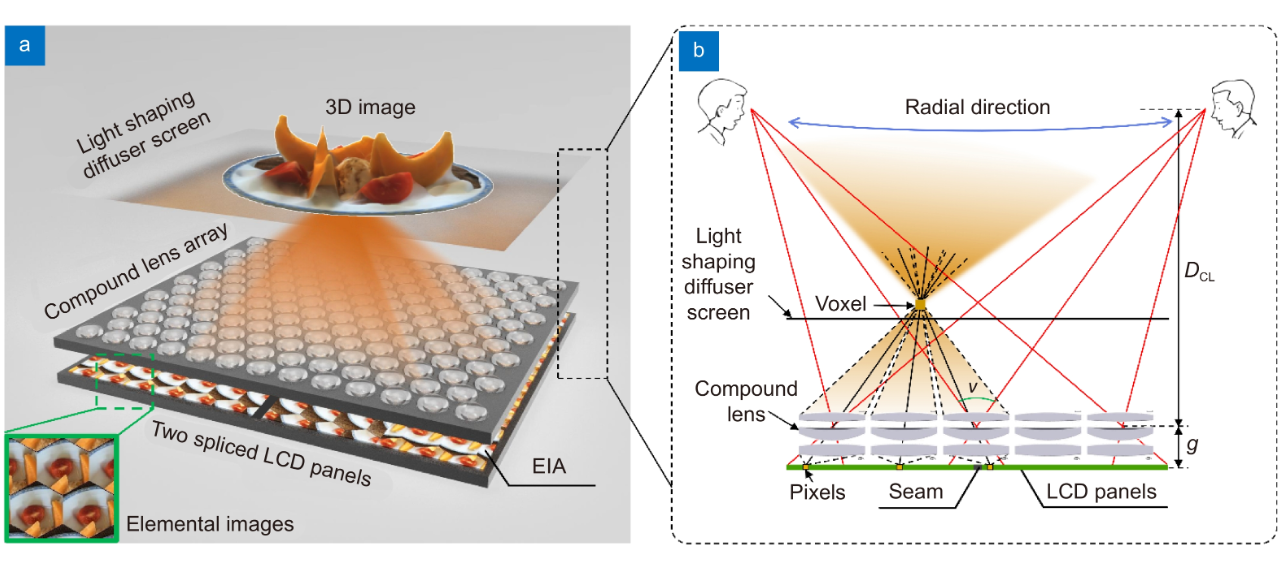
However, a large radial viewing angle and correct radial perspective and parallax are still out of reach for most current tabletop light field 3D displays due to the limited amount of spatial information. To address the viewing angle and perspective issues, a novel integral imaging-based tabletop light field 3D display with a simple flat-panel structure is proposed and developed by applying a compound lens array, two spliced 8K liquid crystal display panels, and a light shaping diffuser screen. The compound lens array is designed to be composed of multiple three-piece compound lens units by employing a reverse design scheme, which greatly extends the radial viewing angle in the case of a limited amount of spatial information and balances other important 3D display parameters.
The proposed display has a radial viewing angle of 68.7° in a large display size of 43.5 inches, which is larger than the conventional tabletop light field 3D displays. The radial perspective and parallax are correct, and high-resolution 3D images can be reproduced in large radial viewing positions. We envision that this proposed display opens up possibility for redefining the display forms of consumer electronics.
Ultrafast all-optical modulation of wide-bandwidth pulses enabled by silicon-metasurfaces
Kaloyan Georgiev, Khosro Zangeneh Kamali, Anton A. Trifonov, Giulia Crotti, Lyuben Petrov, Stefan Georgiev, Hristo Iliev, Lei Xu, Unai Arregui Leon, Mohsen Rahmani, Giuseppe Della Valle, Ivan Buchvarov, Dragomir Neshev
Opto-Electronic Advances
2026-09-15
Physics-informed neural fields enable blind aberration correction for partially coherent quantitative phase imaging
Shun Zhou, Xingyu Huang, Linpeng Lu, Habib Ullah, Kaiyu Du, Maciej Trusiak, Malgorzata Kujawinska, Yuzhen Zhang, Yao Fan, Qian Chen, Qinrong Zhang, Chao Zuo
Opto-Electronic Science
2026-08-26
Heterogeneously integrated micro-ring with SnS₂ for dual-functional optical modulation and photodetection
Jinyi Du, Lidan Lu, Xu Zhang, Bofei Zhu, Wenbo Bo, Yingjie Xu, Guang Chen, Yanlin He, Guanghui Ren, Xiaoping Lou, Zheng You, Lianqing Zhu
Opto-Electronic Advances
2026-08-25
Hardware-aware lightweight photonic spiking neural network for pattern classification
Shuiying Xiang, Yahui Zhang, Shangxuan Shi, Haowen Zhao, Dianzhuang Zheng, Xingxing Guo, Yanan Han, Ye Tian, Liyue Zhang, Yuechun Shi, Yue Hao
Opto-Electronic Advances
2026-08-25
PhyspeNet: An empirical physics-aware network for adaptive speckle reconstructive spectrometry
Junrui Liang, Min Jiang, Jun Li, Zhongming Huang, Junhong He, Yanting Guo, Yanzhao Ke, Jun Ye, Jiangming Xu, Jinyong Leng, Pu Zhou
Opto-Electronic Advances
2026-08-25
A 36 × 240 Gbps hybrid mode/wavelength division multiplexing transmitter using lithium niobate on insulator
Mingyu Zhu, Weihan Wang, Ruitao Ma, Aoyun Gao, Chun Gao, Zexu Wang, Fei Huang, Zhenyuan Bao, Dajian Liu, Jiaxuan Gan, Zejie Yu, Huan Li, Weike Zhao, Daoxin Dai
Opto-Electronic Advances
2026-08-25