(Peer-Reviewed) A lignified-layer bridge controlled by a single recessive gene is associated with high pod-shatter resistance in Brassica napus L
Wen Chu 储文 ¹ ² ³, Jia Liu 刘佳 ¹, Hongtao Cheng 成洪涛 ¹, Chao Li 李超 ¹, Li Fu 付丽 ¹, Wenxiang Wang 汪文祥 ¹, Hui Wang 王会 ¹, Mengyu Hao 郝梦宇 ¹, Desheng Mei 梅德圣 ¹, Kede Liu 刘克德 ², Qiong Hu 胡琼 ¹ ³
¹ Oil Crops Research Institute of Chinese Academy of Agricultural Sciences/Key Laboratory for Biology and Genetic Improvement of Oil Crops, Ministry of Agriculture and Rural Affairs, Wuhan 430062, Hubei, China
中国 湖北 武汉 中国农业科学院油料作物研究所 农业农村部油料作物生物学与遗传育种重点实验室
² National Key Laboratory of Crop Genetic Improvement, Huazhong Agricultural University, Wuhan 430070, Hubei, China
中国 湖北 武汉 华中农业大学 作物遗传改良国家重点实验室
³ Graduate School of Chinese Academy of Agricultural Sciences, Beijing 100081, China
中国 北京 中国农业科学院研究生院
Abstract
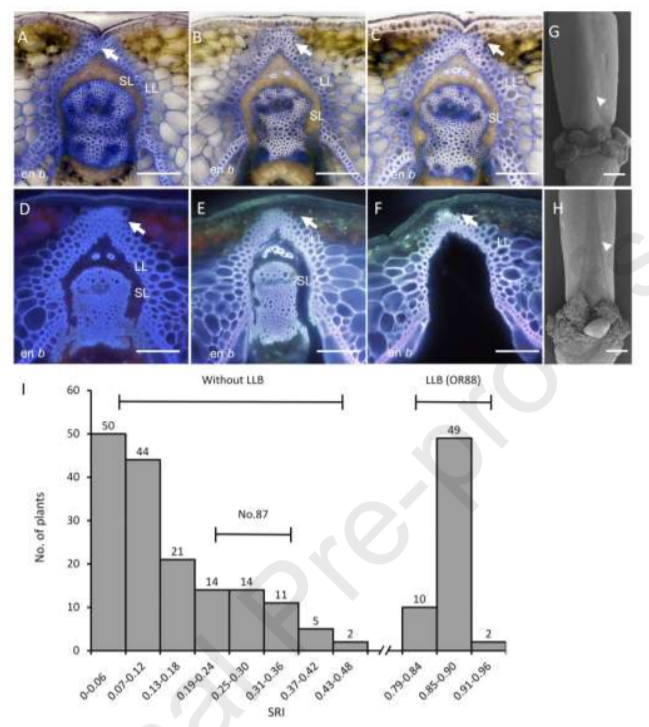
Pod shattering causes severe yield loss in rapeseed (Brassica napus L.) under modern agricultural practice. Identification of highly shatter-resistant germplasm is desirable for the development of rapeseed cultivars for mechanical harvesting. In the present study, an elite line OR88 with strong shatter resistance and a lignified-layer bridge (LLB) structure was identified.
The LLB structure was unique to OR88 and co-segregated with high pod-shatter resistance. The LLB structure is differentiated at stage 12 of gynoecium development without any gynoecium defects. Genetic analysis showed that LLB is controlled by a single recessive gene. By BSA-Seq and map-based cloning, the resistance gene location was delimited to a 0.688 Mb region on chromosome C09. Transcriptome analysis suggested BnTCP8.C09 as the gene responsible for LLB.
The expression of BnTCP.C09 was strongly downregulated in OR88, suppressing cell proliferation in the pod valve margin. KASP markers linked to the candidate gene were developed. This pod shatter-resistant line could be used in rapeseed breeding programs by direct transfer of the gene with the assistance of the DNA markers.
Ultrafast all-optical modulation of wide-bandwidth pulses enabled by silicon-metasurfaces
Kaloyan Georgiev, Khosro Zangeneh Kamali, Anton A. Trifonov, Giulia Crotti, Lyuben Petrov, Stefan Georgiev, Hristo Iliev, Lei Xu, Unai Arregui Leon, Mohsen Rahmani, Giuseppe Della Valle, Ivan Buchvarov, Dragomir Neshev
Opto-Electronic Advances
2026-09-15
Physics-informed neural fields enable blind aberration correction for partially coherent quantitative phase imaging
Shun Zhou, Xingyu Huang, Linpeng Lu, Habib Ullah, Kaiyu Du, Maciej Trusiak, Malgorzata Kujawinska, Yuzhen Zhang, Yao Fan, Qian Chen, Qinrong Zhang, Chao Zuo
Opto-Electronic Science
2026-08-26
Heterogeneously integrated micro-ring with SnS₂ for dual-functional optical modulation and photodetection
Jinyi Du, Lidan Lu, Xu Zhang, Bofei Zhu, Wenbo Bo, Yingjie Xu, Guang Chen, Yanlin He, Guanghui Ren, Xiaoping Lou, Zheng You, Lianqing Zhu
Opto-Electronic Advances
2026-08-25
Hardware-aware lightweight photonic spiking neural network for pattern classification
Shuiying Xiang, Yahui Zhang, Shangxuan Shi, Haowen Zhao, Dianzhuang Zheng, Xingxing Guo, Yanan Han, Ye Tian, Liyue Zhang, Yuechun Shi, Yue Hao
Opto-Electronic Advances
2026-08-25
PhyspeNet: An empirical physics-aware network for adaptive speckle reconstructive spectrometry
Junrui Liang, Min Jiang, Jun Li, Zhongming Huang, Junhong He, Yanting Guo, Yanzhao Ke, Jun Ye, Jiangming Xu, Jinyong Leng, Pu Zhou
Opto-Electronic Advances
2026-08-25
A 36 × 240 Gbps hybrid mode/wavelength division multiplexing transmitter using lithium niobate on insulator
Mingyu Zhu, Weihan Wang, Ruitao Ma, Aoyun Gao, Chun Gao, Zexu Wang, Fei Huang, Zhenyuan Bao, Dajian Liu, Jiaxuan Gan, Zejie Yu, Huan Li, Weike Zhao, Daoxin Dai
Opto-Electronic Advances
2026-08-25