(Peer-Reviewed) Evaluation of Thellungiella halophila ST7 for improving salt tolerance in cotton
ALI Mohsin ¹, NAZISH Tahmina ¹, JAVAID Ayesha ¹, ZHU Yonghong 朱永红 ², LI Jing 李静 ², ZHANG Huangyang 张换样 ², WU Jie 吴杰 ¹, XIANG Chengbin 向成斌 ¹, WU Shenjie 吴慎杰 ³, ALFATIH Alamin ¹
¹ Division of Molecular & Cell Biophysics, School of Life Sciences, Hefei National Science Center for Physical Sciences at the Microscale, University of Science and Technology of China, The Innovative Academy of Seed Design, Chinese Academy of Sciences, Hefei, Anhui, China
中国 安徽 合肥 中国科学技术大学 合肥微尺度物质科学国家研究中心 分子与细胞生物物理研究部 中国科学院种子创新研究院
² Institute of Cotton Research, Shanxi Agricultural University, Yuncheng, 044000, China
中国 运城 山西农业大学棉花研究所
³ College of Life Sciences, Shanxi Agricultural University, Taiyuan, 030031, China
中国 太原 山西农业大学生命科学学院
Background
Gossypium hirsutum (upland cotton) is one of the principal fiber crops in the world. Cotton yield is highly affected by abiotic stresses, among which salt stress is considered as a major problem around the globe. Transgenic approach is efficient to improve cotton salt tolerance but depending on the availability of salt tolerance genes.
Results
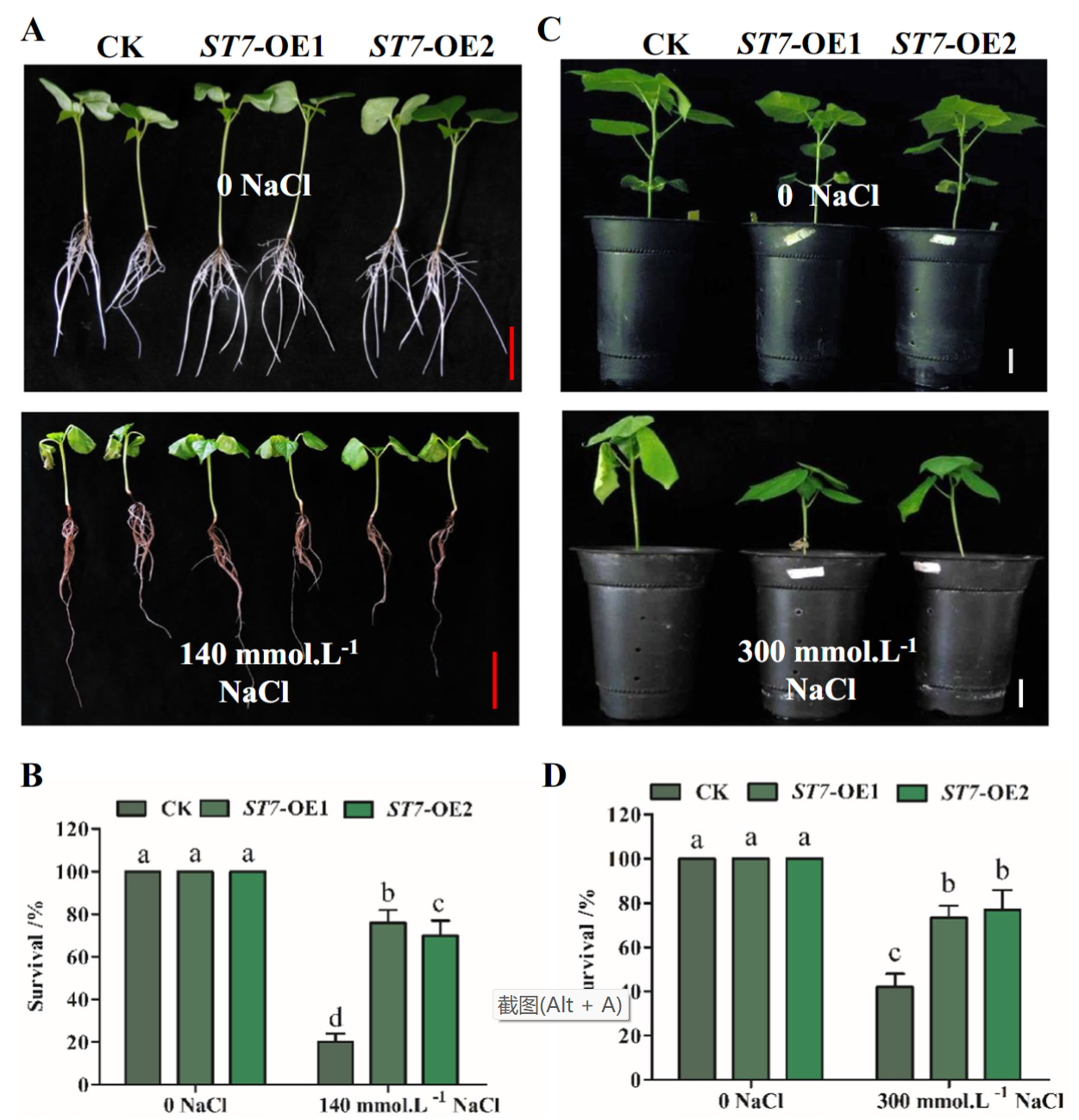
In this study we evaluated salt tolerance candidate gene ST7 from Thellungiella halophila, encoding a homolog of Arabidopsis aluminum-induced protein, in cotton. Our results showed that ThST7 overexpression in cotton improved germination under NaCl stress as well as seedling growth. Our field trials also showed that ThST7 transgenic cotton lines produced higher yield under salt stress conditions. The improved salt tolerance of the transgenic cotton lines was partially contributed by enhanced antioxidation as shown by diaminobenzidine (DAB) and nitrotetrazolium blue chloride (NBT) staining. Moreover, transcriptomic analysis of ThST7 overexpression lines showed a significant upregulation of the genes involved in ion homeostasis and antioxidation, consistent with the salt tolerance phenotype of the transgenic cotton.
Conclusions
Our results demonstrate that ThST7 has the ability to improve salt tolerance in cotton. The ThST7 transgenic cotton may be used in cotton breeding for salt tolerance cultivars.
Ultrafast all-optical modulation of wide-bandwidth pulses enabled by silicon-metasurfaces
Kaloyan Georgiev, Khosro Zangeneh Kamali, Anton A. Trifonov, Giulia Crotti, Lyuben Petrov, Stefan Georgiev, Hristo Iliev, Lei Xu, Unai Arregui Leon, Mohsen Rahmani, Giuseppe Della Valle, Ivan Buchvarov, Dragomir Neshev
Opto-Electronic Advances
2026-09-15
Physics-informed neural fields enable blind aberration correction for partially coherent quantitative phase imaging
Shun Zhou, Xingyu Huang, Linpeng Lu, Habib Ullah, Kaiyu Du, Maciej Trusiak, Malgorzata Kujawinska, Yuzhen Zhang, Yao Fan, Qian Chen, Qinrong Zhang, Chao Zuo
Opto-Electronic Science
2026-08-26
Heterogeneously integrated micro-ring with SnS₂ for dual-functional optical modulation and photodetection
Jinyi Du, Lidan Lu, Xu Zhang, Bofei Zhu, Wenbo Bo, Yingjie Xu, Guang Chen, Yanlin He, Guanghui Ren, Xiaoping Lou, Zheng You, Lianqing Zhu
Opto-Electronic Advances
2026-08-25
Hardware-aware lightweight photonic spiking neural network for pattern classification
Shuiying Xiang, Yahui Zhang, Shangxuan Shi, Haowen Zhao, Dianzhuang Zheng, Xingxing Guo, Yanan Han, Ye Tian, Liyue Zhang, Yuechun Shi, Yue Hao
Opto-Electronic Advances
2026-08-25
PhyspeNet: An empirical physics-aware network for adaptive speckle reconstructive spectrometry
Junrui Liang, Min Jiang, Jun Li, Zhongming Huang, Junhong He, Yanting Guo, Yanzhao Ke, Jun Ye, Jiangming Xu, Jinyong Leng, Pu Zhou
Opto-Electronic Advances
2026-08-25
A 36 × 240 Gbps hybrid mode/wavelength division multiplexing transmitter using lithium niobate on insulator
Mingyu Zhu, Weihan Wang, Ruitao Ma, Aoyun Gao, Chun Gao, Zexu Wang, Fei Huang, Zhenyuan Bao, Dajian Liu, Jiaxuan Gan, Zejie Yu, Huan Li, Weike Zhao, Daoxin Dai
Opto-Electronic Advances
2026-08-25