(Peer-Reviewed) Tracing the formation of oxygen vacancies at the conductive LaAlO₃/SrTiO₃ interface via photoemission
Junyan Chen 陈俊延 ¹ ², Tobias Eul ², Lu Lyu ², Yaolong Li 李耀龙 ¹, Xiaoyong Hu 胡小永 ¹ ⁴, Xingkun Ning 宁兴坤 ³, Shufang Wang 王淑芳 ³, Martin Aeschlimann ², Qihuang Gong 龚旗煌 ¹ ⁴
¹ State Key Laboratory for Mesoscopic Physics & Department of Physics, Collaborative Innovation Center of Quantum Matter & Frontiers Science Center for Nano-optoelectronics, Beijing Academy of Quantum Information Sciences, Peking University, Beijing 100871, China
中国 北京 北京大学物理系 北京量子信息科学研究院 介观物理国家重点实验室 量子物质科学协同创新中心 纳光电子前沿科学中心
² Department of Physics and Research Center OPTIMAS, University of Kaiserslautern, Kaiserslautern 67663, Germany
³ College of Physics Science & Technology, Hebei University, Baoding 071002, China
中国 保定 河北大学物理科学与技术学院
⁴ Collaborative Innovation Center of Extreme Optics, Shanxi University, Taiyuan 030006, China
中国 太原 山西大学 极端光学协同创新中心
Opto-Electronic Science
, 2022-07-15
Abstract
The two-dimensional electron gas (2DEG) generated at the LaAlO₃/SrTiO₃ interface has been in the focus of oxides research since its first discovery. Although oxygen vacancies play an important role in the generation of the insulator-to-metal transition of the SrTiO₃ bare surface, their contribution at the LaAlO₃/SrTiO₃ interface remains unclear.
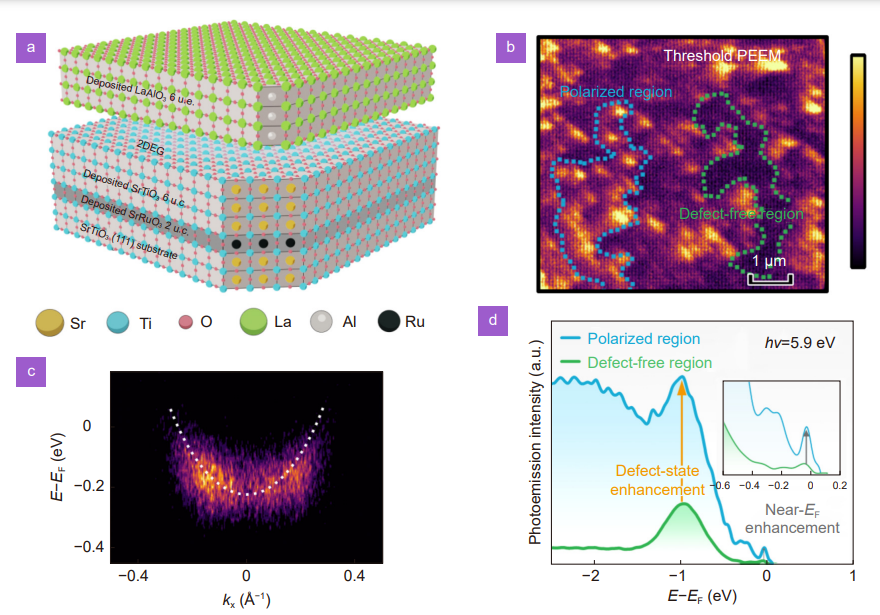
In this work, we investigated a LaAlO₃/SrTiO₃ heterostructure with regional distribution of defect-based localized polar sites at the interface. Using static and time-resolved threshold photoemission electron microscopy, we prove that oxygen vacancies are induced near those polar sites, resulting in the increase of carrier density of the 2DEG states.
In addition, oxygen-related surface states were uncovered, which we attributed to the release of lattice oxygen during the formation of oxygen vacancies. Such effects are mainly found spatially located around the defect sites at the buried interface, while other regions remain unaffected.
Our results confirm that the itinerant electrons induced by oxygen vacancies can coexist with the charge transfer mechanism in the LaAlO₃/SrTiO₃ heterostructure, together leading to the formation of the metallic interface. These observations provide fundamental insights into the nature of LaAlO₃/SrTiO₃ interface based 2DEG and unique perspectives for potential applications.
Ultrafast all-optical modulation of wide-bandwidth pulses enabled by silicon-metasurfaces
Kaloyan Georgiev, Khosro Zangeneh Kamali, Anton A. Trifonov, Giulia Crotti, Lyuben Petrov, Stefan Georgiev, Hristo Iliev, Lei Xu, Unai Arregui Leon, Mohsen Rahmani, Giuseppe Della Valle, Ivan Buchvarov, Dragomir Neshev
Opto-Electronic Advances
2026-09-15
Physics-informed neural fields enable blind aberration correction for partially coherent quantitative phase imaging
Shun Zhou, Xingyu Huang, Linpeng Lu, Habib Ullah, Kaiyu Du, Maciej Trusiak, Malgorzata Kujawinska, Yuzhen Zhang, Yao Fan, Qian Chen, Qinrong Zhang, Chao Zuo
Opto-Electronic Science
2026-08-26
Heterogeneously integrated micro-ring with SnS₂ for dual-functional optical modulation and photodetection
Jinyi Du, Lidan Lu, Xu Zhang, Bofei Zhu, Wenbo Bo, Yingjie Xu, Guang Chen, Yanlin He, Guanghui Ren, Xiaoping Lou, Zheng You, Lianqing Zhu
Opto-Electronic Advances
2026-08-25
Hardware-aware lightweight photonic spiking neural network for pattern classification
Shuiying Xiang, Yahui Zhang, Shangxuan Shi, Haowen Zhao, Dianzhuang Zheng, Xingxing Guo, Yanan Han, Ye Tian, Liyue Zhang, Yuechun Shi, Yue Hao
Opto-Electronic Advances
2026-08-25
PhyspeNet: An empirical physics-aware network for adaptive speckle reconstructive spectrometry
Junrui Liang, Min Jiang, Jun Li, Zhongming Huang, Junhong He, Yanting Guo, Yanzhao Ke, Jun Ye, Jiangming Xu, Jinyong Leng, Pu Zhou
Opto-Electronic Advances
2026-08-25
A 36 × 240 Gbps hybrid mode/wavelength division multiplexing transmitter using lithium niobate on insulator
Mingyu Zhu, Weihan Wang, Ruitao Ma, Aoyun Gao, Chun Gao, Zexu Wang, Fei Huang, Zhenyuan Bao, Dajian Liu, Jiaxuan Gan, Zejie Yu, Huan Li, Weike Zhao, Daoxin Dai
Opto-Electronic Advances
2026-08-25