(Peer-Reviewed) The incidence and predictors of high-degree atrioventricular block in patients with bicuspid aortic valve receiving self-expandable transcatheter aortic valve implantation
Yuan-Weixiang OU 欧袁伟翔 ¹ ², Jing-Jing HE 何婧婧 ², Xuan ZHOU 周轩 ¹ ³, Guo-Yong LI ², Yan-Biao LIAO 廖延标 ², Xin WEI 魏薪 ², Yong PENG 彭勇 ¹ ², Yuan FENG 冯沅 ¹ ², Mao CHEN 陈茂 ¹ ²
¹ Department of Cardiac Catheterization Laboratory, West China Hospital, Sichuan University, Sichuan, China
中国 四川 四川大学 华西医院 心导管室
² Department of Cardiology, West China Hospital, Sichuan University, Sichuan, China
中国 四川 四川大学 华西医院 心脏内科
³ Department of Radiology, West China Hospital, Sichuan University, Sichuan, China
中国 四川 四川大学 华西医院 放射科
BACKGROUND
The high-degree atrioventricular block (HAVB) in patients with bicuspid aortic valve (BAV) treated with transcatheter aortic valve implantation (TAVI) remains high. The study aims to explore this poorly understood subject of mechanisms and predictors for HAVB in BAV self-expandable TAVI patients.
METHODS
We retrospectively included 181 BAV patients for analysis. Using computed tomography data, the curvature of ascending aorta (AAo) was quantified by the angle (AAo angle) between annulus and the cross-section at 35 mm above annulus (where the stent interacts with AAo the most). The valvular anatomy and leaflet calcification were also characterized.
RESULTS
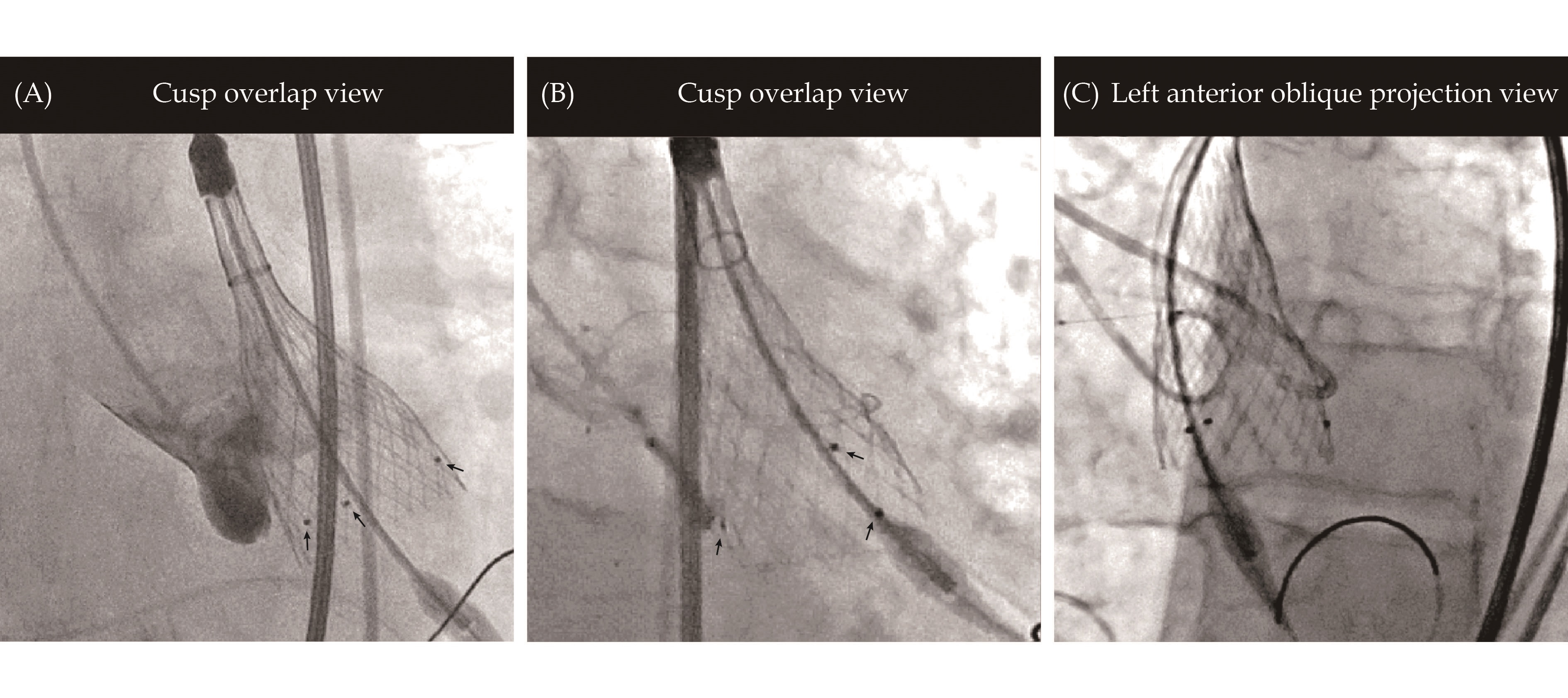
The 30-day HAVB rate was 16.0% (median time to HAVB was three days). Type-1 morphology was found in 79 patients (43.6%) (left- and right-coronary cusps fusion comprised 79.7%). Besides implantation below membrane septum, large AAo angle [odds ratio (OR) = 1.08, P = 0.016] and type-1 morphology (OR = 4.97, P = 0.001) were found as the independent predictors for HAVB. Together with baseline right bundle branch block, these predictors showed strong predictability for HAVB with area under the cure of 0.84 (sensitivity = 62.1%, specificity = 92.8%). Bent AAo and calcified raphe had a synergistic effect in facilitating high implantation, though the former is associated with at-risk deployment (device implanted above annulus + prothesis pop-out, versus straight AAo: 9.9% vs. 2.2%, P = 0.031).
CONCLUSIONS
AAo curvature and type-1 morphology are novel predictors for HAVB in BAV patients following self-expandable TAVI. For patients with bent AAo or calcified raphe, a progressive approach to implant the device above the lower edge of membrane septum is favored, though should be done cautiously to avoid pop-out.
Ultrafast all-optical modulation of wide-bandwidth pulses enabled by silicon-metasurfaces
Kaloyan Georgiev, Khosro Zangeneh Kamali, Anton A. Trifonov, Giulia Crotti, Lyuben Petrov, Stefan Georgiev, Hristo Iliev, Lei Xu, Unai Arregui Leon, Mohsen Rahmani, Giuseppe Della Valle, Ivan Buchvarov, Dragomir Neshev
Opto-Electronic Advances
2026-09-15
Physics-informed neural fields enable blind aberration correction for partially coherent quantitative phase imaging
Shun Zhou, Xingyu Huang, Linpeng Lu, Habib Ullah, Kaiyu Du, Maciej Trusiak, Malgorzata Kujawinska, Yuzhen Zhang, Yao Fan, Qian Chen, Qinrong Zhang, Chao Zuo
Opto-Electronic Science
2026-08-26
Heterogeneously integrated micro-ring with SnS₂ for dual-functional optical modulation and photodetection
Jinyi Du, Lidan Lu, Xu Zhang, Bofei Zhu, Wenbo Bo, Yingjie Xu, Guang Chen, Yanlin He, Guanghui Ren, Xiaoping Lou, Zheng You, Lianqing Zhu
Opto-Electronic Advances
2026-08-25
Hardware-aware lightweight photonic spiking neural network for pattern classification
Shuiying Xiang, Yahui Zhang, Shangxuan Shi, Haowen Zhao, Dianzhuang Zheng, Xingxing Guo, Yanan Han, Ye Tian, Liyue Zhang, Yuechun Shi, Yue Hao
Opto-Electronic Advances
2026-08-25
PhyspeNet: An empirical physics-aware network for adaptive speckle reconstructive spectrometry
Junrui Liang, Min Jiang, Jun Li, Zhongming Huang, Junhong He, Yanting Guo, Yanzhao Ke, Jun Ye, Jiangming Xu, Jinyong Leng, Pu Zhou
Opto-Electronic Advances
2026-08-25
A 36 × 240 Gbps hybrid mode/wavelength division multiplexing transmitter using lithium niobate on insulator
Mingyu Zhu, Weihan Wang, Ruitao Ma, Aoyun Gao, Chun Gao, Zexu Wang, Fei Huang, Zhenyuan Bao, Dajian Liu, Jiaxuan Gan, Zejie Yu, Huan Li, Weike Zhao, Daoxin Dai
Opto-Electronic Advances
2026-08-25