(Peer-Reviewed) Electric-field-induced second-harmonic generation
Hangkai Fan 樊航凯 ¹ ² ³ ⁴, Alexey Proskurin ⁴, Mingzhao Song 宋明肇 ¹ ² ⁵, Andrey Bogdanov ¹ ⁴
¹ Qingdao Innovation and Development Center, Harbin Engineering University, Qingdao 266000, China
中国 青岛 哈尔滨工程大学青岛创新发展基地
² Key Laboratory of Photonic Materials and Device Physics for Oceanic Applications, Ministry of Industry and Information Technology of China, Harbin 150001, China
中国 哈尔滨 海洋光子材料与器件物理工业和信息化部重点实验室
³ College of Information and Communication Engineering, Harbin Engineering University, Harbin 150001, China
中国 哈尔滨 哈尔滨工程大学信息与通信工程学院
⁴ School of Physics and Engineering, ITMO University, St. Petersburg 191002, Russia
⁵ College of Physics and Optoelectronic Engineering, Harbin Engineering University, Harbin 150001, China
中国 哈尔滨 哈尔滨工程大学物理与光电工程学院
Opto-Electronic Advances
, 2026-01-27
Abstract
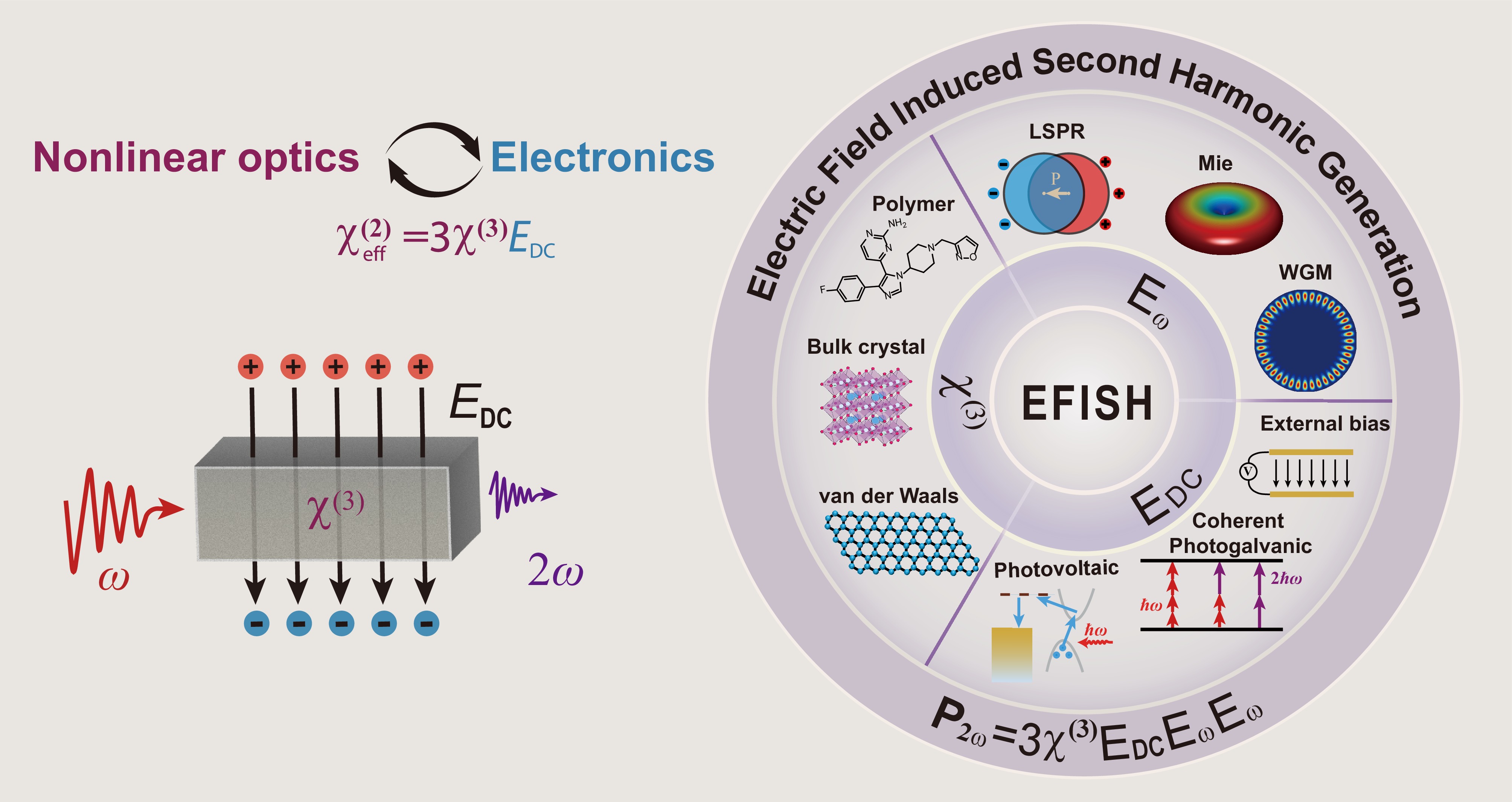
Second-harmonic generation (SHG) is a fundamental nonlinear optical process widely used in photonics; however, it is strictly forbidden in the bulk of centrosymmetric materials due to their inversion symmetry. Nevertheless, applying an external electric field breaks this inversion symmetry. It induces an effective second-order nonlinear response known as the electric-field-induced second-harmonic generation (EFISH) effect.
This mechanism enables SHG in centrosymmetric media and provides a effective mechanism for electrically tunable nonlinear nanophotonics. Here, we present a comprehensive overview of the EFISH effect, covering the fundamentals, various material platforms (including bulk semiconductor crystals, ferroelectrics, van der Waals materials, and polymers), as well as diverse strategies for electric field engineering.
We distinguish EFISH from related effects including current-induced SHG and the quantum-confined Stark effect, and highlight emerging applications of EFISH in tunable photonic devices, carrier dynamics probing, and nonlinear optical modulation across optical, electronic, and THz regimes. Finally, we outline key challenges and prospects for the future development of electrically controlled nonlinear optical systems.
Ultrafast all-optical modulation of wide-bandwidth pulses enabled by silicon-metasurfaces
Kaloyan Georgiev, Khosro Zangeneh Kamali, Anton A. Trifonov, Giulia Crotti, Lyuben Petrov, Stefan Georgiev, Hristo Iliev, Lei Xu, Unai Arregui Leon, Mohsen Rahmani, Giuseppe Della Valle, Ivan Buchvarov, Dragomir Neshev
Opto-Electronic Advances
2026-09-15
Physics-informed neural fields enable blind aberration correction for partially coherent quantitative phase imaging
Shun Zhou, Xingyu Huang, Linpeng Lu, Habib Ullah, Kaiyu Du, Maciej Trusiak, Malgorzata Kujawinska, Yuzhen Zhang, Yao Fan, Qian Chen, Qinrong Zhang, Chao Zuo
Opto-Electronic Science
2026-08-26
Heterogeneously integrated micro-ring with SnS₂ for dual-functional optical modulation and photodetection
Jinyi Du, Lidan Lu, Xu Zhang, Bofei Zhu, Wenbo Bo, Yingjie Xu, Guang Chen, Yanlin He, Guanghui Ren, Xiaoping Lou, Zheng You, Lianqing Zhu
Opto-Electronic Advances
2026-08-25
Hardware-aware lightweight photonic spiking neural network for pattern classification
Shuiying Xiang, Yahui Zhang, Shangxuan Shi, Haowen Zhao, Dianzhuang Zheng, Xingxing Guo, Yanan Han, Ye Tian, Liyue Zhang, Yuechun Shi, Yue Hao
Opto-Electronic Advances
2026-08-25
PhyspeNet: An empirical physics-aware network for adaptive speckle reconstructive spectrometry
Junrui Liang, Min Jiang, Jun Li, Zhongming Huang, Junhong He, Yanting Guo, Yanzhao Ke, Jun Ye, Jiangming Xu, Jinyong Leng, Pu Zhou
Opto-Electronic Advances
2026-08-25
A 36 × 240 Gbps hybrid mode/wavelength division multiplexing transmitter using lithium niobate on insulator
Mingyu Zhu, Weihan Wang, Ruitao Ma, Aoyun Gao, Chun Gao, Zexu Wang, Fei Huang, Zhenyuan Bao, Dajian Liu, Jiaxuan Gan, Zejie Yu, Huan Li, Weike Zhao, Daoxin Dai
Opto-Electronic Advances
2026-08-25