(Peer-Reviewed) Three-dimensional fine crustal P-wave velocity structure in the Yangbi and Eryuan earthquake regions, Yunnan, China
Jia Jia 贾佳 ¹, Qingju Wu 吴庆举 ², Fuyun Wang 王夫运 ¹
¹ Geophysical Exploration Center, China Earthquake Administration, Zhengzhou 450002, China
中国 郑州 中国地震局地球物理勘探中心
² Institute of Geophysics, China Earthquake Administration, Beijing 100081, China
中国 北京 中国地震局地球物理研究所
Abstract
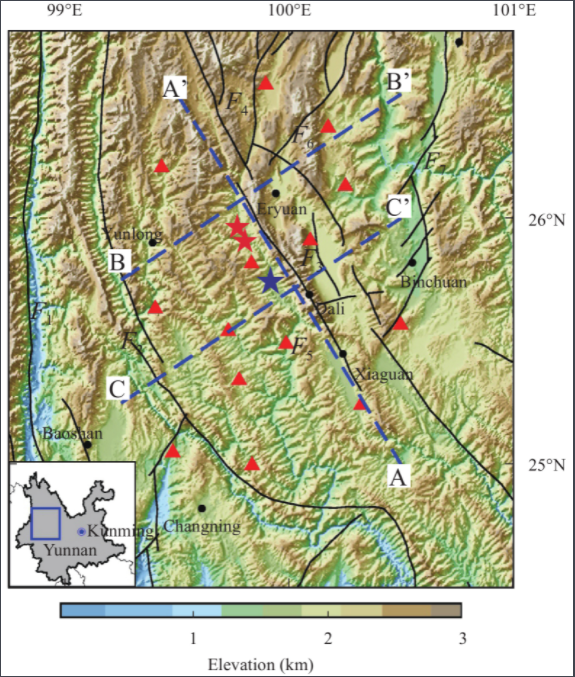
A magnitude 5.5 earthquakes occurred in Eryuan County, Dali Bai Autonomous Prefecture, Yunnan Province, China, on March 3. And a magnitude 5.0 earthquake occurred in the same place on April 17, 2013, i.e., 45 days later. Then, on May 21, 2021, multiple earthquakes-one with magnitude 6.4 and several at 5.0 or above, occurred in Yangbi County, Dali Bai Autonomous Prefecture, Yunnan Province, China.
All of these occurred in the Weixi-Qiaohou-Weishan fault zone. In this study, 1,874 seismic events in Yangbi and Eryuan counties were identified by automatic micro-seismic tools and the first arrivals were picked up manually. Following this, a total of 11,968 direct P-wave absolute arrivals and 73,987 high-quality P-wave relative arrivals were collected for joint inversion via the double difference tomography method. This was done to obtain the regional three-dimensional crustal fine P-wave velocity structure. The results show that the travel time residuals before and after inversion decreased from the initial –0.1–0.1 s to –0.06–0.06 s. The upper crust in the study area, which exhibited a low-velocity anomaly, corresponded to the basin region; this indicated that the low-velocity anomaly in the shallow part of the study area was affected by the basin.
Results also showed some correlation between the distribution of the earthquakes and velocity structure, as there was a low-velocity body Lv1 with a wide distribution at depths ranging from 15–20 km in the Yangbi and Eryuan earthquake regions. In addition, earthquakes occurred predominantly in the high-low velocity abnormal transition zone. The low-velocity body in the middle and lower crust may be prone to concentrating upper crustal stress, thus leading to the occurrence of earthquakes.
Ultrafast all-optical modulation of wide-bandwidth pulses enabled by silicon-metasurfaces
Kaloyan Georgiev, Khosro Zangeneh Kamali, Anton A. Trifonov, Giulia Crotti, Lyuben Petrov, Stefan Georgiev, Hristo Iliev, Lei Xu, Unai Arregui Leon, Mohsen Rahmani, Giuseppe Della Valle, Ivan Buchvarov, Dragomir Neshev
Opto-Electronic Advances
2026-09-15
Physics-informed neural fields enable blind aberration correction for partially coherent quantitative phase imaging
Shun Zhou, Xingyu Huang, Linpeng Lu, Habib Ullah, Kaiyu Du, Maciej Trusiak, Malgorzata Kujawinska, Yuzhen Zhang, Yao Fan, Qian Chen, Qinrong Zhang, Chao Zuo
Opto-Electronic Science
2026-08-26
Heterogeneously integrated micro-ring with SnS₂ for dual-functional optical modulation and photodetection
Jinyi Du, Lidan Lu, Xu Zhang, Bofei Zhu, Wenbo Bo, Yingjie Xu, Guang Chen, Yanlin He, Guanghui Ren, Xiaoping Lou, Zheng You, Lianqing Zhu
Opto-Electronic Advances
2026-08-25
Hardware-aware lightweight photonic spiking neural network for pattern classification
Shuiying Xiang, Yahui Zhang, Shangxuan Shi, Haowen Zhao, Dianzhuang Zheng, Xingxing Guo, Yanan Han, Ye Tian, Liyue Zhang, Yuechun Shi, Yue Hao
Opto-Electronic Advances
2026-08-25
PhyspeNet: An empirical physics-aware network for adaptive speckle reconstructive spectrometry
Junrui Liang, Min Jiang, Jun Li, Zhongming Huang, Junhong He, Yanting Guo, Yanzhao Ke, Jun Ye, Jiangming Xu, Jinyong Leng, Pu Zhou
Opto-Electronic Advances
2026-08-25
A 36 × 240 Gbps hybrid mode/wavelength division multiplexing transmitter using lithium niobate on insulator
Mingyu Zhu, Weihan Wang, Ruitao Ma, Aoyun Gao, Chun Gao, Zexu Wang, Fei Huang, Zhenyuan Bao, Dajian Liu, Jiaxuan Gan, Zejie Yu, Huan Li, Weike Zhao, Daoxin Dai
Opto-Electronic Advances
2026-08-25