(Peer-Reviewed) High performance micromachining of sapphire by laser induced plasma assisted ablation (LIPAA) using GHz burst mode femtosecond pulses
Kotaro Obata ¹, Shota Kawabata ¹ ², Yasutaka Hanada ¹ ³, Godai Miyaji ², Koji Sugioka ¹
¹ RIKEN Center for Advanced Photonics (RAP), Wako-shi, Saitama 351-0198, Japan
² Faculty of Engineering, Tokyo University of Agriculture and Technology, Koganei, Tokyo 184-8588, Japan
³ Graduate school of science and technology, Hirosaki University, Hirosaki, Aomori 036-8561, Japan
Opto-Electronic Science
, 2024-06-24
Abstract
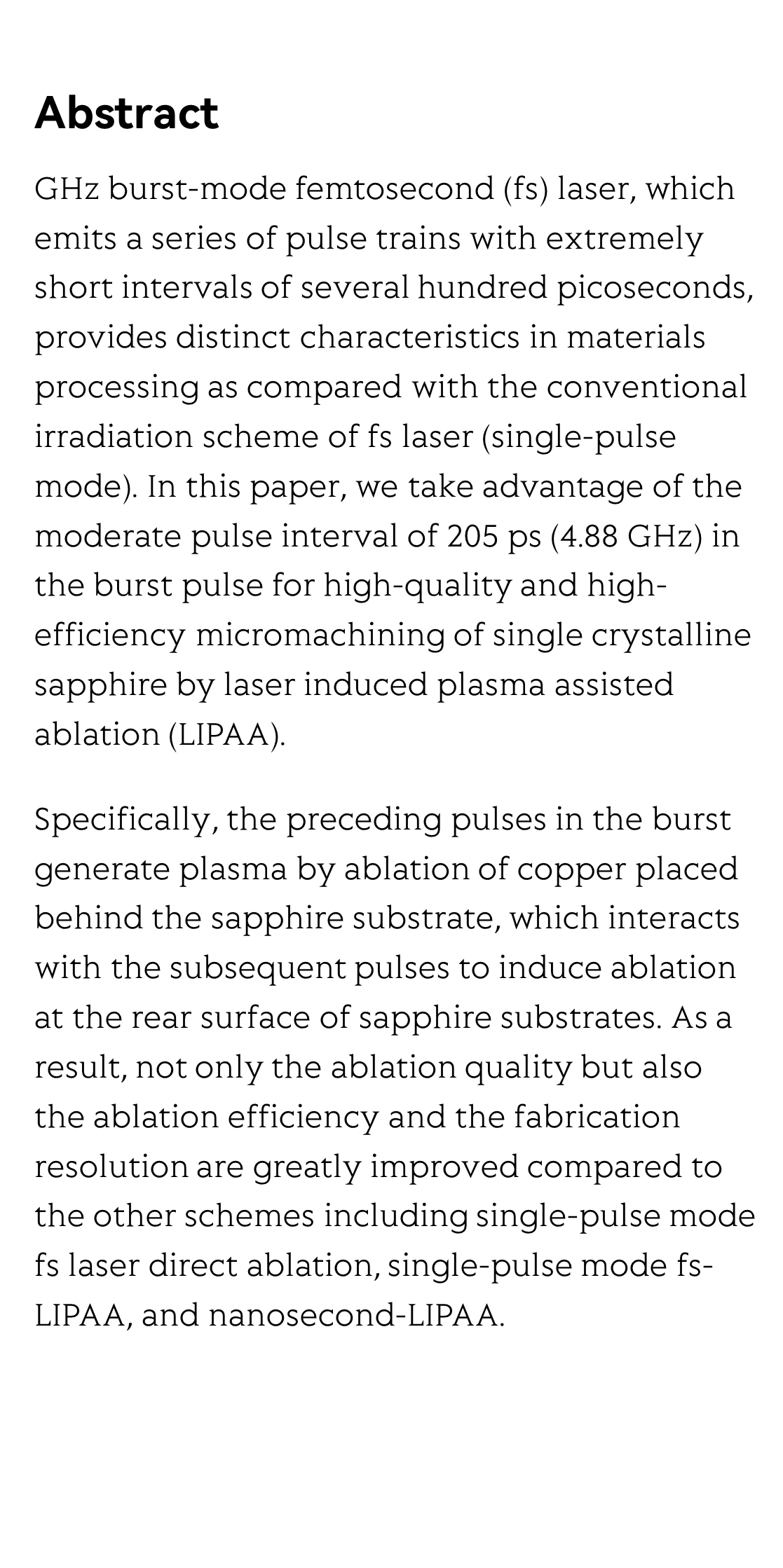
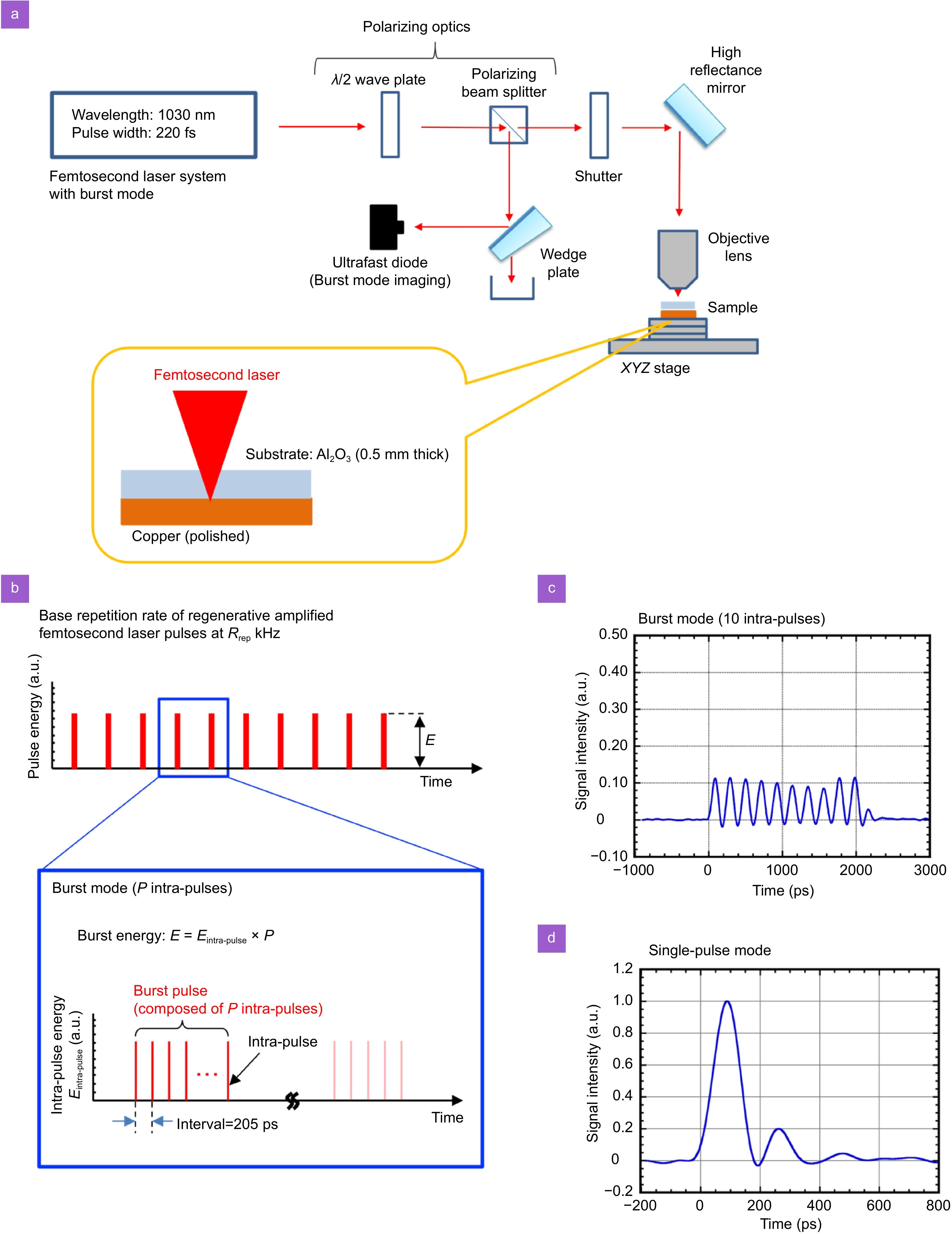
GHz burst-mode femtosecond (fs) laser, which emits a series of pulse trains with extremely short intervals of several hundred picoseconds, provides distinct characteristics in materials processing as compared with the conventional irradiation scheme of fs laser (single-pulse mode). In this paper, we take advantage of the moderate pulse interval of 205 ps (4.88 GHz) in the burst pulse for high-quality and high-efficiency micromachining of single crystalline sapphire by laser induced plasma assisted ablation (LIPAA).
Specifically, the preceding pulses in the burst generate plasma by ablation of copper placed behind the sapphire substrate, which interacts with the subsequent pulses to induce ablation at the rear surface of sapphire substrates. As a result, not only the ablation quality but also the ablation efficiency and the fabrication resolution are greatly improved compared to the other schemes including single-pulse mode fs laser direct ablation, single-pulse mode fs-LIPAA, and nanosecond-LIPAA.
Ultrafast all-optical modulation of wide-bandwidth pulses enabled by silicon-metasurfaces
Kaloyan Georgiev, Khosro Zangeneh Kamali, Anton A. Trifonov, Giulia Crotti, Lyuben Petrov, Stefan Georgiev, Hristo Iliev, Lei Xu, Unai Arregui Leon, Mohsen Rahmani, Giuseppe Della Valle, Ivan Buchvarov, Dragomir Neshev
Opto-Electronic Advances
2026-09-15
Physics-informed neural fields enable blind aberration correction for partially coherent quantitative phase imaging
Shun Zhou, Xingyu Huang, Linpeng Lu, Habib Ullah, Kaiyu Du, Maciej Trusiak, Malgorzata Kujawinska, Yuzhen Zhang, Yao Fan, Qian Chen, Qinrong Zhang, Chao Zuo
Opto-Electronic Science
2026-08-26
Heterogeneously integrated micro-ring with SnS₂ for dual-functional optical modulation and photodetection
Jinyi Du, Lidan Lu, Xu Zhang, Bofei Zhu, Wenbo Bo, Yingjie Xu, Guang Chen, Yanlin He, Guanghui Ren, Xiaoping Lou, Zheng You, Lianqing Zhu
Opto-Electronic Advances
2026-08-25
Hardware-aware lightweight photonic spiking neural network for pattern classification
Shuiying Xiang, Yahui Zhang, Shangxuan Shi, Haowen Zhao, Dianzhuang Zheng, Xingxing Guo, Yanan Han, Ye Tian, Liyue Zhang, Yuechun Shi, Yue Hao
Opto-Electronic Advances
2026-08-25
PhyspeNet: An empirical physics-aware network for adaptive speckle reconstructive spectrometry
Junrui Liang, Min Jiang, Jun Li, Zhongming Huang, Junhong He, Yanting Guo, Yanzhao Ke, Jun Ye, Jiangming Xu, Jinyong Leng, Pu Zhou
Opto-Electronic Advances
2026-08-25
A 36 × 240 Gbps hybrid mode/wavelength division multiplexing transmitter using lithium niobate on insulator
Mingyu Zhu, Weihan Wang, Ruitao Ma, Aoyun Gao, Chun Gao, Zexu Wang, Fei Huang, Zhenyuan Bao, Dajian Liu, Jiaxuan Gan, Zejie Yu, Huan Li, Weike Zhao, Daoxin Dai
Opto-Electronic Advances
2026-08-25