(Peer-Reviewed) Near-perfect fidelity polarization-encoded multilayer optical data storage based on aligned gold nanorods
Linwei Zhu 朱林伟 ¹, Yaoyu Cao 曹耀宇 ², Qiuqun Chen 陈秋群 ³, Xu Ouyang 欧阳旭 ², Yi Xu 徐毅 ², Zhongliang Hu 胡忠亮 ³, Jianrong Qiu 邱建荣 ³ ⁴, Xiangping Li 李向平 ²
¹ School of Physics and Optoelectronic Engineering, Ludong University, Yantai 264025, China
中国 烟台 鲁东大学物理与光电工程学院
² Guangdong Provincial Key Laboratory of Optical Fiber Sensing and Communications, Institute of Photonics Technology, Jinan University, Guangzhou 510632, China
中国 广州 暨南大学光子技术研究院 广东省光纤传感与通信技术重点实验室
³ State Key Laboratory of Luminescent Materials and Devices, and Institute of Optical Communication Materials, South China University of Technology, Guangzhou 510640, China
中国 广州 华南理工大学发光材料与器件国家重点实验室 光通信材料研究所
⁴ State Key Laboratory of Modern Optical Instrumentation, College of Optical Science and Engineering, Zhejiang University, Hangzhou 310027, China
中国 杭州 浙江大学光电科学与工程学院 现代光学仪器国家重点实验室
Opto-Electronic Advances
, 2021-11-25
Abstract
Encoding information in light polarization is of great importance in facilitating optical data storage (ODS) for information security and data storage capacity escalation. However, despite recent advances in nanophotonic techniques vastly enhancing the feasibility of applying polarization channels, the data fidelity in reconstructed bits has been constrained by severe crosstalks occurring between varied polarization angles during data recording and reading process, which gravely hindered the utilization of this technique in practice.
In this paper, we demonstrate an ultra-low crosstalk polarization-encoding multilayer ODS technique for high-fidelity data recording and retrieving by utilizing a nanofibre-based nanocomposite film involving highly aligned gold nanorods (GNRs). With parallelizing the gold nanorods in the recording medium, the information carrier configuration minimizes miswriting and misreading possibilities for information input and output, respectively, compared with its randomly self-assembled counterparts.
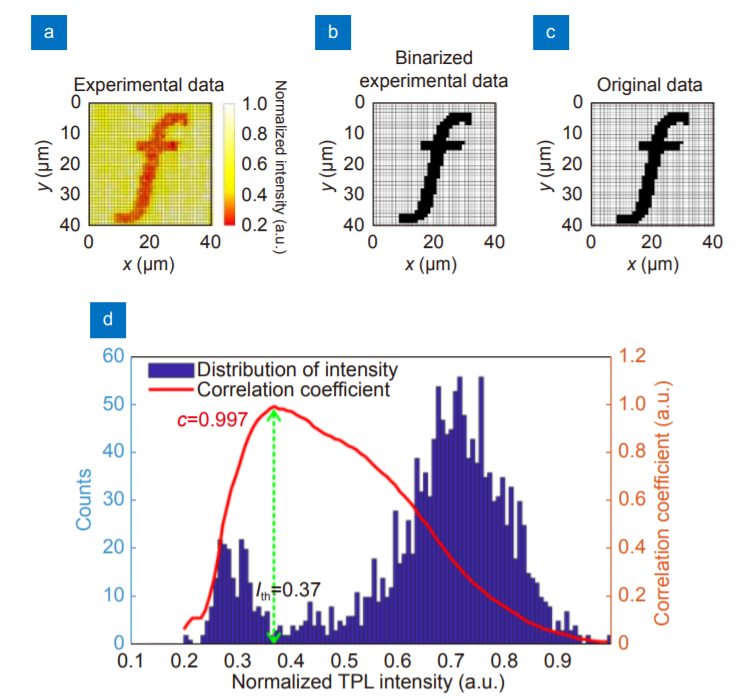
The enhanced data accuracy has significantly improved the bit recall fidelity that is quantified by a correlation coefficient higher than 0.99. It is anticipated that the demonstrated technique can facilitate the development of multiplexing ODS for a greener future.
Ultrafast all-optical modulation of wide-bandwidth pulses enabled by silicon-metasurfaces
Kaloyan Georgiev, Khosro Zangeneh Kamali, Anton A. Trifonov, Giulia Crotti, Lyuben Petrov, Stefan Georgiev, Hristo Iliev, Lei Xu, Unai Arregui Leon, Mohsen Rahmani, Giuseppe Della Valle, Ivan Buchvarov, Dragomir Neshev
Opto-Electronic Advances
2026-09-15
Physics-informed neural fields enable blind aberration correction for partially coherent quantitative phase imaging
Shun Zhou, Xingyu Huang, Linpeng Lu, Habib Ullah, Kaiyu Du, Maciej Trusiak, Malgorzata Kujawinska, Yuzhen Zhang, Yao Fan, Qian Chen, Qinrong Zhang, Chao Zuo
Opto-Electronic Science
2026-08-26
Heterogeneously integrated micro-ring with SnS₂ for dual-functional optical modulation and photodetection
Jinyi Du, Lidan Lu, Xu Zhang, Bofei Zhu, Wenbo Bo, Yingjie Xu, Guang Chen, Yanlin He, Guanghui Ren, Xiaoping Lou, Zheng You, Lianqing Zhu
Opto-Electronic Advances
2026-08-25
Hardware-aware lightweight photonic spiking neural network for pattern classification
Shuiying Xiang, Yahui Zhang, Shangxuan Shi, Haowen Zhao, Dianzhuang Zheng, Xingxing Guo, Yanan Han, Ye Tian, Liyue Zhang, Yuechun Shi, Yue Hao
Opto-Electronic Advances
2026-08-25
PhyspeNet: An empirical physics-aware network for adaptive speckle reconstructive spectrometry
Junrui Liang, Min Jiang, Jun Li, Zhongming Huang, Junhong He, Yanting Guo, Yanzhao Ke, Jun Ye, Jiangming Xu, Jinyong Leng, Pu Zhou
Opto-Electronic Advances
2026-08-25
A 36 × 240 Gbps hybrid mode/wavelength division multiplexing transmitter using lithium niobate on insulator
Mingyu Zhu, Weihan Wang, Ruitao Ma, Aoyun Gao, Chun Gao, Zexu Wang, Fei Huang, Zhenyuan Bao, Dajian Liu, Jiaxuan Gan, Zejie Yu, Huan Li, Weike Zhao, Daoxin Dai
Opto-Electronic Advances
2026-08-25