(Peer-Reviewed) Vertically mounting molybdenum disulfide nanosheets on dimolybdenum carbide nanomeshes enables efficient hydrogen evolution
Tingting Wang 王婷婷 ¹, Pengyan Wang 王鹏颜 ¹, Yajun Pang 庞亚俊 ², Yitian Wu 吴倚天 ², Jin Yang 杨金 ², Hao Chen 陈浩 ², Xiaorui Gao 高晓蕊 ³, Shichun Mu 木士春 ¹, and Zongkui Kou 寇宗魁 ¹
¹ State Key Laboratory of Advanced Technology for Materials Synthesis and Processing, Wuhan University of Technology, Wuhan 430070, China
中国 武汉 武汉理工大学 材料复合新技术国家重点实验室
² College of Chemistry and Materials Engineering, Zhejiang A&F University, Hangzhou 311300, China
中国 杭州 浙江农林大学化学与材料工程学院
³ Jiangsu Laboratory of Advanced Functional Materials, School of Electronic and Information Engineering, Changshu Institute of Technology, Changshu 215500, China
中国 常熟 常熟理工学院电子与信息工程学院 江苏省新型功能材料重点建设实验室
Abstract
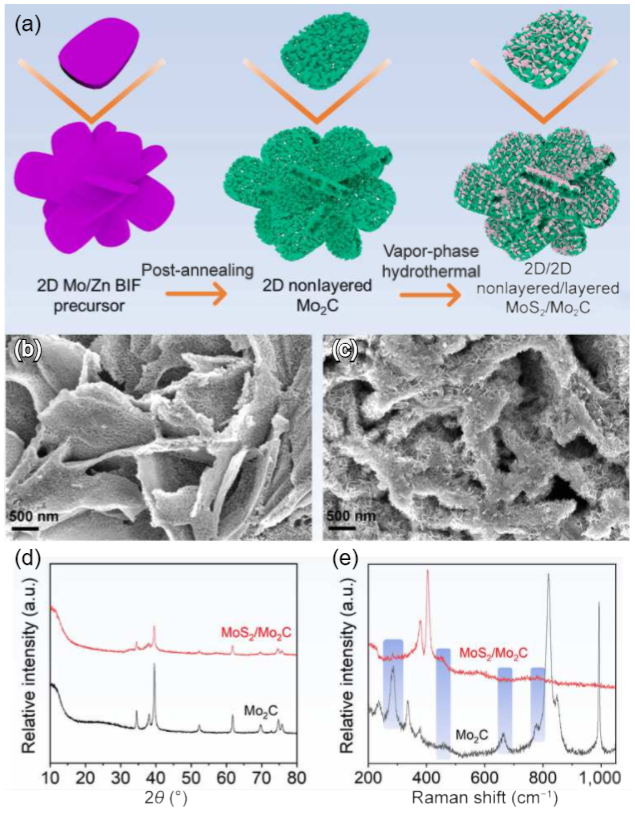
Designing hierarchical heterostructure to optimize the adsorption of hydrogen intermediate (H*) is impressive for hydrogen evolution reaction (HER) catalysis. Herein, we show that vertically mounting two-dimensional (2D) layered molybdenum disulfide (MoS₂) nanosheets on 2D nonlayered dimolybdenum carbide (Mo₂C) nanomeshes to form a hierarchical heterostructure largely accelerates the HER kinetics in acidic electrolyte due to the weakening adsorption strength of H* on 2D Mo₂C nanomeshes.
Our hierarchical MoS₂/Mo₂C heterostructure therefore gives a decrease of overpotential for up to 500 mV at −10 mA·cm⁻² and an almost 200-fold higher kinetics current density compared with the pristine Mo₂C nanomeshes and maintains robust stability with a small drop of overpotential for only 16 mV upon 5,000 cycles. We further rationalize this finding by theoretical calculations and find an optimized adsorption free energy of H*, identifying that the MoS₂ featuring strong H* desorption plays a key role in weakening the strong binding of Mo₂C with H* and therefore improves the intrinsic HER activity on active C sites of Mo₂C.
This present finding shines the light on the rational design of heterostructured catalysts with synergistic geometry.
Ultrafast all-optical modulation of wide-bandwidth pulses enabled by silicon-metasurfaces
Kaloyan Georgiev, Khosro Zangeneh Kamali, Anton A. Trifonov, Giulia Crotti, Lyuben Petrov, Stefan Georgiev, Hristo Iliev, Lei Xu, Unai Arregui Leon, Mohsen Rahmani, Giuseppe Della Valle, Ivan Buchvarov, Dragomir Neshev
Opto-Electronic Advances
2026-09-15
Physics-informed neural fields enable blind aberration correction for partially coherent quantitative phase imaging
Shun Zhou, Xingyu Huang, Linpeng Lu, Habib Ullah, Kaiyu Du, Maciej Trusiak, Malgorzata Kujawinska, Yuzhen Zhang, Yao Fan, Qian Chen, Qinrong Zhang, Chao Zuo
Opto-Electronic Science
2026-08-26
Heterogeneously integrated micro-ring with SnS₂ for dual-functional optical modulation and photodetection
Jinyi Du, Lidan Lu, Xu Zhang, Bofei Zhu, Wenbo Bo, Yingjie Xu, Guang Chen, Yanlin He, Guanghui Ren, Xiaoping Lou, Zheng You, Lianqing Zhu
Opto-Electronic Advances
2026-08-25
Hardware-aware lightweight photonic spiking neural network for pattern classification
Shuiying Xiang, Yahui Zhang, Shangxuan Shi, Haowen Zhao, Dianzhuang Zheng, Xingxing Guo, Yanan Han, Ye Tian, Liyue Zhang, Yuechun Shi, Yue Hao
Opto-Electronic Advances
2026-08-25
PhyspeNet: An empirical physics-aware network for adaptive speckle reconstructive spectrometry
Junrui Liang, Min Jiang, Jun Li, Zhongming Huang, Junhong He, Yanting Guo, Yanzhao Ke, Jun Ye, Jiangming Xu, Jinyong Leng, Pu Zhou
Opto-Electronic Advances
2026-08-25
A 36 × 240 Gbps hybrid mode/wavelength division multiplexing transmitter using lithium niobate on insulator
Mingyu Zhu, Weihan Wang, Ruitao Ma, Aoyun Gao, Chun Gao, Zexu Wang, Fei Huang, Zhenyuan Bao, Dajian Liu, Jiaxuan Gan, Zejie Yu, Huan Li, Weike Zhao, Daoxin Dai
Opto-Electronic Advances
2026-08-25