(Peer-Reviewed) Ultrafast multi-target control of tightly focused light fields
Yanxiang Zhang ¹, Xiaofei Liu ², Han Lin 林瀚 ³, Dan Wang ¹, Ensi Cao 曹恩思 ¹, Shaoding Liu 刘绍鼎 ¹, Zhongquan Nie 聂仲泉 ¹, Baohua Jia 贾宝华 ³
¹ Key Lab of Advanced Transducers and Intelligent Control System, Ministry of Education and Shanxi Province, College of Physics and Optoelectronics, Taiyuan University of Technology, Taiyuan 030024, China
山西 太原 太原理工大学物理与光电工程学院 新型传感器与智能控制教育部与山西省重点实验室
² Department of Physics, Harbin Institute of Technology, Harbin 150001, China
中国 哈尔滨 哈尔滨工业大学物理学院
³ Centre of Translational Atomaterials (CTAM), Faculty of Science, Engineering and Technology, Swinburne University of Technology, Hawthorn, VIC 3122, Australia
Opto-Electronic Advances
, 2022-01-28
Abstract
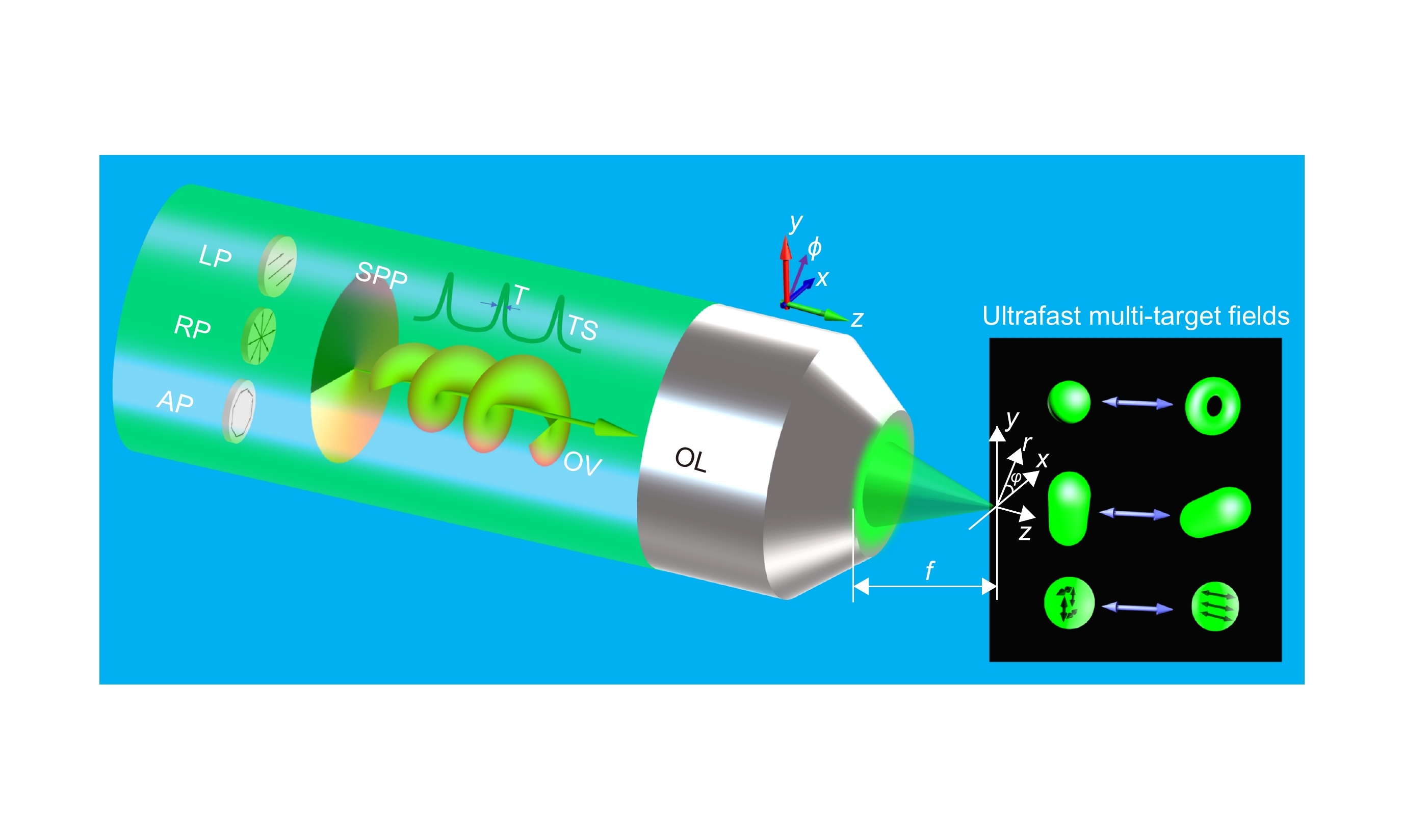
The control of ultrafast optical field is of great interest in developing ultrafast optics as well as the investigation on various light-matter interactions with ultrashort pulses. However, conventional spatial encoding approaches have only limited steerable targets usually neglecting the temporal effect, thus hindering their broad applications. Here we present a new concept for realizing ultrafast modulation of multi-target focal fields based on the facile combination of time-dependent vectorial diffraction theory with fast Fourier transform.
This is achieved by focusing femtosecond pulsed light carrying vectorial-vortex by a single objective lens under tight focusing condition. It is uncovered that the ultrafast temporal degree of freedom within a configurable temporal duration (~400 fs) plays a pivotal role in determining the rich and exotic features of the focused optical field at one time, namely, bright-dark alternation, periodic rotation, and longitudinal/transverse polarization conversion. The underlying control mechanisms have been unveiled.
Besides being of academic interest in diverse ultrafast spectral regimes, these peculiar behaviors of the space-time evolutionary beams may underpin prolific ultrafast-related applications such as multifunctional integrated optical chip, high-efficiency laser trapping, microstructure rotation, super-resolution optical microscopy, precise optical measurement, and liveness tracking.
Ultrafast all-optical modulation of wide-bandwidth pulses enabled by silicon-metasurfaces
Kaloyan Georgiev, Khosro Zangeneh Kamali, Anton A. Trifonov, Giulia Crotti, Lyuben Petrov, Stefan Georgiev, Hristo Iliev, Lei Xu, Unai Arregui Leon, Mohsen Rahmani, Giuseppe Della Valle, Ivan Buchvarov, Dragomir Neshev
Opto-Electronic Advances
2026-09-15
Physics-informed neural fields enable blind aberration correction for partially coherent quantitative phase imaging
Shun Zhou, Xingyu Huang, Linpeng Lu, Habib Ullah, Kaiyu Du, Maciej Trusiak, Malgorzata Kujawinska, Yuzhen Zhang, Yao Fan, Qian Chen, Qinrong Zhang, Chao Zuo
Opto-Electronic Science
2026-08-26
Heterogeneously integrated micro-ring with SnS₂ for dual-functional optical modulation and photodetection
Jinyi Du, Lidan Lu, Xu Zhang, Bofei Zhu, Wenbo Bo, Yingjie Xu, Guang Chen, Yanlin He, Guanghui Ren, Xiaoping Lou, Zheng You, Lianqing Zhu
Opto-Electronic Advances
2026-08-25
Hardware-aware lightweight photonic spiking neural network for pattern classification
Shuiying Xiang, Yahui Zhang, Shangxuan Shi, Haowen Zhao, Dianzhuang Zheng, Xingxing Guo, Yanan Han, Ye Tian, Liyue Zhang, Yuechun Shi, Yue Hao
Opto-Electronic Advances
2026-08-25
PhyspeNet: An empirical physics-aware network for adaptive speckle reconstructive spectrometry
Junrui Liang, Min Jiang, Jun Li, Zhongming Huang, Junhong He, Yanting Guo, Yanzhao Ke, Jun Ye, Jiangming Xu, Jinyong Leng, Pu Zhou
Opto-Electronic Advances
2026-08-25
A 36 × 240 Gbps hybrid mode/wavelength division multiplexing transmitter using lithium niobate on insulator
Mingyu Zhu, Weihan Wang, Ruitao Ma, Aoyun Gao, Chun Gao, Zexu Wang, Fei Huang, Zhenyuan Bao, Dajian Liu, Jiaxuan Gan, Zejie Yu, Huan Li, Weike Zhao, Daoxin Dai
Opto-Electronic Advances
2026-08-25