(Peer-Reviewed) Decoding subject-invariant emotional information from cardiac signals detected by photonic sensing system
Yukun Long 龙裕坤 ¹ ² ³, Rui Min 闵锐 ³ ⁴ ⁵, Kun Xiao 肖坤 ⁶, Zhuo Wang 王茁 ⁶, Lanfang Liu 刘兰芳 ³ ⁴ ⁵, Yifan Sun 孙一藩 ⁷, Xiaoli Li 李小俚 ³ ⁴ ⁵, Zhaohui Li 李朝晖 ⁸ ⁹, Zeev Zalevsky ¹⁰
¹ Department of Systems Science, Faculty of Arts and Sciences, Beijing Normal University, Zhuhai 519087, China
中国 珠海 北京师范大学珠海校区 文理学院 系统科学系
² School of Systems Science, Beijing Normal University, Beijing 100875, China
中国 北京 北京师范大学系统科学学院
³ Department of Psychology, Faculty of Arts and Sciences, Beijing Normal University, Zhuhai 519087, China
中国 珠海 北京师范大学珠海校区 文理学院 心理学系
⁴ Faculty of Psychology, Beijing Normal University, Beijing 100875, China
中国 北京 北京师范大学心理学部
⁵ Center for Cognition and Neuroergonomics, State Key Laboratory of Cognitive Neuroscience and Learning, Beijing Normal University, Zhuhai 519087, China
中国 珠海 北京师范大学认知神经工效研究中心 认知神经科学与学习国家重点实验室
⁶ Department of Physics, Faculty of Arts and Sciences, Beijing Normal University, Zhuhai 519087, China
中国 珠海 北京师范大学珠海校区 文理学院物理系
⁷ Service OPERA-Photonique, Université libre de Bruxelles, B-1050 Brussels, Belgium
⁸ Guangdong Provincial Key Laboratory of Optoelectronic Information Processing Chips and Systems and School of Electronics and Information Technology, Sun Yat-sen University, Guangzhou 510006, China
中国 广州 中山大学电子与信息工程学院 广东省光电信息处理芯片与系统重点实验室
⁹ Southern Laboratory of Ocean Science and Engineering, Zhuhai 519000, China
中国 珠海 南方海洋科学与工程广东省实验室(珠海)
¹⁰ Faculty of Engineering and Nano Technology Center, Bar-Ilan University, Ramat Gan 5290002, Israel
Opto-Electronic Technology
, 2025-12-25
Abstract
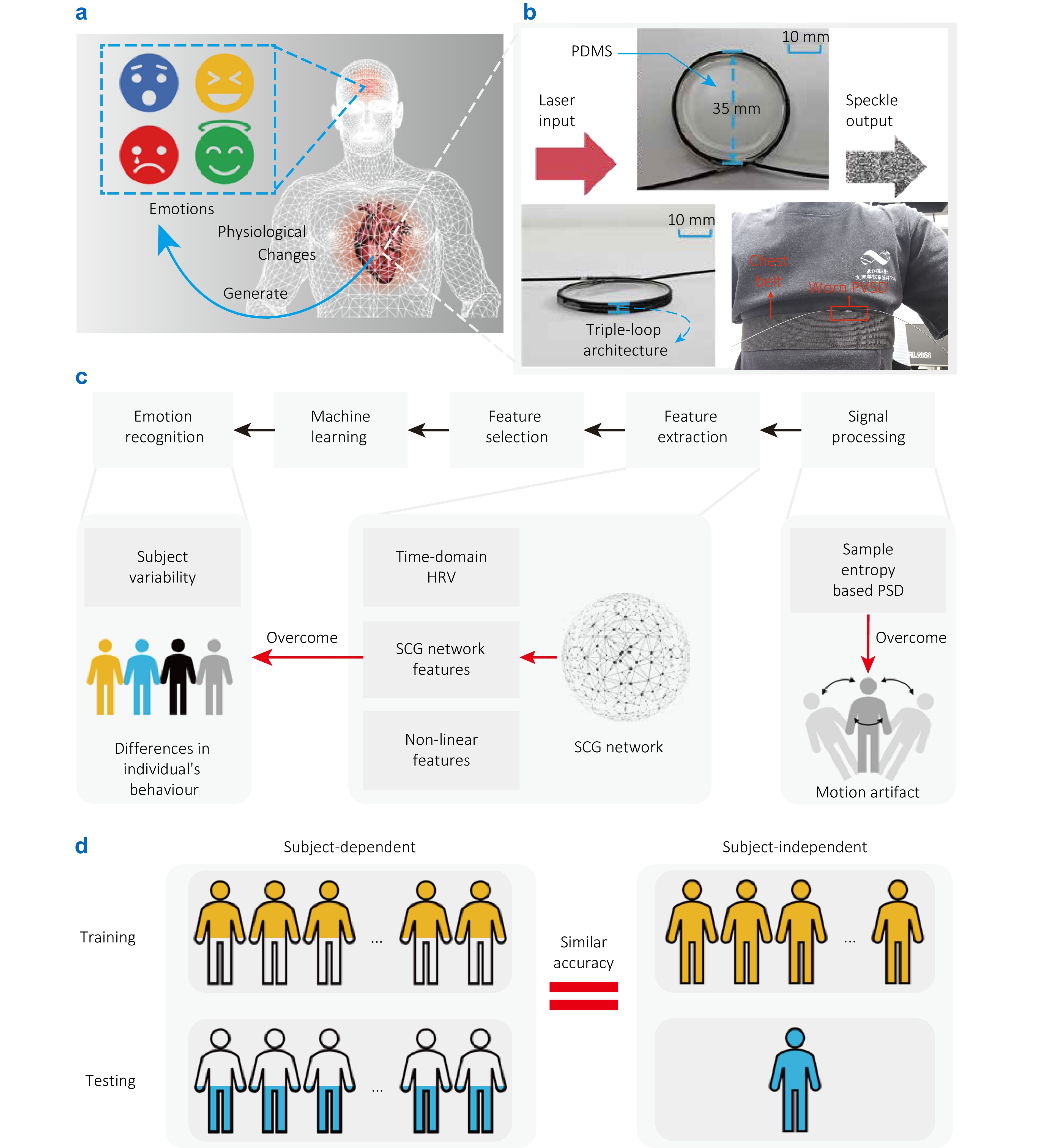
Emotion recognition systems hold significant practical value due to the vital role emotions play in daily human life. Since cardiac activities are critically involved in the process of emotional arousal, developing emotion recognition systems based on cardiac signals is of great importance. However, inter-subject variability causes a major challenge for cross-subject emotion recognition and remains a key bottleneck for the practical application of emotion recognition systems.
Here we report a photonic cross-subject emotion recognition system (PCERS) based on seismocardiography (SCG) signals, leveraging machine learning techniques driven by complex network feature engineering to decode subject-invariant emotional information from signals. In the cardiac activity monitoring component, we developed a photonic system for SCG signal detection and implemented a sample entropy-based signal processing pipeline. These designs enable precise cardiac activity monitoring as the foundation for emotion recognition.
In the emotion recognition component, the complex network features extracted from SCG signals show significant differences between different emotional states, but no significant differences across subjects. Incorporating these features into the machine learning pipeline enables efficient cross-subject emotion recognition, achieving accuracies 81.25% in leave one-out (LOO) subject-independent emotion recognition. Results in this work suggested that PCERS has potential to contribute meaningfully to practical, real-life emotion recognition applications.
Ultrafast all-optical modulation of wide-bandwidth pulses enabled by silicon-metasurfaces
Kaloyan Georgiev, Khosro Zangeneh Kamali, Anton A. Trifonov, Giulia Crotti, Lyuben Petrov, Stefan Georgiev, Hristo Iliev, Lei Xu, Unai Arregui Leon, Mohsen Rahmani, Giuseppe Della Valle, Ivan Buchvarov, Dragomir Neshev
Opto-Electronic Advances
2026-09-15
Physics-informed neural fields enable blind aberration correction for partially coherent quantitative phase imaging
Shun Zhou, Xingyu Huang, Linpeng Lu, Habib Ullah, Kaiyu Du, Maciej Trusiak, Malgorzata Kujawinska, Yuzhen Zhang, Yao Fan, Qian Chen, Qinrong Zhang, Chao Zuo
Opto-Electronic Science
2026-08-26
Heterogeneously integrated micro-ring with SnS₂ for dual-functional optical modulation and photodetection
Jinyi Du, Lidan Lu, Xu Zhang, Bofei Zhu, Wenbo Bo, Yingjie Xu, Guang Chen, Yanlin He, Guanghui Ren, Xiaoping Lou, Zheng You, Lianqing Zhu
Opto-Electronic Advances
2026-08-25
Hardware-aware lightweight photonic spiking neural network for pattern classification
Shuiying Xiang, Yahui Zhang, Shangxuan Shi, Haowen Zhao, Dianzhuang Zheng, Xingxing Guo, Yanan Han, Ye Tian, Liyue Zhang, Yuechun Shi, Yue Hao
Opto-Electronic Advances
2026-08-25
PhyspeNet: An empirical physics-aware network for adaptive speckle reconstructive spectrometry
Junrui Liang, Min Jiang, Jun Li, Zhongming Huang, Junhong He, Yanting Guo, Yanzhao Ke, Jun Ye, Jiangming Xu, Jinyong Leng, Pu Zhou
Opto-Electronic Advances
2026-08-25
A 36 × 240 Gbps hybrid mode/wavelength division multiplexing transmitter using lithium niobate on insulator
Mingyu Zhu, Weihan Wang, Ruitao Ma, Aoyun Gao, Chun Gao, Zexu Wang, Fei Huang, Zhenyuan Bao, Dajian Liu, Jiaxuan Gan, Zejie Yu, Huan Li, Weike Zhao, Daoxin Dai
Opto-Electronic Advances
2026-08-25