(Peer-Reviewed) Dual bound states in the continuum enhanced second harmonic generation with transition metal dichalcogenides monolayer
Peilong Hong 洪佩龙 ¹, Lei Xu 徐雷 ², Mohsen Rahmani ²
¹ School of Optoelectronic Science and Engineering, University of Electronic Science and Technology of China (UESTC), Chengdu 611731, China
中国 成都 电子科技大学 光电科学与工程学院
² Advanced Optics & Photonics Laboratory, Department of Engineering, School of Science & Technology, Nottingham Trent University, Nottingham NG11 8NS, UK
Opto-Electronic Advances
, 2022-06-25
Abstract
The emergence of two dimensional (2D) materials has opened new possibilities for exhibiting second harmonic generation (SHG) at the nanoscale, due to their remarkable optical response related to stable excitons at room temperature. However, the ultimate atomic-scale interaction length with light makes the SHG of Transition Metal Dichalcogenides (TMDs) monolayers naturally weak.
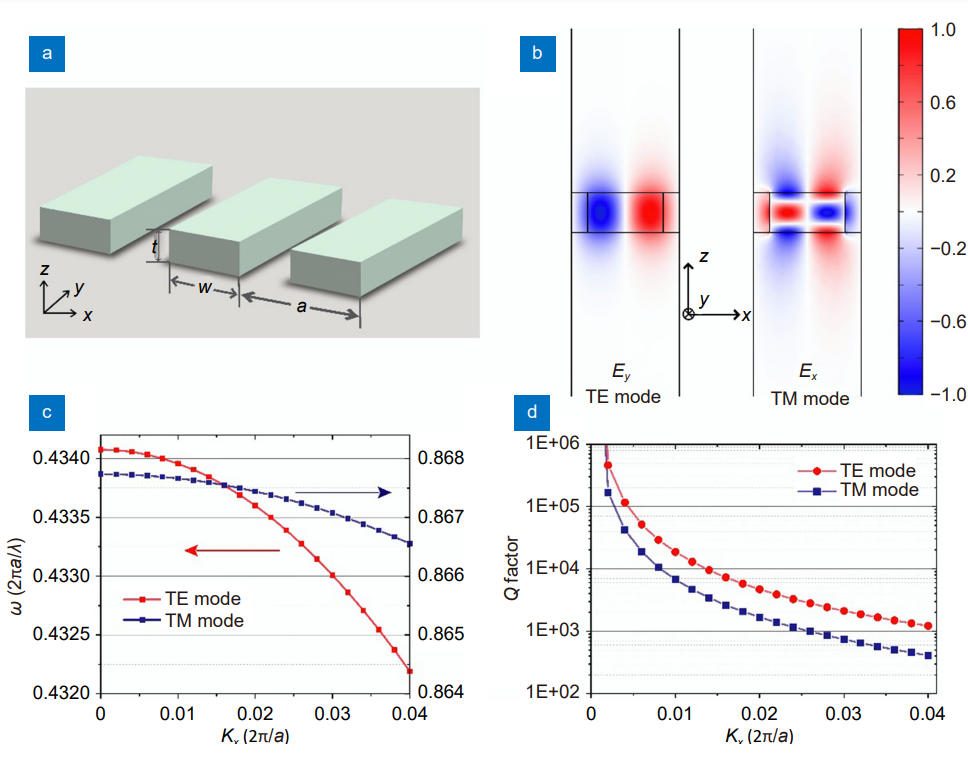
Here, we propose coupling a monolayer of TMDs with a photonic grating slab that works with doubly resonant bound states in the continuum (BIC). The BIC slabs are designed to exhibit a pair of BICs, resonant with both the fundamental wave (FW) and the second harmonic wave (SHW). Firstly, the spatial mode matching can be fulfilled by tilting FW's incident angle. We theoretically demonstrate that this strategy leads to more than four orders of magnitude enhancement of SHG efficiency than a sole monolayer of TMDs, under a pump light intensity of 0.1 GW/cm2.
Moreover, we demonstrate that patterning the TMDs monolayer can further enhance the spatial overlap coefficient, which leads to an extra three orders of magnitude enhancement of SHG efficiency. These results demonstrate remarkable possibilities for enhancing SHG with nonlinear 2D materials, opening many opportunities for chip-based light sources, nanolasers, imaging, and biochemical sensing.
Ultrafast all-optical modulation of wide-bandwidth pulses enabled by silicon-metasurfaces
Kaloyan Georgiev, Khosro Zangeneh Kamali, Anton A. Trifonov, Giulia Crotti, Lyuben Petrov, Stefan Georgiev, Hristo Iliev, Lei Xu, Unai Arregui Leon, Mohsen Rahmani, Giuseppe Della Valle, Ivan Buchvarov, Dragomir Neshev
Opto-Electronic Advances
2026-09-15
Physics-informed neural fields enable blind aberration correction for partially coherent quantitative phase imaging
Shun Zhou, Xingyu Huang, Linpeng Lu, Habib Ullah, Kaiyu Du, Maciej Trusiak, Malgorzata Kujawinska, Yuzhen Zhang, Yao Fan, Qian Chen, Qinrong Zhang, Chao Zuo
Opto-Electronic Science
2026-08-26
Heterogeneously integrated micro-ring with SnS₂ for dual-functional optical modulation and photodetection
Jinyi Du, Lidan Lu, Xu Zhang, Bofei Zhu, Wenbo Bo, Yingjie Xu, Guang Chen, Yanlin He, Guanghui Ren, Xiaoping Lou, Zheng You, Lianqing Zhu
Opto-Electronic Advances
2026-08-25
Hardware-aware lightweight photonic spiking neural network for pattern classification
Shuiying Xiang, Yahui Zhang, Shangxuan Shi, Haowen Zhao, Dianzhuang Zheng, Xingxing Guo, Yanan Han, Ye Tian, Liyue Zhang, Yuechun Shi, Yue Hao
Opto-Electronic Advances
2026-08-25
PhyspeNet: An empirical physics-aware network for adaptive speckle reconstructive spectrometry
Junrui Liang, Min Jiang, Jun Li, Zhongming Huang, Junhong He, Yanting Guo, Yanzhao Ke, Jun Ye, Jiangming Xu, Jinyong Leng, Pu Zhou
Opto-Electronic Advances
2026-08-25
A 36 × 240 Gbps hybrid mode/wavelength division multiplexing transmitter using lithium niobate on insulator
Mingyu Zhu, Weihan Wang, Ruitao Ma, Aoyun Gao, Chun Gao, Zexu Wang, Fei Huang, Zhenyuan Bao, Dajian Liu, Jiaxuan Gan, Zejie Yu, Huan Li, Weike Zhao, Daoxin Dai
Opto-Electronic Advances
2026-08-25