(Peer-Reviewed) Time-dependent borehole stability in hard-brittle shale
Chuan-Liang Yan 闫传梁 ¹ ², Lei-Feng Dong 董磊峰 ², Kai Zhao 赵凯 ³. Yuan-Fang Cheng 程远方 ¹ ², Xiao-Rong Li 李晓蓉 ⁴, Jin-Gen Deng 邓金根 ⁴, Zhen-Qi Li ², Yong Chen 陈勇 ²
¹ Key Laboratory of Unconventional Oil & Gas Development (China University of Petroleum (East China)), Ministry of Education, Qingdao, 266580, Shandong, China
中国 山东 青岛 中国石油大学(华东) 非常规油气开发教育部重点实验室
² School of Petroleum Engineering, China University of Petroleum (East China), Qingdao, 266580, Shandong, China
中国 青岛 中国石油大学(华东)石油工程学院
³ College of Petroleum Engineering, Xi’an Shiyou University, Xi'an, 710065, Shaanxi, China
中国 西安 西安石油大学石油工程学院
⁴ State Key Laboratory of Petroleum Resources and Prospecting, China University of Petroleum (Beijing), Beijing, 102249, China
中国 北京 中国石油大学(北京)油气资源与探测国家重点实验室
Abstract
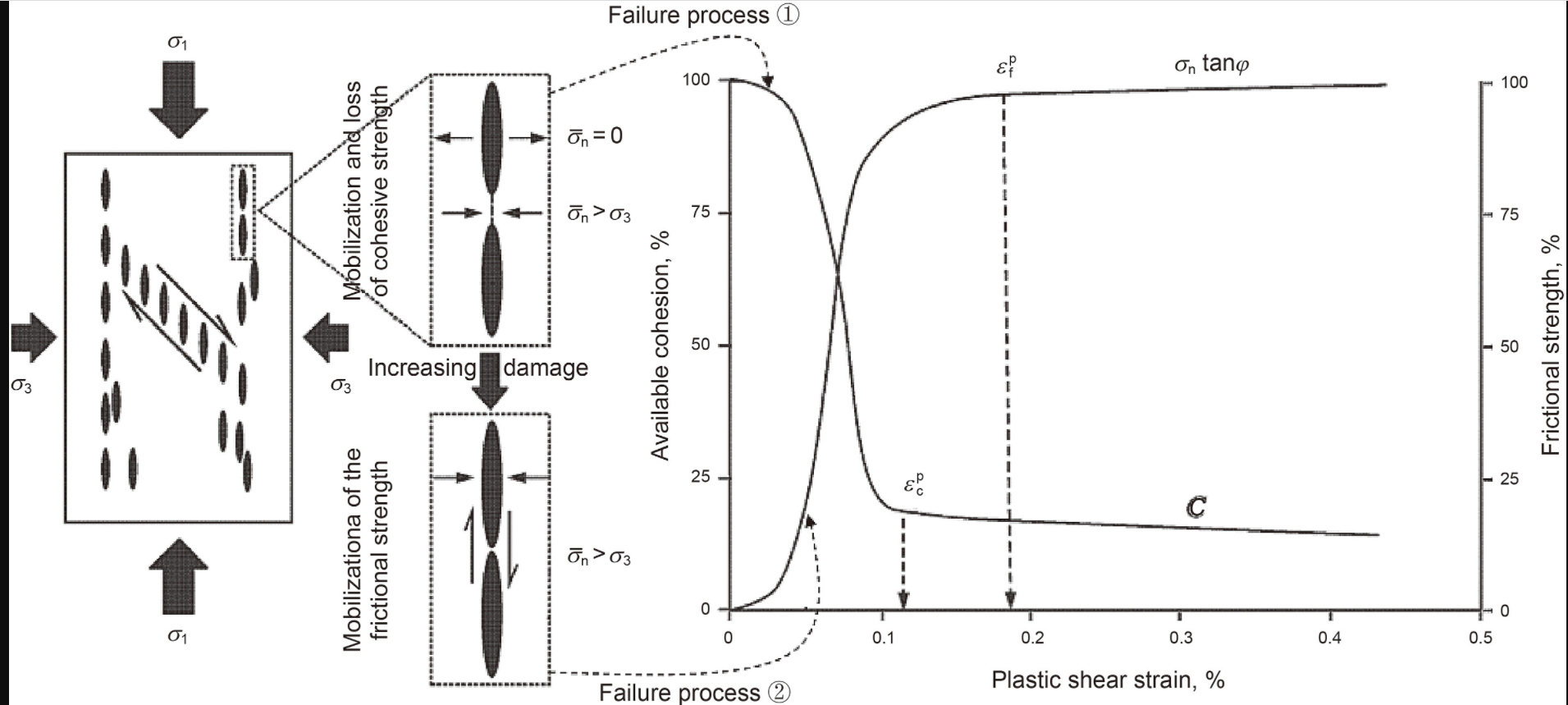
Rock damage appears in brittle shale even prior to peak stress (i.e., before failure) due to the occurrence of microcracks in these rocks. In this work, a coupled hydromechanical model was built by incorporating the mechanical and fluid seepage induced stresses around a wellbore during drilling. The borehole instability mechanism of hard-brittle shale was studied. The results show that even if a well were simply drilled into a hard-brittle shale formation, the formation around the borehole can be subjected to rock damage.
The maximum failure ratio of the formation around the borehole increases with drilling time. A lower drilling fluid density corresponds to a faster increase in the failure ratio of the borehole with time and a shorter period of borehole collapse. When the initial drilling fluid density is too low, serious rock damage occurs in the formation around the borehole. Even though a high-density drilling fluid is used after drilling, long-term borehole stability is difficult to maintain. While drilling in hard-brittle shale, drilling fluid with a proper density should be used rather than increasing the density of the drilling fluid only after borehole collapse occurs, which is more favorable for maintaining long-term borehole stability.
Ultrafast all-optical modulation of wide-bandwidth pulses enabled by silicon-metasurfaces
Kaloyan Georgiev, Khosro Zangeneh Kamali, Anton A. Trifonov, Giulia Crotti, Lyuben Petrov, Stefan Georgiev, Hristo Iliev, Lei Xu, Unai Arregui Leon, Mohsen Rahmani, Giuseppe Della Valle, Ivan Buchvarov, Dragomir Neshev
Opto-Electronic Advances
2026-09-15
Physics-informed neural fields enable blind aberration correction for partially coherent quantitative phase imaging
Shun Zhou, Xingyu Huang, Linpeng Lu, Habib Ullah, Kaiyu Du, Maciej Trusiak, Malgorzata Kujawinska, Yuzhen Zhang, Yao Fan, Qian Chen, Qinrong Zhang, Chao Zuo
Opto-Electronic Science
2026-08-26
Heterogeneously integrated micro-ring with SnS₂ for dual-functional optical modulation and photodetection
Jinyi Du, Lidan Lu, Xu Zhang, Bofei Zhu, Wenbo Bo, Yingjie Xu, Guang Chen, Yanlin He, Guanghui Ren, Xiaoping Lou, Zheng You, Lianqing Zhu
Opto-Electronic Advances
2026-08-25
Hardware-aware lightweight photonic spiking neural network for pattern classification
Shuiying Xiang, Yahui Zhang, Shangxuan Shi, Haowen Zhao, Dianzhuang Zheng, Xingxing Guo, Yanan Han, Ye Tian, Liyue Zhang, Yuechun Shi, Yue Hao
Opto-Electronic Advances
2026-08-25
PhyspeNet: An empirical physics-aware network for adaptive speckle reconstructive spectrometry
Junrui Liang, Min Jiang, Jun Li, Zhongming Huang, Junhong He, Yanting Guo, Yanzhao Ke, Jun Ye, Jiangming Xu, Jinyong Leng, Pu Zhou
Opto-Electronic Advances
2026-08-25
A 36 × 240 Gbps hybrid mode/wavelength division multiplexing transmitter using lithium niobate on insulator
Mingyu Zhu, Weihan Wang, Ruitao Ma, Aoyun Gao, Chun Gao, Zexu Wang, Fei Huang, Zhenyuan Bao, Dajian Liu, Jiaxuan Gan, Zejie Yu, Huan Li, Weike Zhao, Daoxin Dai
Opto-Electronic Advances
2026-08-25