(Peer-Reviewed) A virus-derived small RNA targets the rice transcription factor ROC1 to induce disease-like symptom
Xiuqin Huang 黄秀琴 ¹, Feifei Li 李飞飞 ¹, Xishan Zhang 张喜珊 ¹, Jiahao Chen 陈嘉豪 ¹, Junkai Wang 王俊凯 ¹, Jing Wei ², Xin Yang 杨新 ¹, Guohui Zhou 周国辉 ¹, Tong Zhang 张彤 ¹
¹ Guangdong Province Key Laboratory of Microbial Signals and Disease Control, College of Plant Protection, South China Agricultural University, Guangzhou, 510642, China
中国 广州 华南农业大学植物保护学院 广东省微生物信号与作物病害防控重点实验室
² School of Basic Medicine and Biological Sciences, Soochow University, Suzhou, 215123, China
中国 苏州 苏州大学基础医学与生物科学学院
Abstract
Virus-derived small interfering RNAs (vsiRNAs) in plants can target host transcripts to induce symptom development. Southern rice black-streaked dwarf virus (SRBSDV) is the most damaging rice-infecting virus, which causes severe stunting and poorly developed roots in rice plants, thereby posing a serious threat to rice production.
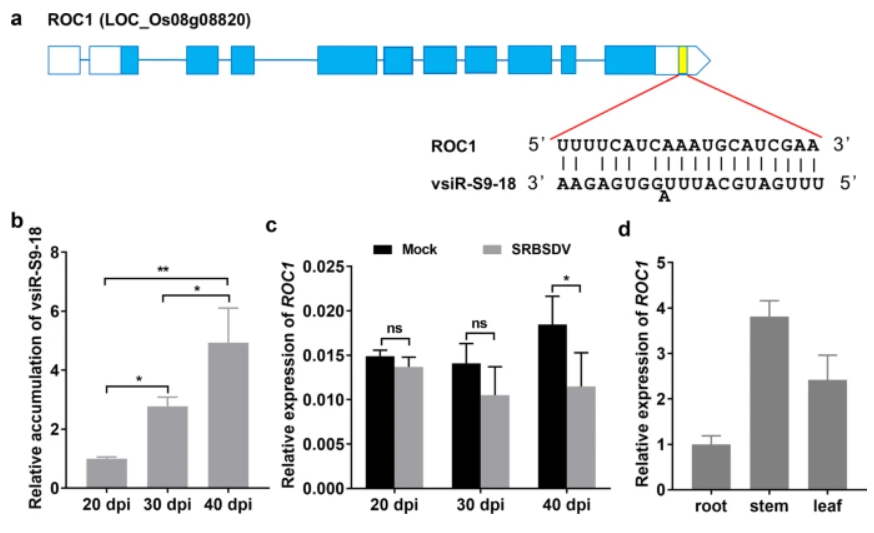
In this study, we show that a vsiRNA (vsiR-S9-18), generated from SRBSDV genome segment 9, targets the transcription factor ROC1 in rice. SRBSDV infection triggered the production of vsiR-S9-18 and resulted in the downregulation of ROC1 in rice plants. Transient expression of vsiR-S9-18 in rice protoplasts and tobacco leaves further demonstrated the specific association of vsiR-S9-18 with ROC1.
Moreover, the ROC1-knockout rice plants displayed shortened roots, similar to the phenotype of root growth inhibition caused by SRBSDV infection. We propose that vsiR-S9-18 inhibits root elongation via ROC1, which has been proven to regulate root growth. This finding extends our understanding of the role of vsiRNA in viral disease development and is helpful for the development of new antiviral approaches.
Ultrafast all-optical modulation of wide-bandwidth pulses enabled by silicon-metasurfaces
Kaloyan Georgiev, Khosro Zangeneh Kamali, Anton A. Trifonov, Giulia Crotti, Lyuben Petrov, Stefan Georgiev, Hristo Iliev, Lei Xu, Unai Arregui Leon, Mohsen Rahmani, Giuseppe Della Valle, Ivan Buchvarov, Dragomir Neshev
Opto-Electronic Advances
2026-09-15
Physics-informed neural fields enable blind aberration correction for partially coherent quantitative phase imaging
Shun Zhou, Xingyu Huang, Linpeng Lu, Habib Ullah, Kaiyu Du, Maciej Trusiak, Malgorzata Kujawinska, Yuzhen Zhang, Yao Fan, Qian Chen, Qinrong Zhang, Chao Zuo
Opto-Electronic Science
2026-08-26
Heterogeneously integrated micro-ring with SnS₂ for dual-functional optical modulation and photodetection
Jinyi Du, Lidan Lu, Xu Zhang, Bofei Zhu, Wenbo Bo, Yingjie Xu, Guang Chen, Yanlin He, Guanghui Ren, Xiaoping Lou, Zheng You, Lianqing Zhu
Opto-Electronic Advances
2026-08-25
Hardware-aware lightweight photonic spiking neural network for pattern classification
Shuiying Xiang, Yahui Zhang, Shangxuan Shi, Haowen Zhao, Dianzhuang Zheng, Xingxing Guo, Yanan Han, Ye Tian, Liyue Zhang, Yuechun Shi, Yue Hao
Opto-Electronic Advances
2026-08-25
PhyspeNet: An empirical physics-aware network for adaptive speckle reconstructive spectrometry
Junrui Liang, Min Jiang, Jun Li, Zhongming Huang, Junhong He, Yanting Guo, Yanzhao Ke, Jun Ye, Jiangming Xu, Jinyong Leng, Pu Zhou
Opto-Electronic Advances
2026-08-25
A 36 × 240 Gbps hybrid mode/wavelength division multiplexing transmitter using lithium niobate on insulator
Mingyu Zhu, Weihan Wang, Ruitao Ma, Aoyun Gao, Chun Gao, Zexu Wang, Fei Huang, Zhenyuan Bao, Dajian Liu, Jiaxuan Gan, Zejie Yu, Huan Li, Weike Zhao, Daoxin Dai
Opto-Electronic Advances
2026-08-25