(Conference Paper) SmartCommit: a graph-based interactive assistant for activity-oriented commits
Bo Shen 申博 ¹, Wei Zhang 张伟 ¹, Christian Kästner ², Haiyan Zhao 赵海燕 ¹, Zhao Wei ³, Guangtai Liang 梁广泰 ³, Zhi Jin 金芝 ¹
¹ Key Lab of High Confidence Software Technology (Peking University), MoE Beijing, China
中国 北京 高可信软件技术教育部重点实验室(北京大学)
² Carnegie Mellon University Pittsburgh, PA, USA
³ Huawei Technologies Co., Ltd. Beijing, China
中国 北京 华为技术有限公司
ESEC/FSE 2021: Proceedings of the 29th ACM Joint Meeting on European Software Engineering Conference and Symposium on the Foundations of Software Engineering
, 2021-08-20
Abstract
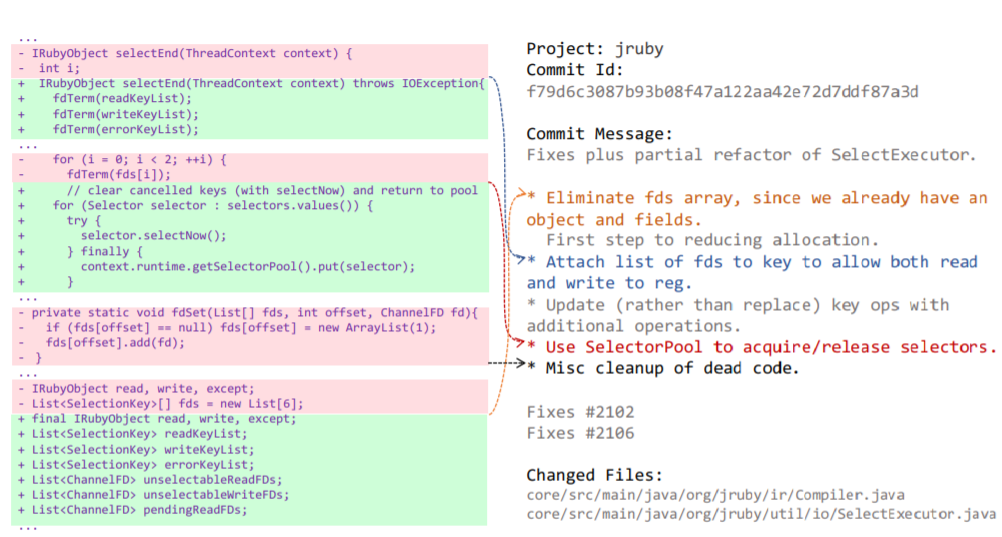
In collaborative software development, it is considered to be a best practice to submit code changes as a sequence of cohesive commits, each of which records the work result of a specific development activity, such as adding a new feature, bug fixing, and refactoring. However, rather than following this best practice, developers often submit a set of loosely-related changes serving for different development activities as a composite commit, due to the tedious manual work and lack of effective tool support to decompose such a tangled changeset.
Composite commits often obfuscate the change history of software artifacts and bring challenges to efficient collaboration among developers. To encourage activity-oriented commits, we propose SmartCommit, a graph-partitioning-based interactive approach to tangled changeset decomposition that leverages not only the efficiency of algorithms but also the knowledge of developers. To evaluate the effectiveness of our approach, we (1) deployed SmartCommit in an international IT company, and analyzed usage data collected from a field study with 83 engineers over 9 months; and (2) conducted a controlled experiment on 3,000 synthetic composite commits from 10 diverse open-source projects.
Results show that SmartCommit achieves a median accuracy between 71–84% when decomposing composite commits without developer involvement, and significantly helps developers follow the best practice of submitting activity-oriented commits with acceptable interaction effort and time cost in real collaborative software development.
Ultrafast all-optical modulation of wide-bandwidth pulses enabled by silicon-metasurfaces
Kaloyan Georgiev, Khosro Zangeneh Kamali, Anton A. Trifonov, Giulia Crotti, Lyuben Petrov, Stefan Georgiev, Hristo Iliev, Lei Xu, Unai Arregui Leon, Mohsen Rahmani, Giuseppe Della Valle, Ivan Buchvarov, Dragomir Neshev
Opto-Electronic Advances
2026-09-15
Physics-informed neural fields enable blind aberration correction for partially coherent quantitative phase imaging
Shun Zhou, Xingyu Huang, Linpeng Lu, Habib Ullah, Kaiyu Du, Maciej Trusiak, Malgorzata Kujawinska, Yuzhen Zhang, Yao Fan, Qian Chen, Qinrong Zhang, Chao Zuo
Opto-Electronic Science
2026-08-26
Heterogeneously integrated micro-ring with SnS₂ for dual-functional optical modulation and photodetection
Jinyi Du, Lidan Lu, Xu Zhang, Bofei Zhu, Wenbo Bo, Yingjie Xu, Guang Chen, Yanlin He, Guanghui Ren, Xiaoping Lou, Zheng You, Lianqing Zhu
Opto-Electronic Advances
2026-08-25
Hardware-aware lightweight photonic spiking neural network for pattern classification
Shuiying Xiang, Yahui Zhang, Shangxuan Shi, Haowen Zhao, Dianzhuang Zheng, Xingxing Guo, Yanan Han, Ye Tian, Liyue Zhang, Yuechun Shi, Yue Hao
Opto-Electronic Advances
2026-08-25
PhyspeNet: An empirical physics-aware network for adaptive speckle reconstructive spectrometry
Junrui Liang, Min Jiang, Jun Li, Zhongming Huang, Junhong He, Yanting Guo, Yanzhao Ke, Jun Ye, Jiangming Xu, Jinyong Leng, Pu Zhou
Opto-Electronic Advances
2026-08-25
A 36 × 240 Gbps hybrid mode/wavelength division multiplexing transmitter using lithium niobate on insulator
Mingyu Zhu, Weihan Wang, Ruitao Ma, Aoyun Gao, Chun Gao, Zexu Wang, Fei Huang, Zhenyuan Bao, Dajian Liu, Jiaxuan Gan, Zejie Yu, Huan Li, Weike Zhao, Daoxin Dai
Opto-Electronic Advances
2026-08-25