(Peer-Reviewed) Femtosecond laser rapid customization of high-performance anti-reflection windows
Yulong Ding 丁玉龙 ¹, Xiang Jiang 江翔 ¹, Cong Wang 王聪 ¹, Xianshi Jia 贾贤石 ¹, Linpeng Liu 刘林鹏 ¹, Weina Han 韩伟娜 ², Zheng Gao 高政 ¹, Shiyu Wang 王世钰 ¹, Nai Lin 林奈 ³, Dejin Yan 阎德劲 ³, Ji'an Duan 段吉安 ¹
¹ State Key Laboratory of Precision Manufacturing for Extreme Service Performance, College of Mechanical and Electrical Engineering, Central South University, Changsha 410083, China
中国 长沙 中南大学机电学院极端服役性能精准制造全国重点实验室
² Laser Micro/Nano Fabrication Laboratory, School of Mechanical Engineering, Beijing Institute of Technology, Beijing 100081, China
中国 北京 北京理工大学机械与车辆学院激光微纳制造研究所
³ The 10th Research Institute of CETC, Chengdu 610036, China
中国 成都 中国电子科技集团公司第十研究所
Opto-Electronic Science
, 2026-04-23
Abstract
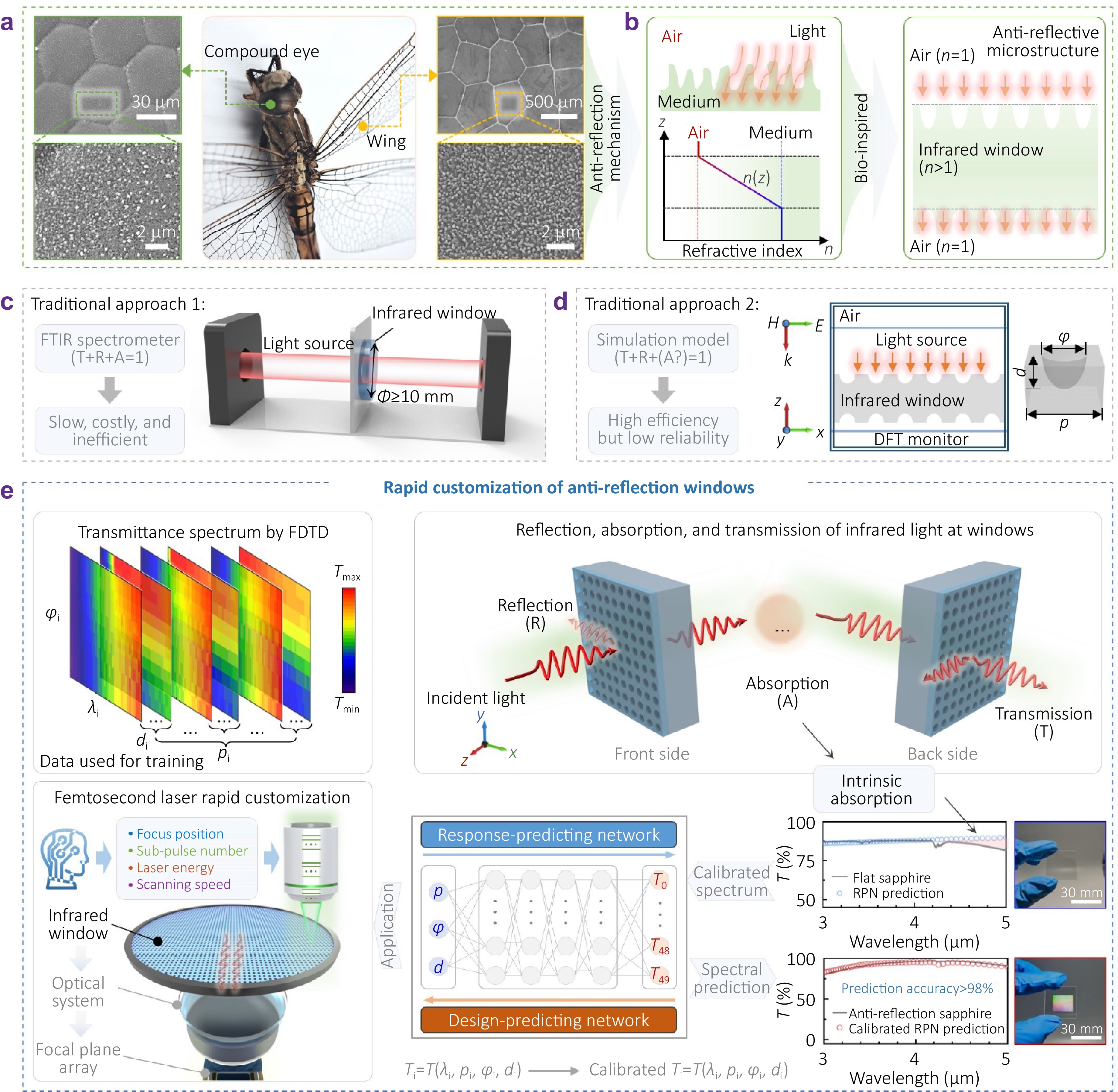
Bionic anti-reflection windows are critical for enhancing the performance of aerospace infrared detection systems. The manufacturing of anti-reflective microstructures (ARMs), however, faces a significant challenge that the transmittance spectrum is difficult to predict both accurately and swiftly, leading to long-term reliance on blind and inefficient trial-and-error for process optimization. Here, we report a method that integrates machine learning (ML) with femtosecond laser for the rapid customization of high-performance anti-reflection windows.
Embedding of the material’s absorption characteristics as a physical constraint into the ML model enables highly accurate prediction across an ultra-broad transmittance spectrum, overcoming the failure of conventional simulations in these intrinsic absorption bands. The trained ML model serves as an intelligent agent to guide the precise control over multiple femtosecond laser parameters, thus converting the costly process of physical trial-and-error into one of efficient virtual screening and iteration.
As a proof of concept, an anti-reflective sapphire window was produced that demonstrates broadband (3.3–6.0 μm) and high transmittance (~96.8% peak at 4.2 μm), along with excellent wide-angle characteristics, mechanical wear resistance, and high-quality imaging capability. This work provides a novel paradigm for rapidly manufacturing high-performance anti-reflective windows, laying the foundation for next-generation optical components.
Ultrafast all-optical modulation of wide-bandwidth pulses enabled by silicon-metasurfaces
Kaloyan Georgiev, Khosro Zangeneh Kamali, Anton A. Trifonov, Giulia Crotti, Lyuben Petrov, Stefan Georgiev, Hristo Iliev, Lei Xu, Unai Arregui Leon, Mohsen Rahmani, Giuseppe Della Valle, Ivan Buchvarov, Dragomir Neshev
Opto-Electronic Advances
2026-09-15
Physics-informed neural fields enable blind aberration correction for partially coherent quantitative phase imaging
Shun Zhou, Xingyu Huang, Linpeng Lu, Habib Ullah, Kaiyu Du, Maciej Trusiak, Malgorzata Kujawinska, Yuzhen Zhang, Yao Fan, Qian Chen, Qinrong Zhang, Chao Zuo
Opto-Electronic Science
2026-08-26
Heterogeneously integrated micro-ring with SnS₂ for dual-functional optical modulation and photodetection
Jinyi Du, Lidan Lu, Xu Zhang, Bofei Zhu, Wenbo Bo, Yingjie Xu, Guang Chen, Yanlin He, Guanghui Ren, Xiaoping Lou, Zheng You, Lianqing Zhu
Opto-Electronic Advances
2026-08-25
Hardware-aware lightweight photonic spiking neural network for pattern classification
Shuiying Xiang, Yahui Zhang, Shangxuan Shi, Haowen Zhao, Dianzhuang Zheng, Xingxing Guo, Yanan Han, Ye Tian, Liyue Zhang, Yuechun Shi, Yue Hao
Opto-Electronic Advances
2026-08-25
PhyspeNet: An empirical physics-aware network for adaptive speckle reconstructive spectrometry
Junrui Liang, Min Jiang, Jun Li, Zhongming Huang, Junhong He, Yanting Guo, Yanzhao Ke, Jun Ye, Jiangming Xu, Jinyong Leng, Pu Zhou
Opto-Electronic Advances
2026-08-25
A 36 × 240 Gbps hybrid mode/wavelength division multiplexing transmitter using lithium niobate on insulator
Mingyu Zhu, Weihan Wang, Ruitao Ma, Aoyun Gao, Chun Gao, Zexu Wang, Fei Huang, Zhenyuan Bao, Dajian Liu, Jiaxuan Gan, Zejie Yu, Huan Li, Weike Zhao, Daoxin Dai
Opto-Electronic Advances
2026-08-25