(Peer-Reviewed) Giant magneto field effect in up-conversion amplified spontaneous emission via spatially extended states in organic-inorganic hybrid perovskites
Tangyao Shen 沈唐尧 ¹, Jiajun Qin ², Yujie Bai 白玉杰 ¹, Jia Zhang ³, Lei Shi 石磊 ¹, Xiaoyuan Hou 侯晓远 ¹, Jian Zi 资剑 ¹, Bin Hu 胡斌 ³
¹ Department of Physics, Fudan University, Shanghai 200433, China
中国 上海 复旦大学物理系
² Department of Physics, Chemistry and Biology (IFM), Linköping University, Linköping 58183, Sweden
³ Department of Materials Science and Engineering, University of Tennessee, Knoxville, Tennessee 37996, USA
Opto-Electronic Advances
, 2022-02-28
Abstract
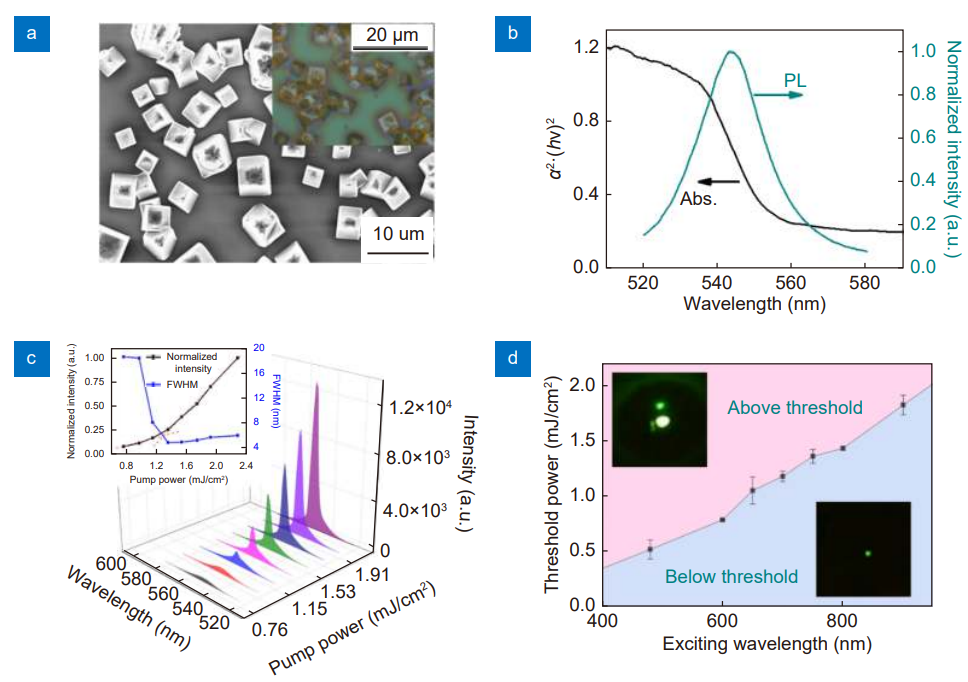
Up-conversion lasing actions are normally difficult to realize in light-emitting materials due to small multi-photon absorption cross section and fast dephasing of excited states during multi-photon excitation. This paper reports an easily accessible up-conversion amplified spontaneous emission (ASE) in organic-inorganic hybrid perovskites (MAPbBr3) films by optically exciting broad gap states with sub-bandgap laser excitation.
The broad absorption was optimized by adjusting the grain sizes in the MAPbBr₃ films. At low sub-bandgap pumping intensities, directly exciting the gap states leads to 2-photon, 3-photon, and 4-photon up-conversion spontaneous emission, revealing a large optical cross section of multi-photon excitation occurring in such hybrid perovskite films. At moderate pumping intensity (1.19 mJ/cm²) of 700 nm laser excitation, a significant spectral narrowing phenomenon was observed with the full width at half maximum (FWHM) decreasing from 18 nm to 4 nm at the peak wavelength of 550 nm, simultaneously with a nonlinear increase on spectral peak intensity, showing an up-conversion ASE realized at low threshold pumping fluence.
More interestingly, the up-conversion ASE demonstrated a giant magnetic field effect, leading to a magneto-ASE reaching 120%. In contrast, the up-conversion photoluminescence (PL) showed a negligible magnetic field effect (< 1%). This observation provides an evidence to indicate that the light-emitting states responsible for up-conversion ASE are essentially formed as spatially extended states.
The angular dependent spectrum results further verify the existence of spatially extended states which are polarized to develop coherent in-phase interaction. Clearly, using broad gap states with spatially extended light-emitting states presents a new approach to develop up-conversion ASE in organic-inorganic hybrid perovskites.
Ultrafast all-optical modulation of wide-bandwidth pulses enabled by silicon-metasurfaces
Kaloyan Georgiev, Khosro Zangeneh Kamali, Anton A. Trifonov, Giulia Crotti, Lyuben Petrov, Stefan Georgiev, Hristo Iliev, Lei Xu, Unai Arregui Leon, Mohsen Rahmani, Giuseppe Della Valle, Ivan Buchvarov, Dragomir Neshev
Opto-Electronic Advances
2026-09-15
Physics-informed neural fields enable blind aberration correction for partially coherent quantitative phase imaging
Shun Zhou, Xingyu Huang, Linpeng Lu, Habib Ullah, Kaiyu Du, Maciej Trusiak, Malgorzata Kujawinska, Yuzhen Zhang, Yao Fan, Qian Chen, Qinrong Zhang, Chao Zuo
Opto-Electronic Science
2026-08-26
Heterogeneously integrated micro-ring with SnS₂ for dual-functional optical modulation and photodetection
Jinyi Du, Lidan Lu, Xu Zhang, Bofei Zhu, Wenbo Bo, Yingjie Xu, Guang Chen, Yanlin He, Guanghui Ren, Xiaoping Lou, Zheng You, Lianqing Zhu
Opto-Electronic Advances
2026-08-25
Hardware-aware lightweight photonic spiking neural network for pattern classification
Shuiying Xiang, Yahui Zhang, Shangxuan Shi, Haowen Zhao, Dianzhuang Zheng, Xingxing Guo, Yanan Han, Ye Tian, Liyue Zhang, Yuechun Shi, Yue Hao
Opto-Electronic Advances
2026-08-25
PhyspeNet: An empirical physics-aware network for adaptive speckle reconstructive spectrometry
Junrui Liang, Min Jiang, Jun Li, Zhongming Huang, Junhong He, Yanting Guo, Yanzhao Ke, Jun Ye, Jiangming Xu, Jinyong Leng, Pu Zhou
Opto-Electronic Advances
2026-08-25
A 36 × 240 Gbps hybrid mode/wavelength division multiplexing transmitter using lithium niobate on insulator
Mingyu Zhu, Weihan Wang, Ruitao Ma, Aoyun Gao, Chun Gao, Zexu Wang, Fei Huang, Zhenyuan Bao, Dajian Liu, Jiaxuan Gan, Zejie Yu, Huan Li, Weike Zhao, Daoxin Dai
Opto-Electronic Advances
2026-08-25