(Peer-Reviewed) Timeshare surface-enhanced Raman scattering platform with sensitive and quantitative mode
Qianqian Ding 丁倩倩 ¹ ² ³, Xueyan Chen 陈雪妍 ¹ ⁴, 荚耘路 Yunlu Jia ¹, 刘洪 Hong Liu ³, 张晓琛 Xiaochen Zhang ¹, Ningtao Cheng 程年生 ⁵, Shikuan Yang 杨士宽 ¹ ³
¹ Department of Medical Oncology, The First Affiliated Hospital, Zhejiang University School of Medicine, Hangzhou 310003, China
中国 杭州 浙江大学医学院附属第一医院肿瘤内科
² Institute of Micro-nano Photonic and Quantum Manipulation, School of Physics, Nanjing University of Science and Technology, Nanjing 210094, China
中国 南京 南京理工大学 微纳光子与量子调控应用研究所
³ Institute for Composites Science Innovation, School of Materials Science and Engineering, Zhejiang University, Hangzhou 310027, China
中国 杭州 浙江大学 材料科学与工程学院 功能复合材料与结构研究所
⁴ Inner Mongolia Metallic Materials Research Institute, Baotou 014030, China
中国 包头市 内蒙古金属材料研究所
⁵ School of Medicine, Zhejiang University, Hangzhou 310058, China
中国 杭州 浙江大学医学院
Opto-Electronic Advances
, 2026-01-27
Abstract
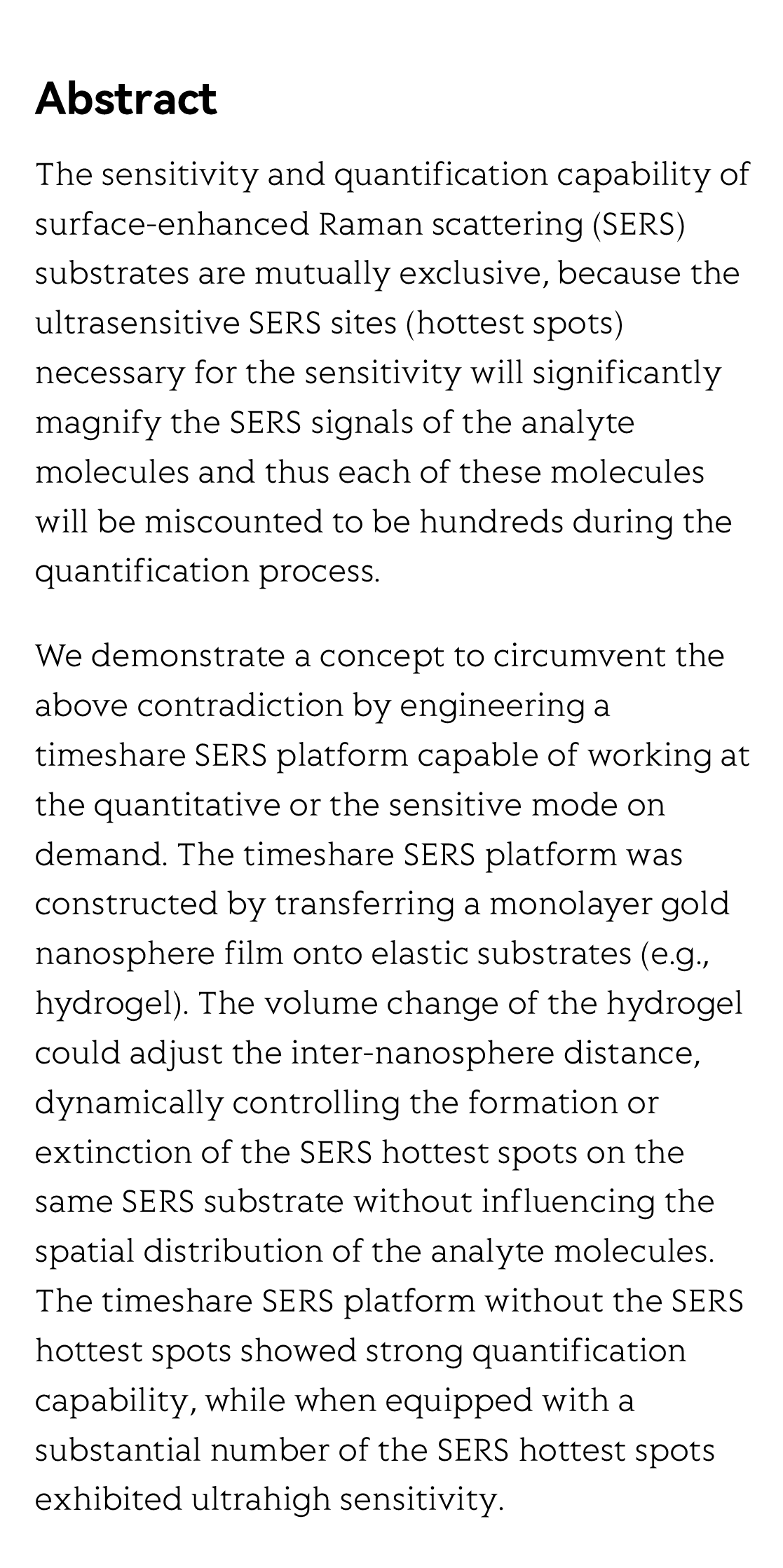
The sensitivity and quantification capability of surface-enhanced Raman scattering (SERS) substrates are mutually exclusive, because the ultrasensitive SERS sites (hottest spots) necessary for the sensitivity will significantly magnify the SERS signals of the analyte molecules and thus each of these molecules will be miscounted to be hundreds during the quantification process.
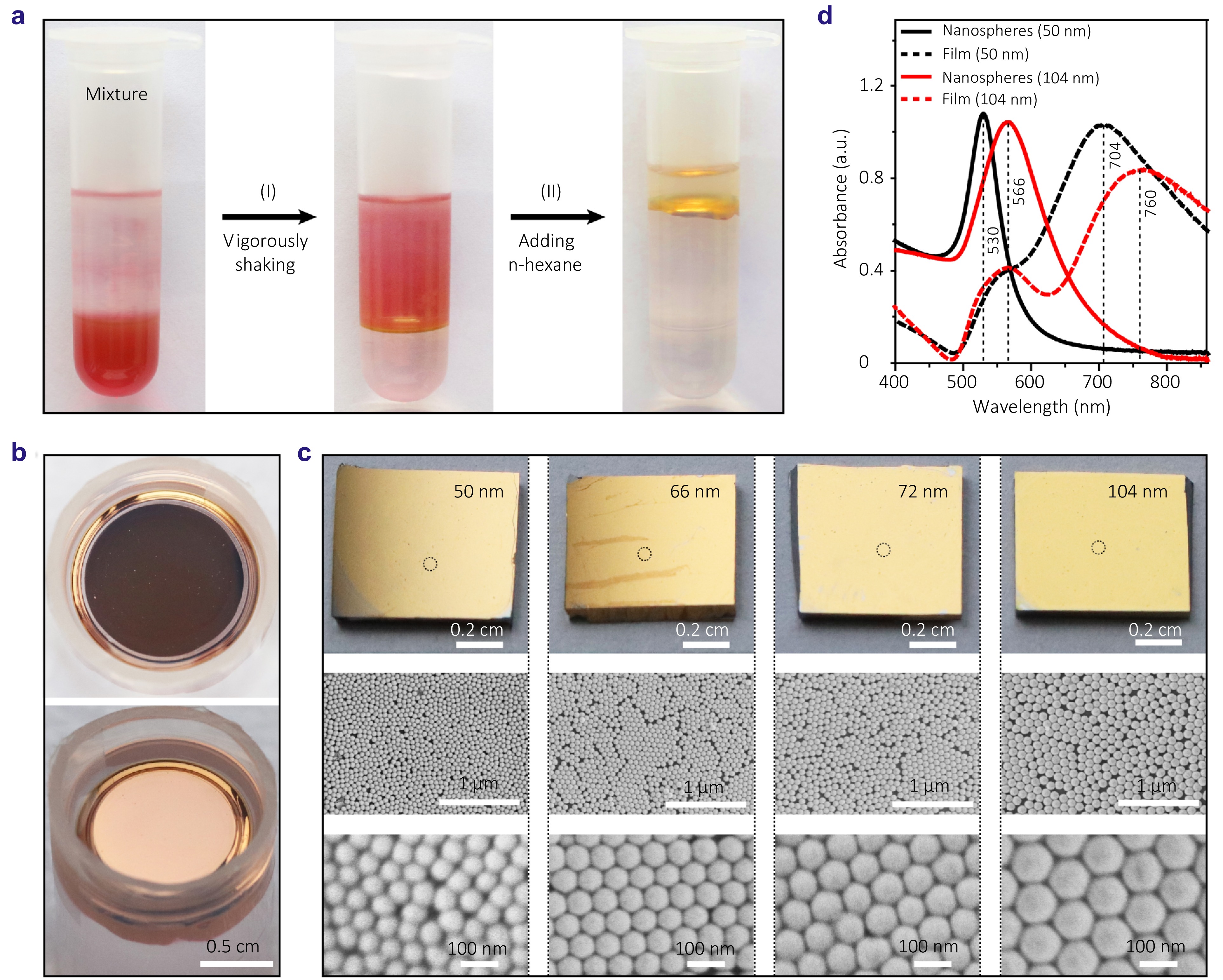
We demonstrate a concept to circumvent the above contradiction by engineering a timeshare SERS platform capable of working at the quantitative or the sensitive mode on demand. The timeshare SERS platform was constructed by transferring a monolayer gold nanosphere film onto elastic substrates (e.g., hydrogel). The volume change of the hydrogel could adjust the inter-nanosphere distance, dynamically controlling the formation or extinction of the SERS hottest spots on the same SERS substrate without influencing the spatial distribution of the analyte molecules. The timeshare SERS platform without the SERS hottest spots showed strong quantification capability, while when equipped with a substantial number of the SERS hottest spots exhibited ultrahigh sensitivity.
We demonstrated quantitative and ultrasensitive detection of various analyte molecules using the quantitative and the sensitive mode of the timeshare SERS platform, respectively. We opened an avenue towards designing SERS substrates with both high sensitivity and strong quantification capability.
Ultrafast all-optical modulation of wide-bandwidth pulses enabled by silicon-metasurfaces
Kaloyan Georgiev, Khosro Zangeneh Kamali, Anton A. Trifonov, Giulia Crotti, Lyuben Petrov, Stefan Georgiev, Hristo Iliev, Lei Xu, Unai Arregui Leon, Mohsen Rahmani, Giuseppe Della Valle, Ivan Buchvarov, Dragomir Neshev
Opto-Electronic Advances
2026-09-15
Physics-informed neural fields enable blind aberration correction for partially coherent quantitative phase imaging
Shun Zhou, Xingyu Huang, Linpeng Lu, Habib Ullah, Kaiyu Du, Maciej Trusiak, Malgorzata Kujawinska, Yuzhen Zhang, Yao Fan, Qian Chen, Qinrong Zhang, Chao Zuo
Opto-Electronic Science
2026-08-26
Heterogeneously integrated micro-ring with SnS₂ for dual-functional optical modulation and photodetection
Jinyi Du, Lidan Lu, Xu Zhang, Bofei Zhu, Wenbo Bo, Yingjie Xu, Guang Chen, Yanlin He, Guanghui Ren, Xiaoping Lou, Zheng You, Lianqing Zhu
Opto-Electronic Advances
2026-08-25
Hardware-aware lightweight photonic spiking neural network for pattern classification
Shuiying Xiang, Yahui Zhang, Shangxuan Shi, Haowen Zhao, Dianzhuang Zheng, Xingxing Guo, Yanan Han, Ye Tian, Liyue Zhang, Yuechun Shi, Yue Hao
Opto-Electronic Advances
2026-08-25
PhyspeNet: An empirical physics-aware network for adaptive speckle reconstructive spectrometry
Junrui Liang, Min Jiang, Jun Li, Zhongming Huang, Junhong He, Yanting Guo, Yanzhao Ke, Jun Ye, Jiangming Xu, Jinyong Leng, Pu Zhou
Opto-Electronic Advances
2026-08-25
A 36 × 240 Gbps hybrid mode/wavelength division multiplexing transmitter using lithium niobate on insulator
Mingyu Zhu, Weihan Wang, Ruitao Ma, Aoyun Gao, Chun Gao, Zexu Wang, Fei Huang, Zhenyuan Bao, Dajian Liu, Jiaxuan Gan, Zejie Yu, Huan Li, Weike Zhao, Daoxin Dai
Opto-Electronic Advances
2026-08-25