(Peer-Reviewed) A narrative review of glaucoma screening from fundus images
Xingxing Cao 曹星星, Xu Sun 孙旭, Shuai Yan 闫帅, Yanwu Xu 许言午
Intelligent Healthcare Unit, Baidu Inc., Beijing, China
中国 北京 百度智慧医疗事业部
Annals of Eye Science
, 2021-09-15
Abstract
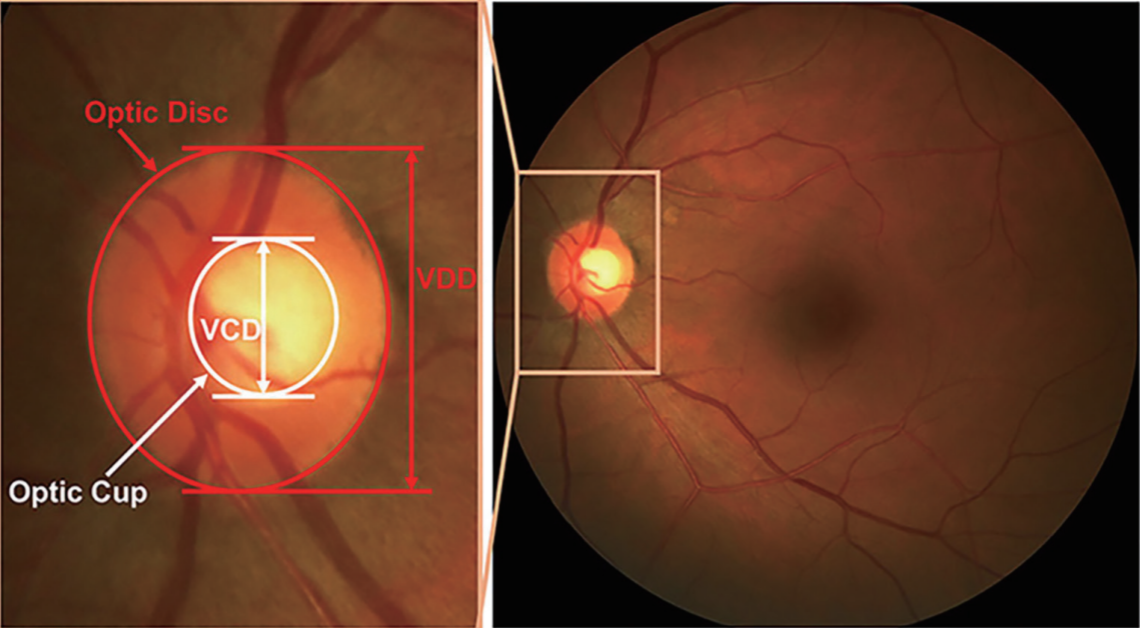
The objective of the paper is to provide a general view for automatic cup to disc ratio (CDR) assessment in fundus images. As for the cause of blindness, glaucoma ranks as the second in ocular diseases. Vision loss caused by glaucoma cannot be reversed, but the loss may be avoided if screened in the early stage of glaucoma. Thus, early screening of glaucoma is very requisite to preserve vision and maintain quality of life.
Optic nerve head (ONH) assessment is a useful and practical technique among current glaucoma screening methods. Vertical CDR as one of the clinical indicators for ONH assessment, has been well-used by clinicians and professionals for the analysis and diagnosis of glaucoma. The key for automatic calculation of vertical CDR in fundus images is the segmentation of optic cup (OC) and optic disc (OD). We take a brief description of methodologies about the OC and disc optic segmentation and comprehensively presented these methods as two aspects: hand-craft feature and deep learning feature. Sliding window regression, super-pixel level, image reconstruction, super-pixel level low-rank representation (LRR), deep learning methodologies for segmentation of OD and OC have been shown.
It is hoped that this paper can provide guidance and bring inspiration to other researchers. Every mentioned method has its advantages and limitations. Appropriate method should be selected or explored according to the actual situation. For automatic glaucoma screening, CDR is just the reflection for a small part of the disc, while utilizing comprehensive factors or multimodal images is the promising future direction to furthermore enhance the performance.
Ultrafast all-optical modulation of wide-bandwidth pulses enabled by silicon-metasurfaces
Kaloyan Georgiev, Khosro Zangeneh Kamali, Anton A. Trifonov, Giulia Crotti, Lyuben Petrov, Stefan Georgiev, Hristo Iliev, Lei Xu, Unai Arregui Leon, Mohsen Rahmani, Giuseppe Della Valle, Ivan Buchvarov, Dragomir Neshev
Opto-Electronic Advances
2026-09-15
Physics-informed neural fields enable blind aberration correction for partially coherent quantitative phase imaging
Shun Zhou, Xingyu Huang, Linpeng Lu, Habib Ullah, Kaiyu Du, Maciej Trusiak, Malgorzata Kujawinska, Yuzhen Zhang, Yao Fan, Qian Chen, Qinrong Zhang, Chao Zuo
Opto-Electronic Science
2026-08-26
Heterogeneously integrated micro-ring with SnS₂ for dual-functional optical modulation and photodetection
Jinyi Du, Lidan Lu, Xu Zhang, Bofei Zhu, Wenbo Bo, Yingjie Xu, Guang Chen, Yanlin He, Guanghui Ren, Xiaoping Lou, Zheng You, Lianqing Zhu
Opto-Electronic Advances
2026-08-25
Hardware-aware lightweight photonic spiking neural network for pattern classification
Shuiying Xiang, Yahui Zhang, Shangxuan Shi, Haowen Zhao, Dianzhuang Zheng, Xingxing Guo, Yanan Han, Ye Tian, Liyue Zhang, Yuechun Shi, Yue Hao
Opto-Electronic Advances
2026-08-25
PhyspeNet: An empirical physics-aware network for adaptive speckle reconstructive spectrometry
Junrui Liang, Min Jiang, Jun Li, Zhongming Huang, Junhong He, Yanting Guo, Yanzhao Ke, Jun Ye, Jiangming Xu, Jinyong Leng, Pu Zhou
Opto-Electronic Advances
2026-08-25
A 36 × 240 Gbps hybrid mode/wavelength division multiplexing transmitter using lithium niobate on insulator
Mingyu Zhu, Weihan Wang, Ruitao Ma, Aoyun Gao, Chun Gao, Zexu Wang, Fei Huang, Zhenyuan Bao, Dajian Liu, Jiaxuan Gan, Zejie Yu, Huan Li, Weike Zhao, Daoxin Dai
Opto-Electronic Advances
2026-08-25