(Peer-Reviewed) Photoacoustic spectroscopy and light-induced thermoelastic spectroscopy based on inverted-triangular lithium niobate tuning fork
Junjie Mu ¹ ², Guowei Han ³, Runqiu Wang ¹ ², Shunda Qiao 乔顺达 ¹ ², Ying He 何应 ¹ ², Yufei Ma 马欲飞 ¹ ²
¹ National Key Laboratory of Laser Spatial Information, Harbin Institute of Technology, Harbin 150001, China
中国 哈尔滨 哈尔滨工业大学 激光空间信息全国重点实验室
² Zhengzhou Research Institute, Harbin Institute of Technology, Zhengzhou 450008, China
中国 郑州 哈尔滨工业大学郑州高等研究院
³ Engineering Research Center for Semiconductor Integrated Technology, Institute of Semiconductors, Chinese Academy of Sciences, Beijing 100083, China
中国 北京 中国科学院半导体研究所 半导体集成技术工程研究中心
Opto-Electronic Science
, 2025-12-25
Abstract
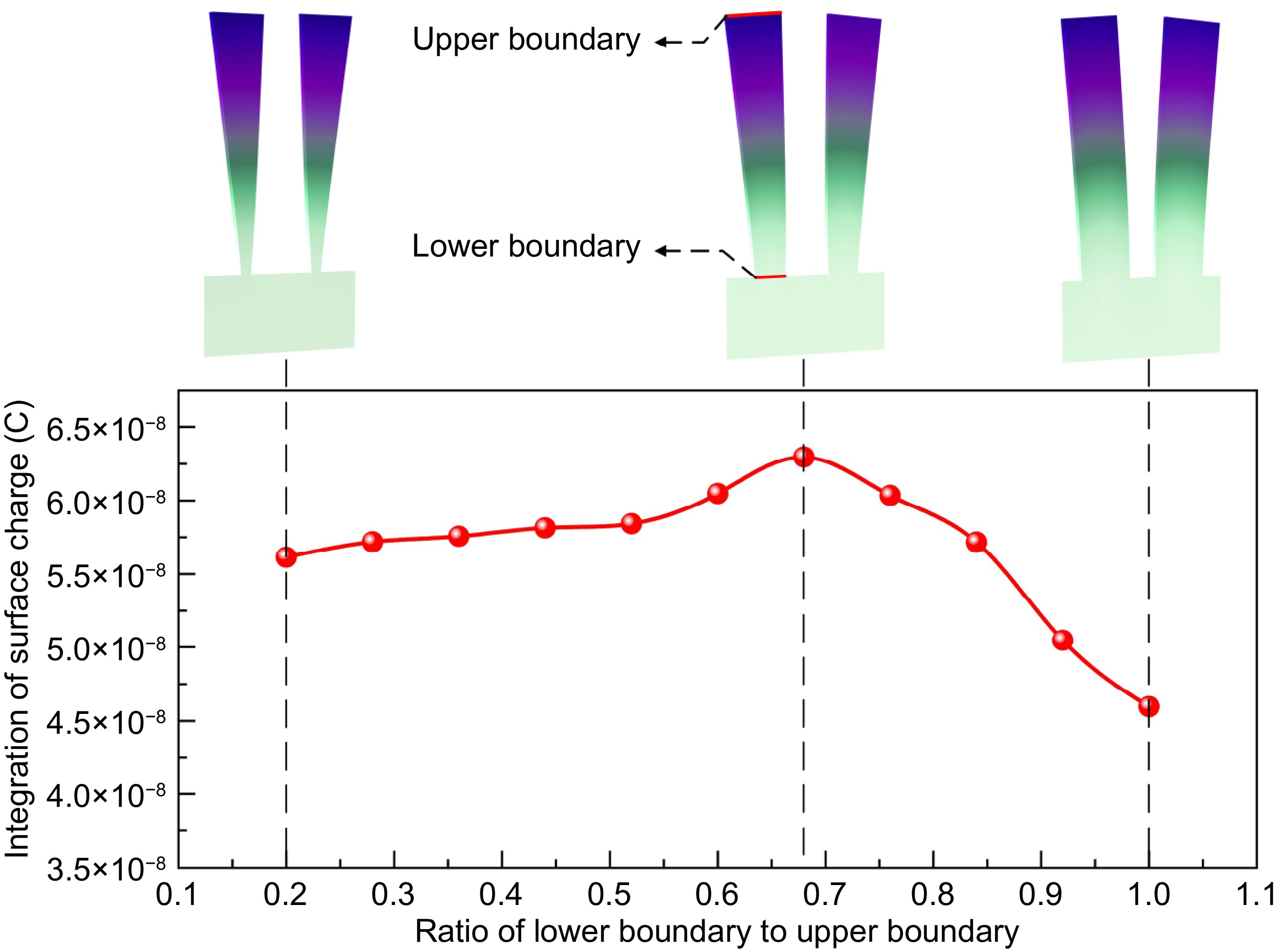
In this paper, a novel self-designed inverted-triangular lithium niobate tuning fork (LiNTF) was used to construct gas sensing system for the first time. The optimal ratio of the upper and lower boundaries of the inverted-triangular LiNTF is found by scanning through finite element analysis (FEA). The surface charge density and stress value of the inverted-triangular LiNTF are both higher than those of the standard quartz tuning fork (QTF).
In the lithium niobate-enhanced photoacoustic spectroscopy (LiNPAS) sensing system, the 2f peak and signal-to-noise ratio (SNR) of the inverted-triangular LiNTF are 7.41 times and 5.89 times those of the standard QTF, respectively. After forming acoustic standing wave field with the acoustic micro-resonator (AmR), the LiNPAS system achieves an SNR 56.16 times higher than without the AmR.
Based on Allan variance analysis, the system achieves a minimum detection limit (MDL) of 7.25 ppb with an averaging time of 800 seconds. In the light-induced thermoelastic spectroscopy (LITES) sensing system, the 2f peak and SNR of the inverted-triangular LiNTF are 7.82 times and 6.03 times those of the standard QTF, respectively. When the averaging time reaches 100 s, the MDL of the system is found to be 25.78 ppb.
Ultrafast all-optical modulation of wide-bandwidth pulses enabled by silicon-metasurfaces
Kaloyan Georgiev, Khosro Zangeneh Kamali, Anton A. Trifonov, Giulia Crotti, Lyuben Petrov, Stefan Georgiev, Hristo Iliev, Lei Xu, Unai Arregui Leon, Mohsen Rahmani, Giuseppe Della Valle, Ivan Buchvarov, Dragomir Neshev
Opto-Electronic Advances
2026-09-15
Physics-informed neural fields enable blind aberration correction for partially coherent quantitative phase imaging
Shun Zhou, Xingyu Huang, Linpeng Lu, Habib Ullah, Kaiyu Du, Maciej Trusiak, Malgorzata Kujawinska, Yuzhen Zhang, Yao Fan, Qian Chen, Qinrong Zhang, Chao Zuo
Opto-Electronic Science
2026-08-26
Heterogeneously integrated micro-ring with SnS₂ for dual-functional optical modulation and photodetection
Jinyi Du, Lidan Lu, Xu Zhang, Bofei Zhu, Wenbo Bo, Yingjie Xu, Guang Chen, Yanlin He, Guanghui Ren, Xiaoping Lou, Zheng You, Lianqing Zhu
Opto-Electronic Advances
2026-08-25
Hardware-aware lightweight photonic spiking neural network for pattern classification
Shuiying Xiang, Yahui Zhang, Shangxuan Shi, Haowen Zhao, Dianzhuang Zheng, Xingxing Guo, Yanan Han, Ye Tian, Liyue Zhang, Yuechun Shi, Yue Hao
Opto-Electronic Advances
2026-08-25
PhyspeNet: An empirical physics-aware network for adaptive speckle reconstructive spectrometry
Junrui Liang, Min Jiang, Jun Li, Zhongming Huang, Junhong He, Yanting Guo, Yanzhao Ke, Jun Ye, Jiangming Xu, Jinyong Leng, Pu Zhou
Opto-Electronic Advances
2026-08-25
A 36 × 240 Gbps hybrid mode/wavelength division multiplexing transmitter using lithium niobate on insulator
Mingyu Zhu, Weihan Wang, Ruitao Ma, Aoyun Gao, Chun Gao, Zexu Wang, Fei Huang, Zhenyuan Bao, Dajian Liu, Jiaxuan Gan, Zejie Yu, Huan Li, Weike Zhao, Daoxin Dai
Opto-Electronic Advances
2026-08-25