(Peer-Reviewed) Agile cavity ringdown spectroscopy enabled by moderate optical feedback to a quantum cascade laser
Qinxue Nie ¹, Yibo Peng ², Qiheng Chen ¹, Ningwu Liu ¹, Zhen Wang ¹, Cheng Wang 王成 ², Wei Ren 任伟 ¹
¹ Department of Mechanical and Automation Engineering, The Chinese University of Hong Kong, Hong Kong SAR 999077, China
中国 香港 香港中文大学 机械与自动化工程学
² School of Information Science and Technology, ShanghaiTech University, Shanghai 201210, China
中国 上海 上海科技大学 信息科学与技术学院
Opto-Electronic Advances
, 2024-09-20
Abstract
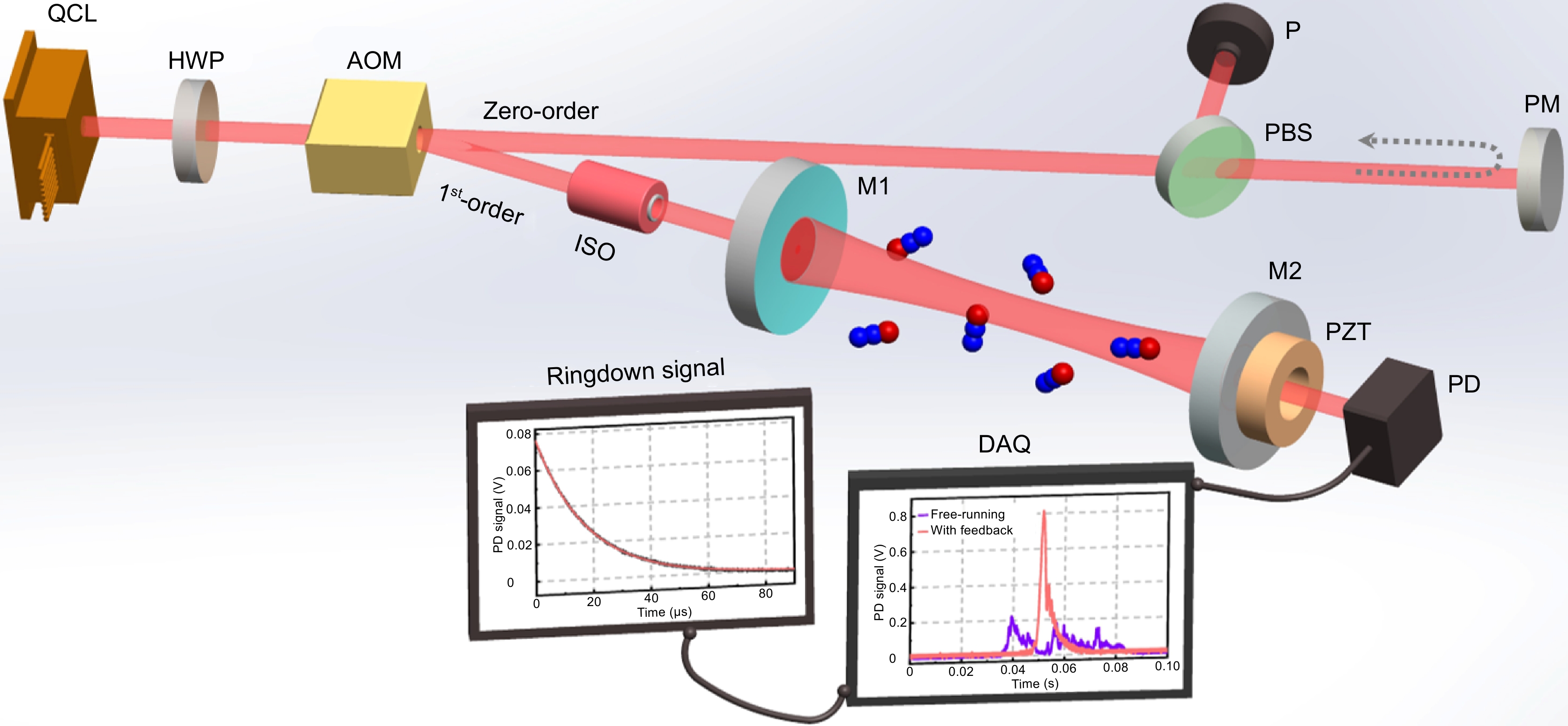
Cavity ringdown spectroscopy (CRDS), relying on measuring the decay time of photons inside a high-finesse optical cavity, offers an important analytical tool for chemistry, physics, environmental science, and biology. Through the reflection of a slight amount of phase-coherent light back to the laser source, the resonant optical feedback approach effectively couples the laser beam into the optical cavity and achieves a high signal-to-noise ratio.
However, the need for active phase-locking mechanisms complicates the spectroscopic system, limiting its primarily laboratory-based use. Here, we report how passive optical feedback can be implemented in a quantum cascade laser (QCL) based CRDS system to address this issue. Without using any phase-locking loops, we reflect a moderate amount of light (–18.2 dB) to a continuous-wave QCL simply using a fixed flat mirror, narrowing the QCL linewidth from 1.2 MHz to 170 kHz and significantly increasing the laser-cavity coupling efficiency.
To validate the method’s feasibility and effectiveness, we measured the absorption line (P(18e), 2207.62 cm−1) of N2O in a Fabry–Perot cavity with a high finesse of ~52000 and an inter-mirror distance of 33 cm. This agile approach paves the way for revolutionizing existing analytical tools by offering compact and high-fidelity mid-infrared CRDS systems.
Ultrafast all-optical modulation of wide-bandwidth pulses enabled by silicon-metasurfaces
Kaloyan Georgiev, Khosro Zangeneh Kamali, Anton A. Trifonov, Giulia Crotti, Lyuben Petrov, Stefan Georgiev, Hristo Iliev, Lei Xu, Unai Arregui Leon, Mohsen Rahmani, Giuseppe Della Valle, Ivan Buchvarov, Dragomir Neshev
Opto-Electronic Advances
2026-09-15
Physics-informed neural fields enable blind aberration correction for partially coherent quantitative phase imaging
Shun Zhou, Xingyu Huang, Linpeng Lu, Habib Ullah, Kaiyu Du, Maciej Trusiak, Malgorzata Kujawinska, Yuzhen Zhang, Yao Fan, Qian Chen, Qinrong Zhang, Chao Zuo
Opto-Electronic Science
2026-08-26
Heterogeneously integrated micro-ring with SnS₂ for dual-functional optical modulation and photodetection
Jinyi Du, Lidan Lu, Xu Zhang, Bofei Zhu, Wenbo Bo, Yingjie Xu, Guang Chen, Yanlin He, Guanghui Ren, Xiaoping Lou, Zheng You, Lianqing Zhu
Opto-Electronic Advances
2026-08-25
Hardware-aware lightweight photonic spiking neural network for pattern classification
Shuiying Xiang, Yahui Zhang, Shangxuan Shi, Haowen Zhao, Dianzhuang Zheng, Xingxing Guo, Yanan Han, Ye Tian, Liyue Zhang, Yuechun Shi, Yue Hao
Opto-Electronic Advances
2026-08-25
PhyspeNet: An empirical physics-aware network for adaptive speckle reconstructive spectrometry
Junrui Liang, Min Jiang, Jun Li, Zhongming Huang, Junhong He, Yanting Guo, Yanzhao Ke, Jun Ye, Jiangming Xu, Jinyong Leng, Pu Zhou
Opto-Electronic Advances
2026-08-25
A 36 × 240 Gbps hybrid mode/wavelength division multiplexing transmitter using lithium niobate on insulator
Mingyu Zhu, Weihan Wang, Ruitao Ma, Aoyun Gao, Chun Gao, Zexu Wang, Fei Huang, Zhenyuan Bao, Dajian Liu, Jiaxuan Gan, Zejie Yu, Huan Li, Weike Zhao, Daoxin Dai
Opto-Electronic Advances
2026-08-25