(Peer-Reviewed) Deep-ultraviolet photonics for the disinfection of SARS-CoV-2 and its variants (Delta and Omicron) in the cryogenic environment
Wenyu Kang 康闻宇 ¹, Jing Zheng 郑靖 ², Jiaxin Huang 黄家新 ¹, Lina Jiang 蒋丽娜 ², Qingna Wang 王清娜 ¹ ³, Zhinan Guo 郭志南 ², Jun Yin 尹君 ¹, Xianming Deng 邓贤明 ⁴, Ye Wang 王野 ¹, Junyong Kang 康俊勇 ¹
¹ Engineering Research Center of Micro-nano Optoelectronic Materials and Devices, Ministry of Education, Fujian Key Laboratory of Semiconductor Materials and Applications, College of Chemistry and Chemical Engineering, Pen-Tung Sah Institute of Micro-Nano Science and Technology, College of Physical Science and Technology, Xiamen University, Xiamen 361005, China
中国 厦门 厦门大学物理科学与技术学院 萨本栋微米纳米科学技术研究院 化学化工学院 福建省半导体材料及应用重点实验室 微纳光电子材料与器件教育部工程研究中心
² Xiamen Center for Disease Control and Prevention, Xiamen 361021, China
中国 厦门 厦门市疾病预防控制中心
³ Xiamen Intelligent Health Research Institute, Xiamen 361009, China
中国 厦门 厦门市智慧健康研究院
⁴ School of Life Sciences, Xiamen University, Xiamen 361005, China
中国 厦门 厦门大学生命科学学院
Opto-Electronic Advances
, 2023-09-27
Abstract
Deep-ultraviolet (DUV) disinfection technology provides an expeditious and efficient way to suppress the transmission of coronavirus disease 2019 (COVID-19). However, the influences of viral variants (Delta and Omicron) and low temperatures on the DUV virucidal efficacy are still unknown.
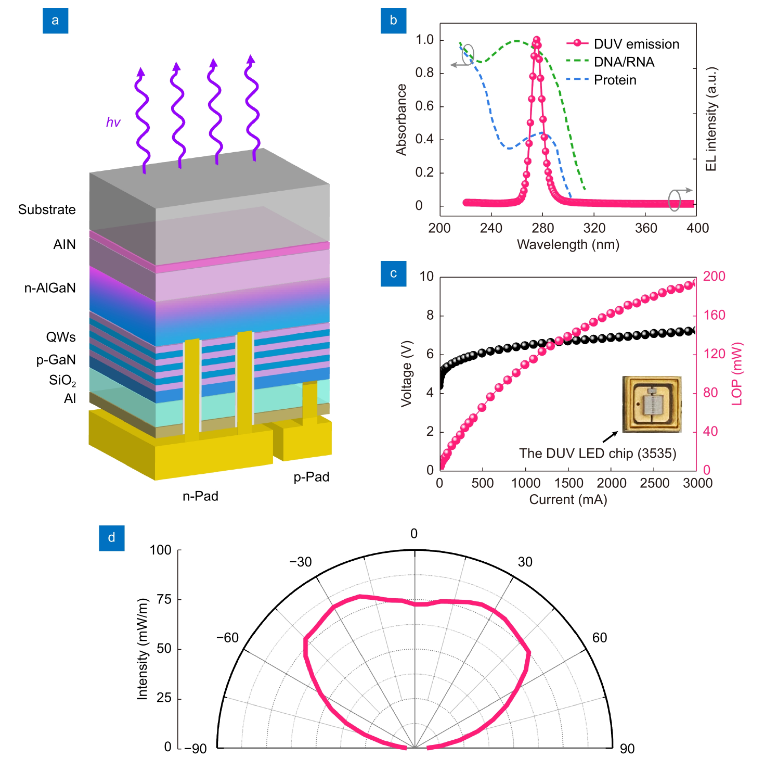
Here, we developed a reliable and uniform planar light source comprised of 275-nm light-emitting diodes (LEDs) to investigate the effects of these two unknown factors and delineated the principle behind different disinfection performances. We found the lethal effect of DUV at the same radiation dose was reduced by the cryogenic environment, and a negative-U large-relaxation model was used to explain the difference in view of the photoelectronic nature. The chances were higher in the cryogenic environment for the capture of excited electrons within active genetic molecules back to the initial photo-ionised positions.
Additionally, the variant of Omicron required a significantly higher DUV dose to achieve the same virucidal efficacy, and this was thanks to the genetic and proteinic characteristics of the Omicron. The findings in this study are important for human society using DUV disinfection in cold conditions (e.g., the food cold chain logistics and the open air in winter), and the relevant DUV disinfection suggestion against COVID-19 is provided.
Ultrafast all-optical modulation of wide-bandwidth pulses enabled by silicon-metasurfaces
Kaloyan Georgiev, Khosro Zangeneh Kamali, Anton A. Trifonov, Giulia Crotti, Lyuben Petrov, Stefan Georgiev, Hristo Iliev, Lei Xu, Unai Arregui Leon, Mohsen Rahmani, Giuseppe Della Valle, Ivan Buchvarov, Dragomir Neshev
Opto-Electronic Advances
2026-09-15
Physics-informed neural fields enable blind aberration correction for partially coherent quantitative phase imaging
Shun Zhou, Xingyu Huang, Linpeng Lu, Habib Ullah, Kaiyu Du, Maciej Trusiak, Malgorzata Kujawinska, Yuzhen Zhang, Yao Fan, Qian Chen, Qinrong Zhang, Chao Zuo
Opto-Electronic Science
2026-08-26
Heterogeneously integrated micro-ring with SnS₂ for dual-functional optical modulation and photodetection
Jinyi Du, Lidan Lu, Xu Zhang, Bofei Zhu, Wenbo Bo, Yingjie Xu, Guang Chen, Yanlin He, Guanghui Ren, Xiaoping Lou, Zheng You, Lianqing Zhu
Opto-Electronic Advances
2026-08-25
Hardware-aware lightweight photonic spiking neural network for pattern classification
Shuiying Xiang, Yahui Zhang, Shangxuan Shi, Haowen Zhao, Dianzhuang Zheng, Xingxing Guo, Yanan Han, Ye Tian, Liyue Zhang, Yuechun Shi, Yue Hao
Opto-Electronic Advances
2026-08-25
PhyspeNet: An empirical physics-aware network for adaptive speckle reconstructive spectrometry
Junrui Liang, Min Jiang, Jun Li, Zhongming Huang, Junhong He, Yanting Guo, Yanzhao Ke, Jun Ye, Jiangming Xu, Jinyong Leng, Pu Zhou
Opto-Electronic Advances
2026-08-25
A 36 × 240 Gbps hybrid mode/wavelength division multiplexing transmitter using lithium niobate on insulator
Mingyu Zhu, Weihan Wang, Ruitao Ma, Aoyun Gao, Chun Gao, Zexu Wang, Fei Huang, Zhenyuan Bao, Dajian Liu, Jiaxuan Gan, Zejie Yu, Huan Li, Weike Zhao, Daoxin Dai
Opto-Electronic Advances
2026-08-25