(Peer-Reviewed) Universal Adversarial Examples and Perturbations for Quantum Classifiers
Weiyuan Gong ¹, Dong-Ling Deng 邓东灵 ¹ ²
¹ Center for Quantum Information, IIIS, Tsinghua University, Beijing 100084, People's Republic of China 清华大学 交叉信息研究院 量子信息中心
² Shanghai Qi Zhi Institute, 41th Floor, AI Tower, No. 701 Yunjin Road, Xuhui District, Shanghai 200232, China 上海期智研究院
National Science Review
, 2021-07-22
Abstract
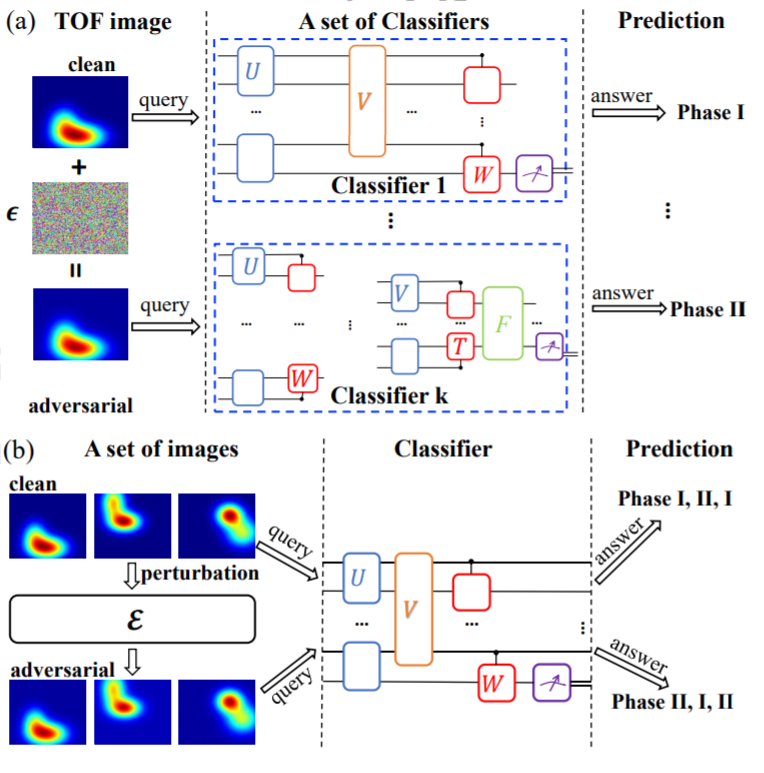
Quantum machine learning explores the interplay between machine learning and quantum physics, which may lead to unprecedented perspectives for both fields. In fact, recent works have shown strong evidences that quantum computers could outperform classical computers in solving certain notable machine learning tasks. Yet, quantum learning systems may also suffer from the vulnerability problem: adding a tiny carefully-crafted perturbation to the legitimate input data would cause the systems to make incorrect predictions at a notably high confidence level.
In this paper, we study the universality of adversarial examples and perturbations for quantum classifiers. Through concrete examples involving classifications of real-life images and quantum phases of matter, we show that there exist universal adversarial examples that can fool a set of different quantum classifiers. We prove that for a set of k classifiers with each receiving input data of n qubits, an O(ln k/2ⁿ) increase of the perturbation strength is enough to ensure a moderate universal adversarial risk.
In addition, for a given quantum classifier we show that there exist universal adversarial perturbations, which can be added to different legitimate samples and make them to be adversarial examples for the classifier.
Our results reveal the universality perspective of adversarial attacks for quantum machine learning systems, which would be crucial for practical applications of both near-term and future quantum technologies in solving machine learning problems.
Ultrafast all-optical modulation of wide-bandwidth pulses enabled by silicon-metasurfaces
Kaloyan Georgiev, Khosro Zangeneh Kamali, Anton A. Trifonov, Giulia Crotti, Lyuben Petrov, Stefan Georgiev, Hristo Iliev, Lei Xu, Unai Arregui Leon, Mohsen Rahmani, Giuseppe Della Valle, Ivan Buchvarov, Dragomir Neshev
Opto-Electronic Advances
2026-09-15
Physics-informed neural fields enable blind aberration correction for partially coherent quantitative phase imaging
Shun Zhou, Xingyu Huang, Linpeng Lu, Habib Ullah, Kaiyu Du, Maciej Trusiak, Malgorzata Kujawinska, Yuzhen Zhang, Yao Fan, Qian Chen, Qinrong Zhang, Chao Zuo
Opto-Electronic Science
2026-08-26
Heterogeneously integrated micro-ring with SnS₂ for dual-functional optical modulation and photodetection
Jinyi Du, Lidan Lu, Xu Zhang, Bofei Zhu, Wenbo Bo, Yingjie Xu, Guang Chen, Yanlin He, Guanghui Ren, Xiaoping Lou, Zheng You, Lianqing Zhu
Opto-Electronic Advances
2026-08-25
Hardware-aware lightweight photonic spiking neural network for pattern classification
Shuiying Xiang, Yahui Zhang, Shangxuan Shi, Haowen Zhao, Dianzhuang Zheng, Xingxing Guo, Yanan Han, Ye Tian, Liyue Zhang, Yuechun Shi, Yue Hao
Opto-Electronic Advances
2026-08-25
PhyspeNet: An empirical physics-aware network for adaptive speckle reconstructive spectrometry
Junrui Liang, Min Jiang, Jun Li, Zhongming Huang, Junhong He, Yanting Guo, Yanzhao Ke, Jun Ye, Jiangming Xu, Jinyong Leng, Pu Zhou
Opto-Electronic Advances
2026-08-25
A 36 × 240 Gbps hybrid mode/wavelength division multiplexing transmitter using lithium niobate on insulator
Mingyu Zhu, Weihan Wang, Ruitao Ma, Aoyun Gao, Chun Gao, Zexu Wang, Fei Huang, Zhenyuan Bao, Dajian Liu, Jiaxuan Gan, Zejie Yu, Huan Li, Weike Zhao, Daoxin Dai
Opto-Electronic Advances
2026-08-25