(Peer-Reviewed) High-Q resonances governed by the quasi-bound states in the continuum in all-dielectric metasurfaces
Cizhe Fang 方慈浙 ¹, Qiyu Yang ¹, Qingchen Yuan 元晴晨 ², Xuetao Gan 甘雪涛 ², Jianlin Zhao 赵建林 ², Yao Shao 邵瑶 ³, Yan Liu 刘艳 ¹, Genquan Han 韩根全 ¹, Yue Hao 郝跃 ¹
¹ State Key Discipline Laboratory of Wide Band Gap Semiconductor Technology, Shaanxi Joint Key Laboratory of Graphene, School of Microelectronics, Xidian University, Xi'an 710071, China
中国 西安 西安电子科技大学微电子学院 宽带隙半导体技术国家重点学科实验室 陕西省石墨烯联合实验室
² MOE Key Laboratory of Material Physics and Chemistry under Extraordinary Conditions, and Shaanxi Key Laboratory of Optical Information Technology, School of Physical Science and Technology, Northwestern Polytechnical University, Xi'an 710129, China
中国 西安 西北工业大学物理科学与技术学院 超常条件材料物理与化学教育部重点实验室 陕西省光信息技术重点实验室
³ Shanghai Energy Internet Research Institute of State Grid, 251 Libing Road, Pudong New Area, Shanghai 201210, China
中国 上海 国网上海能源互联网研究院
Opto-Electronic Advances
, 2021-06-20
Abstract
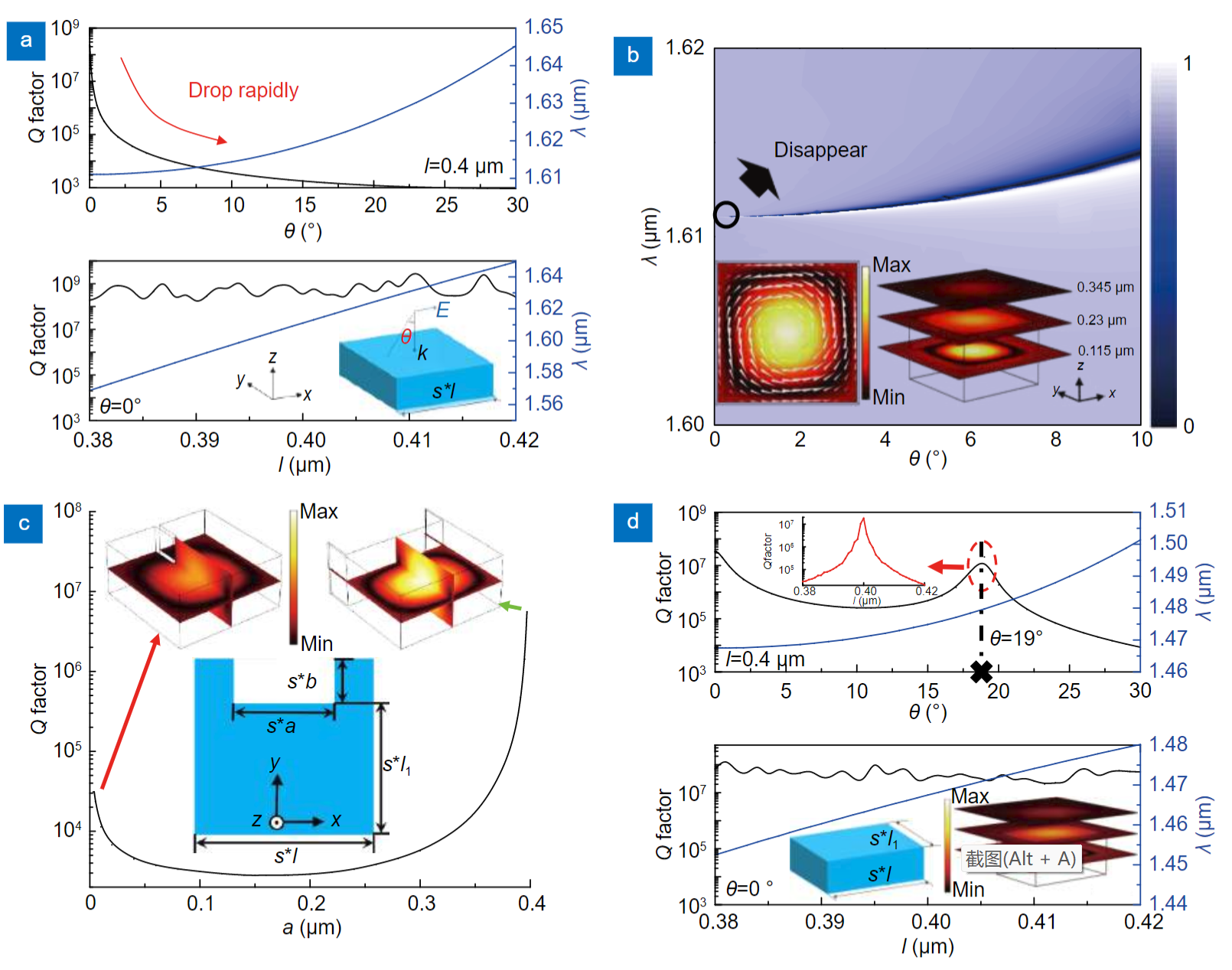
The realization of high-Q resonances in a silicon metasurface with various broken-symmetry blocks is reported. Theoretical analysis reveals that the sharp resonances in the metasurfaces originate from symmetry-protected bound in the continuum (BIC) and the magnetic dipole dominates these peculiar states. A smaller size of the defect in the broken-symmetry block gives rise to the resonance with a larger Q factor.
Importantly, this relationship can be tuned by changing the structural parameter, resulting from the modulation of the topological configuration of BICs. Consequently, a Q factor of more than 3,000 can be easily achieved by optimizing dimensions of the nanostructure. At this sharp resonance, the intensity of the third harmonic generation signal in the patterned structure can be 368 times larger than that of the flat silicon film.
The proposed strategy and underlying theory can open up new avenues to realize ultrasharp resonances, which may promote the development of the potential meta-devices for nonlinearity, lasing action, and sensing.
Ultrafast all-optical modulation of wide-bandwidth pulses enabled by silicon-metasurfaces
Kaloyan Georgiev, Khosro Zangeneh Kamali, Anton A. Trifonov, Giulia Crotti, Lyuben Petrov, Stefan Georgiev, Hristo Iliev, Lei Xu, Unai Arregui Leon, Mohsen Rahmani, Giuseppe Della Valle, Ivan Buchvarov, Dragomir Neshev
Opto-Electronic Advances
2026-09-15
Physics-informed neural fields enable blind aberration correction for partially coherent quantitative phase imaging
Shun Zhou, Xingyu Huang, Linpeng Lu, Habib Ullah, Kaiyu Du, Maciej Trusiak, Malgorzata Kujawinska, Yuzhen Zhang, Yao Fan, Qian Chen, Qinrong Zhang, Chao Zuo
Opto-Electronic Science
2026-08-26
Heterogeneously integrated micro-ring with SnS₂ for dual-functional optical modulation and photodetection
Jinyi Du, Lidan Lu, Xu Zhang, Bofei Zhu, Wenbo Bo, Yingjie Xu, Guang Chen, Yanlin He, Guanghui Ren, Xiaoping Lou, Zheng You, Lianqing Zhu
Opto-Electronic Advances
2026-08-25
Hardware-aware lightweight photonic spiking neural network for pattern classification
Shuiying Xiang, Yahui Zhang, Shangxuan Shi, Haowen Zhao, Dianzhuang Zheng, Xingxing Guo, Yanan Han, Ye Tian, Liyue Zhang, Yuechun Shi, Yue Hao
Opto-Electronic Advances
2026-08-25
PhyspeNet: An empirical physics-aware network for adaptive speckle reconstructive spectrometry
Junrui Liang, Min Jiang, Jun Li, Zhongming Huang, Junhong He, Yanting Guo, Yanzhao Ke, Jun Ye, Jiangming Xu, Jinyong Leng, Pu Zhou
Opto-Electronic Advances
2026-08-25
A 36 × 240 Gbps hybrid mode/wavelength division multiplexing transmitter using lithium niobate on insulator
Mingyu Zhu, Weihan Wang, Ruitao Ma, Aoyun Gao, Chun Gao, Zexu Wang, Fei Huang, Zhenyuan Bao, Dajian Liu, Jiaxuan Gan, Zejie Yu, Huan Li, Weike Zhao, Daoxin Dai
Opto-Electronic Advances
2026-08-25