(Peer-Reviewed) Tailoring spatiotemporal dynamics of plasmonic vortices
Xinyao Yuan 袁欣瑶 ¹, Quan Xu 许全 ¹, Yuanhao Lang 郎元灏 ¹, Xiaohan Jiang 蒋啸寒 ¹, Yuehong Xu 许悦红 ¹, Xieyu Chen 陈勰宇 ¹, Jie Han 韩洁 ¹, Xueqian Zhang 张学迁 ¹, Jiaguang Han 韩家广 ¹ ², Weili Zhang 张伟力 ³
¹ Center for Terahertz Waves and College of Precision Instrument and Optoelectronics Engineering, Tianjin University and the Key Laboratory of Optoelectronics Information and Technology (Ministry of Education), Tianjin 300072, China
中国 天津 天津大学精密仪器与光电子工程学院 太赫兹研究中心 光电信息技术教育部重点实验室
² Guangxi Key Laboratory of Optoelectronic Information Processing, School of Optoelectronic Engineering, Guilin University of Electronic Technology, Guilin 541004, China
中国 桂林 桂林电子科技大学光电工程学院 广西光电信息处理重点实验室
³ School of Electronic and Computer Engineering, Oklahoma State University, Stillwater, OK 74078, USA
Opto-Electronic Advances
, 2023-04-28
Abstract
Plasmonic vortices confining orbital angular momentums to surface have aroused wide research interest in the last decade. Recent advances of near-field microscopes have enabled the study on the spatiotemporal dynamics of plasmonic vortices, providing a better understanding of optical orbital angular momentums in the evanescent wave regime.
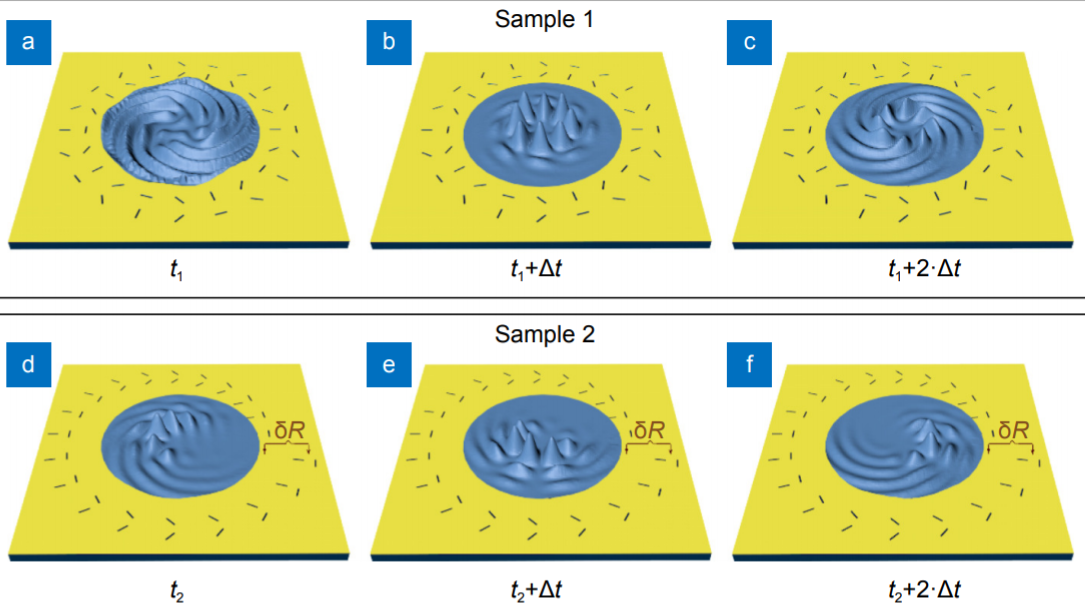
However, these works only focused on the objective characterization of plasmonic vortex and have not achieved subjectively tailoring of its spatiotemporal dynamics for specific applications. Herein, it is demonstrated that the plasmonic vortices with the same topological charge can be endowed with distinct spatiotemporal dynamics by simply changing the coupler design. Based on a near-field scanning terahertz microscopy, the surface plasmon fields are directly obtained with ultrahigh spatiotemporal resolution, experimentally exhibiting the generation and evolution divergences during the whole lifetime of plasmonic vortices.
The proposed strategy is straightforward and universal, which can be readily applied into visible or infrared frequencies, facilitating the development of plasmonic vortex related researches and applications.
Ultrafast all-optical modulation of wide-bandwidth pulses enabled by silicon-metasurfaces
Kaloyan Georgiev, Khosro Zangeneh Kamali, Anton A. Trifonov, Giulia Crotti, Lyuben Petrov, Stefan Georgiev, Hristo Iliev, Lei Xu, Unai Arregui Leon, Mohsen Rahmani, Giuseppe Della Valle, Ivan Buchvarov, Dragomir Neshev
Opto-Electronic Advances
2026-09-15
Physics-informed neural fields enable blind aberration correction for partially coherent quantitative phase imaging
Shun Zhou, Xingyu Huang, Linpeng Lu, Habib Ullah, Kaiyu Du, Maciej Trusiak, Malgorzata Kujawinska, Yuzhen Zhang, Yao Fan, Qian Chen, Qinrong Zhang, Chao Zuo
Opto-Electronic Science
2026-08-26
Heterogeneously integrated micro-ring with SnS₂ for dual-functional optical modulation and photodetection
Jinyi Du, Lidan Lu, Xu Zhang, Bofei Zhu, Wenbo Bo, Yingjie Xu, Guang Chen, Yanlin He, Guanghui Ren, Xiaoping Lou, Zheng You, Lianqing Zhu
Opto-Electronic Advances
2026-08-25
Hardware-aware lightweight photonic spiking neural network for pattern classification
Shuiying Xiang, Yahui Zhang, Shangxuan Shi, Haowen Zhao, Dianzhuang Zheng, Xingxing Guo, Yanan Han, Ye Tian, Liyue Zhang, Yuechun Shi, Yue Hao
Opto-Electronic Advances
2026-08-25
PhyspeNet: An empirical physics-aware network for adaptive speckle reconstructive spectrometry
Junrui Liang, Min Jiang, Jun Li, Zhongming Huang, Junhong He, Yanting Guo, Yanzhao Ke, Jun Ye, Jiangming Xu, Jinyong Leng, Pu Zhou
Opto-Electronic Advances
2026-08-25
A 36 × 240 Gbps hybrid mode/wavelength division multiplexing transmitter using lithium niobate on insulator
Mingyu Zhu, Weihan Wang, Ruitao Ma, Aoyun Gao, Chun Gao, Zexu Wang, Fei Huang, Zhenyuan Bao, Dajian Liu, Jiaxuan Gan, Zejie Yu, Huan Li, Weike Zhao, Daoxin Dai
Opto-Electronic Advances
2026-08-25