(Peer-Reviewed) Ultra-high-capacity full-vectorial meta-holography
Dengji He 何登极 ¹ ² ³, Yuanjian Wan 万远剑 ¹ ² ³, Yajuan Dong 董亚娟 ¹ ² ³, Yu Wang 王瑜 ¹ ² ³, Xiaotong Zhu 朱潇桐 ¹ ² ³, Tao Wang 王涛 ¹ ² ³, Jinwei Zeng 曾进炜 ¹ ² ³, Jian Wang 王健 ¹ ² ³
¹ Wuhan National Laboratory for Optoelectronics and School of Optical and Electronic Information, Huazhong University of Science and Technology, Wuhan, 430074, China
中国 武汉 华中科技大学光学与电子信息学院 武汉光电国家研究中心
² Hubei Optical Fundamental Research Center, Wuhan 430074, China
中国 武汉 湖北省光学基础学科研究中心
³ Optics Valley Laboratory, Wuhan 430074, China
中国 武汉 湖北光谷实验室
Opto-Electronic Advances
, 2026-03-24
Abstract
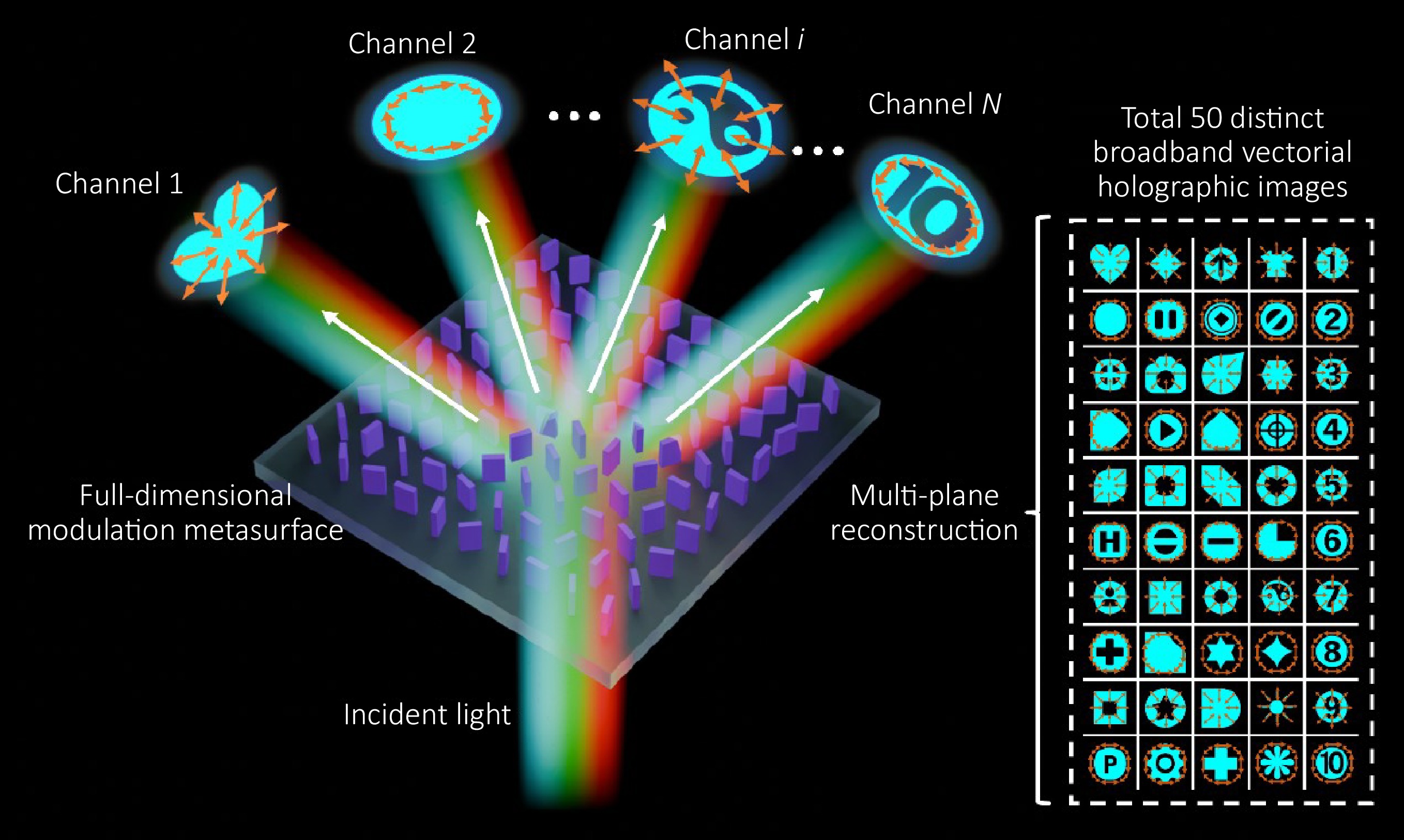
Vectorial metasurface holography is a powerful technique that relies on full-dimensional modulation of optical fields to realize its full potential, laying the foundation for encoding vast amounts of optical information and enhancing optical encryption. However, current methods for achieving such modulation remain challenging, as they typically require tuning multiple structural parameters or employing multilayer metasurfaces to provide sufficient degrees of control.
Here, we propose a broadband full-vectorial meta-holography (BFVM) strategy based on a purely dielectric geometric-phase metasurface, which achieves complete control over the amplitude, phase, inhomogeneous polarization, and position of light solely by varying the rotation angles of the meta-units. This approach not only enables the generation of full-vectorial holographic images with complete Stokes polarization distributions, but also supports the creation of up to 50 distinct, ultra-high-capacity vectorial holograms, each encoding a designed polarization structure with spatial variation.
These structured polarization states can serve as a previously overlooked degree of freedom for enhancing holographic storage. This advancement expands the frontier of vectorial holography, paving the way for next-generation full-vectorial beam shaping, full-color holographic displays, and immersive AR/VR technologies.
Ultrafast all-optical modulation of wide-bandwidth pulses enabled by silicon-metasurfaces
Kaloyan Georgiev, Khosro Zangeneh Kamali, Anton A. Trifonov, Giulia Crotti, Lyuben Petrov, Stefan Georgiev, Hristo Iliev, Lei Xu, Unai Arregui Leon, Mohsen Rahmani, Giuseppe Della Valle, Ivan Buchvarov, Dragomir Neshev
Opto-Electronic Advances
2026-09-15
Physics-informed neural fields enable blind aberration correction for partially coherent quantitative phase imaging
Shun Zhou, Xingyu Huang, Linpeng Lu, Habib Ullah, Kaiyu Du, Maciej Trusiak, Malgorzata Kujawinska, Yuzhen Zhang, Yao Fan, Qian Chen, Qinrong Zhang, Chao Zuo
Opto-Electronic Science
2026-08-26
Heterogeneously integrated micro-ring with SnS₂ for dual-functional optical modulation and photodetection
Jinyi Du, Lidan Lu, Xu Zhang, Bofei Zhu, Wenbo Bo, Yingjie Xu, Guang Chen, Yanlin He, Guanghui Ren, Xiaoping Lou, Zheng You, Lianqing Zhu
Opto-Electronic Advances
2026-08-25
Hardware-aware lightweight photonic spiking neural network for pattern classification
Shuiying Xiang, Yahui Zhang, Shangxuan Shi, Haowen Zhao, Dianzhuang Zheng, Xingxing Guo, Yanan Han, Ye Tian, Liyue Zhang, Yuechun Shi, Yue Hao
Opto-Electronic Advances
2026-08-25
PhyspeNet: An empirical physics-aware network for adaptive speckle reconstructive spectrometry
Junrui Liang, Min Jiang, Jun Li, Zhongming Huang, Junhong He, Yanting Guo, Yanzhao Ke, Jun Ye, Jiangming Xu, Jinyong Leng, Pu Zhou
Opto-Electronic Advances
2026-08-25
A 36 × 240 Gbps hybrid mode/wavelength division multiplexing transmitter using lithium niobate on insulator
Mingyu Zhu, Weihan Wang, Ruitao Ma, Aoyun Gao, Chun Gao, Zexu Wang, Fei Huang, Zhenyuan Bao, Dajian Liu, Jiaxuan Gan, Zejie Yu, Huan Li, Weike Zhao, Daoxin Dai
Opto-Electronic Advances
2026-08-25