(Peer-Reviewed) Tailoring temperature response for a multimode fiber
Han Gao 高涵 ¹ ², Haifeng Hu 胡海峰 ¹ ³ ⁴, Qiwen Zhan 詹其文 ¹ ³ ⁴
¹ School of Optical-Electrical and Computer Engineering, University of Shanghai for Science and Technology, Shanghai 200093, China
中国 上海 上海理工大学光电信息与计算机工程学院
² Institute of Modern Optics, Nankai University, Tianjin 300350, China
中国 天津 南开大学现代光学研究所
³ Zhangjiang Laboratory, 100 Haike Road, Shanghai 201204, China
中国 上海 张江实验室
⁴ Shanghai Key Lab of Modern Optical System, University of Shanghai for Science and Technology, Shanghai 200093, China
中国 上海 上海理工大学 上海市现代光学系统重点实验室
Opto-Electronic Science, 2024-08-20
Abstract
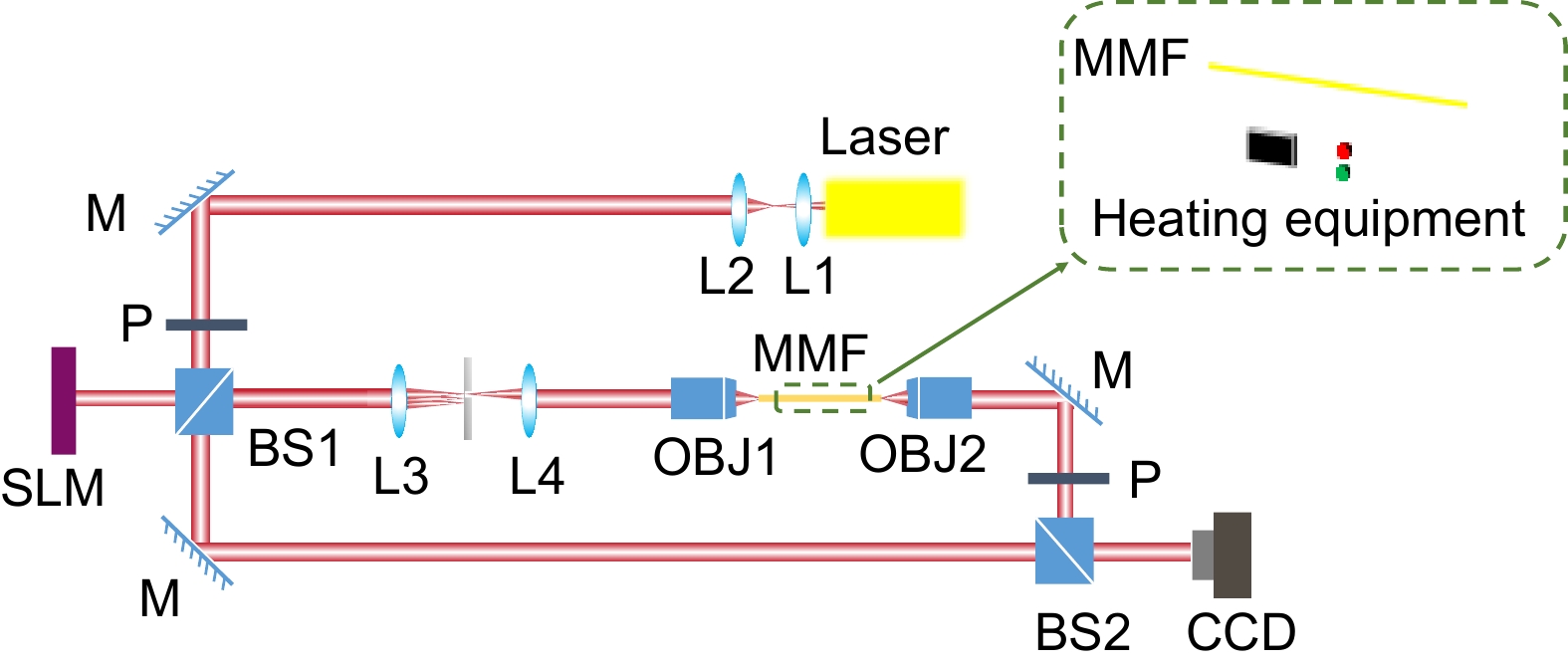
This work introduces special states for light in multimode fibers featuring strongly enhanced or reduced correlations between output fields in the presence of environmental temperature fluctuations. Using experimentally measured multi-temperature transmission matrix, a set of temperature principal modes that exhibit resilience to disturbances caused by temperature fluctuations can be generated.
Reversing this concept also allows the construction of temperature anti-principal modes, with output profiles more susceptible to temperature influences than the unmodulated wavefront. Despite changes in the length of the multimode fiber within the temperature-fluctuating region, the proposed approach remains capable of robustly controlling the temperature response within the fiber. To illustrate the practicality of the proposed special state, a learning-empowered fiber specklegram temperature sensor based on temperature anti-principal mode sensitization is proposed.
This sensor exhibits outstanding superiority over traditional approaches in terms of resolution and accuracy. These novel states are anticipated to have wide-ranging applications in fiber communication, sensing, imaging, and spectroscopy, and serve as a source of inspiration for the discovery of other novel states.
Electrically switchable bright-field and interference-synthesized edge-enhanced imaging with a polarization-multiplexed metalens
Xiaotong Li, Junhwa Seong, Yeseul Kim, Kwang-Suk Oh, Shiqi Hu, Le Dai, Harit Keawmuang, Beomha Yang, Minseok Choi, Youngsun Jeon, Cherry Park, Weiyan Li, Tianxu Jia, Han Zhu, Xiaodong Cai, Qi Zheng, Jinhui Shi, Young-Ki Kim, Yuchuan Shao, Trevon Badloe, Junsuk Rho
Opto-Electronic Science
2026-09-20
3D-printed copper water cooling system assisted fabrication of 10.6-μm high-power CO₂ laser resistance reflectors
Hongfei Jiao, Binbin Jiang, Xinshang Niu, Yifan Wang, Dongdong Li, Jun Yu, Xiaochuan Ji, Jingjing Xia, Jinlong Zhang, Xinbin Cheng, Zhanshan Wang
Opto-Electronic Advances
2026-09-15
Ultrafast all-optical modulation of wide-bandwidth pulses enabled by silicon-metasurfaces
Kaloyan Georgiev, Khosro Zangeneh Kamali, Anton A. Trifonov, Giulia Crotti, Lyuben Petrov, Stefan Georgiev, Hristo Iliev, Lei Xu, Unai Arregui Leon, Mohsen Rahmani, Giuseppe Della Valle, Ivan Buchvarov, Dragomir Neshev
Opto-Electronic Advances
2026-09-15
Physics-informed neural fields enable blind aberration correction for partially coherent quantitative phase imaging
Shun Zhou, Xingyu Huang, Linpeng Lu, Habib Ullah, Kaiyu Du, Maciej Trusiak, Malgorzata Kujawinska, Yuzhen Zhang, Yao Fan, Qian Chen, Qinrong Zhang, Chao Zuo
Opto-Electronic Science
2026-08-26