(Peer-Reviewed) Artificial intelligence-assisted chiral nanophotonic designs
Xuanru Zhang 张璇如 ¹ ² ³, Tie Jun Cui 崔铁军 ¹ ² ³
¹ State Key Laboratory of Millimeter Waves, Southeast University, Nanjing 210096, China
中国 南京 东南大学 毫米波国家重点实验室
² Institute of Electromagnetic Space, Southeast University, Nanjing 210096, China
中国 南京 东南大学 电磁空间科学与技术研究院
³ School of Information Science and Engineering, Southeast University, Nanjing 210096, China
中国 南京 东南大学 信息科学与工程学院
Opto-Electronic Advances, 2023-10-31
Abstract
Chiral nanostructures can enhance the weak inherent chiral effects of biomolecules and highlight the important roles in chiral detection. However, the design of the chiral nanostructures is challenged by extensive theoretical simulations and explorative experiments.
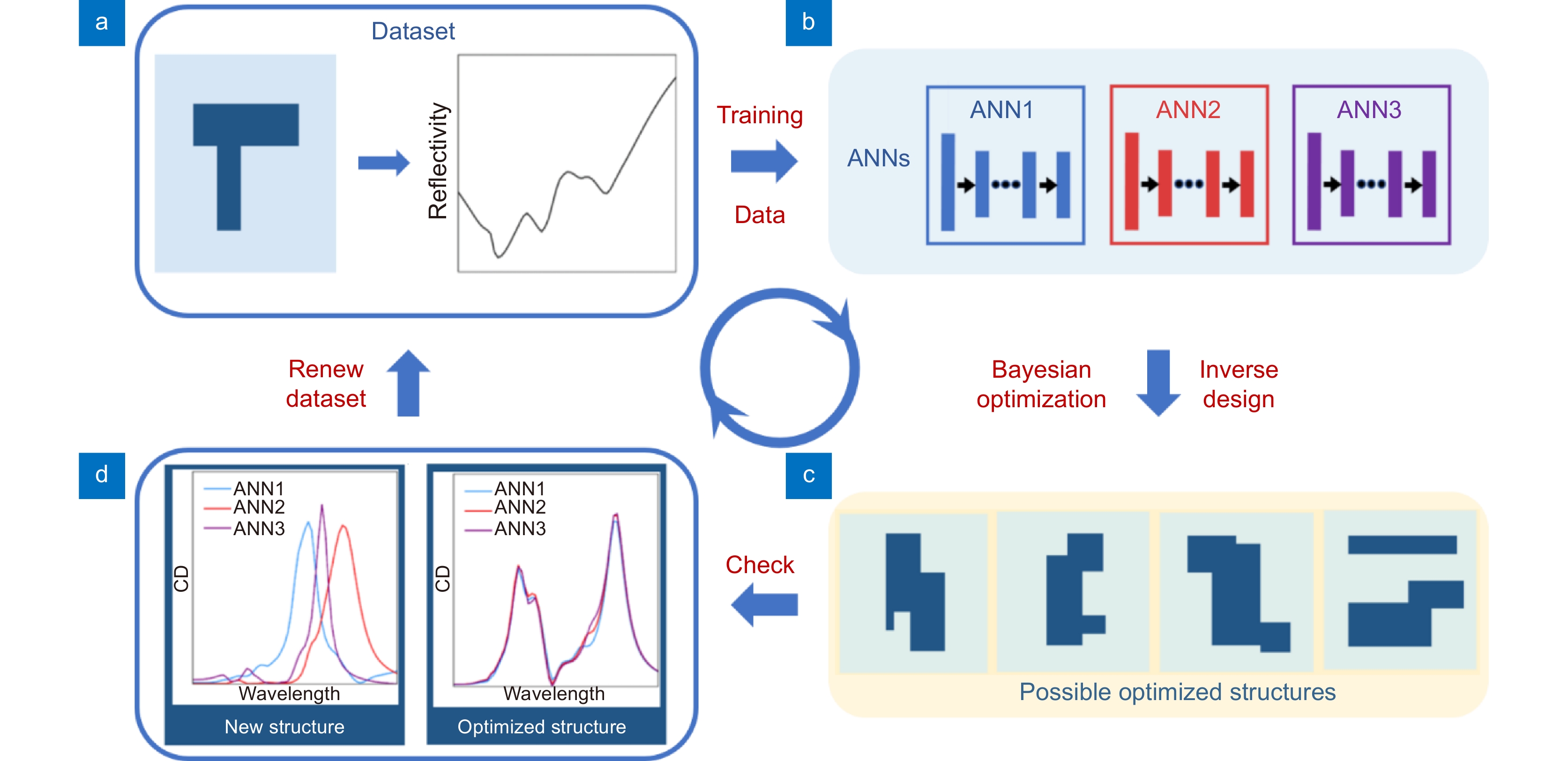
Recently, Zheyu Fang’s group proposed a chiral nanostructure design method based on reinforcement learning, which can find out metallic chiral nanostructures with a sharp peak in circular dichroism spectra and enhance the chiral detection signals. This work envisions the powerful roles of artificial intelligence in nanophotonic designs.
Electrically switchable bright-field and interference-synthesized edge-enhanced imaging with a polarization-multiplexed metalens
Xiaotong Li, Junhwa Seong, Yeseul Kim, Kwang-Suk Oh, Shiqi Hu, Le Dai, Harit Keawmuang, Beomha Yang, Minseok Choi, Youngsun Jeon, Cherry Park, Weiyan Li, Tianxu Jia, Han Zhu, Xiaodong Cai, Qi Zheng, Jinhui Shi, Young-Ki Kim, Yuchuan Shao, Trevon Badloe, Junsuk Rho
Opto-Electronic Science
2026-09-20
3D-printed copper water cooling system assisted fabrication of 10.6-μm high-power CO₂ laser resistance reflectors
Hongfei Jiao, Binbin Jiang, Xinshang Niu, Yifan Wang, Dongdong Li, Jun Yu, Xiaochuan Ji, Jingjing Xia, Jinlong Zhang, Xinbin Cheng, Zhanshan Wang
Opto-Electronic Advances
2026-09-15
Ultrafast all-optical modulation of wide-bandwidth pulses enabled by silicon-metasurfaces
Kaloyan Georgiev, Khosro Zangeneh Kamali, Anton A. Trifonov, Giulia Crotti, Lyuben Petrov, Stefan Georgiev, Hristo Iliev, Lei Xu, Unai Arregui Leon, Mohsen Rahmani, Giuseppe Della Valle, Ivan Buchvarov, Dragomir Neshev
Opto-Electronic Advances
2026-09-15
Physics-informed neural fields enable blind aberration correction for partially coherent quantitative phase imaging
Shun Zhou, Xingyu Huang, Linpeng Lu, Habib Ullah, Kaiyu Du, Maciej Trusiak, Malgorzata Kujawinska, Yuzhen Zhang, Yao Fan, Qian Chen, Qinrong Zhang, Chao Zuo
Opto-Electronic Science
2026-08-26