(Peer-Reviewed) Joint 3D facial shape reconstruction and texture completion from a single image
Xiaoxing Zeng 曾小星 ¹ ², Zhelun Wu ¹, Xiaojiang Peng 彭小江 ¹, Yu Qiao 乔宇 ¹
¹ Shenzhen Institute of Advanced Technology, ChineseAcademy of Sciences, Shenzhen, China
中国 深圳 中国科学院深圳先进技术研究院
² University of Chinese Academy of Sciences, Beijing, China
中国 北京 中国科学院大学
Abstract
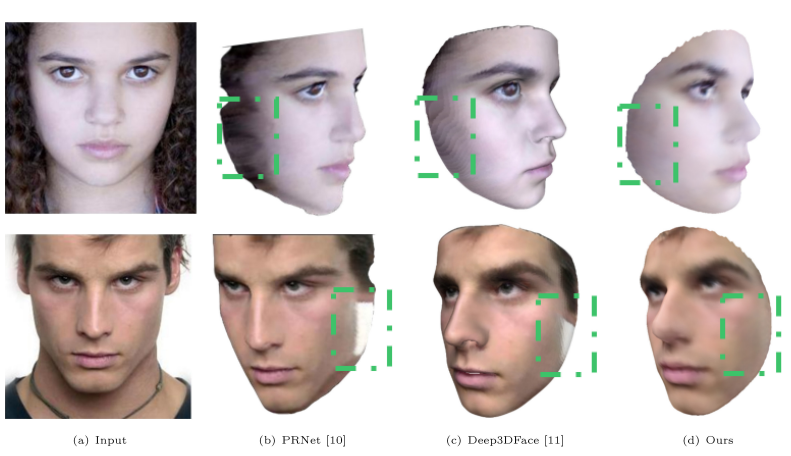
Recent years have witnessed significant progress in image-based 3D face reconstruction using deep convolutional neural networks. However, current reconstruction methods often perform improperly in self-occluded regions and can lead to inaccurate correspondences between a 2D input image and a 3D face template, hindering use in real applications. To address these problems, we propose a deep shape reconstruction and texture completion network, SRTC-Net, which jointly reconstructs 3D facial geometry and completes texture with correspondences from a single input face image.
In SRTC-Net, we leverage the geometric cues from completed 3D texture to reconstruct detailed structures of 3D shapes. The SRTC-Net pipeline has three stages. The first introduces a correspondence network to identify pixel-wise correspondence between the input 2D image and a 3D template model, and transfers the input 2D image to a U-V texture map. Then we complete the invisible and occluded areas in the U-V texture map using an inpainting network. To get the 3D facial geometries, we predict coarse shape (U-V position maps) from the segmented face from the correspondence network using a shape network, and then refine the 3D coarse shape by regressing the U-V displacement map from the completed U-V texture map in a pixel-to-pixel way.
We examine our methods on 3D reconstruction tasks as well as face frontalization and pose invariant face recognition tasks, using both in-the-lab datasets (MICC, MultiPIE) and in-the-wild datasets (CFP). The qualitative and quantitative results demonstrate the effectiveness of our methods on inferring 3D facial geometry and complete texture; they outperform or are comparable to the state-of-the-art.
Unlocking home-based nocturnal health management: A fiber-optic approach for early detection of cardiorespiratory rhythm disorders
Hanyu Jin, Hao Li, Zhuolin Chen, Liangye Li, Zurui Wang, Kai Zhou, Weijian Hang, Zhipeng Chen, Junfeng Chen, Kai Shen, Jianfeng Wen, Chen Chen, Cunzheng Fan, Zhijun Yan, Feng Wang, Qizhen Sun
Opto-Electronic Advances
2026-07-10
A flexible wireless system for prospective photodynamic therapy applications
Rolan Mansour, Bhavani Yalagala, Vikas Vikas, Nikolas Bruce, Fawziye Tarhini, Georgios N. Arvanitakis, Mohammed Mughal, Jamie Blanche, Ahmad Taha, Jonathan Copper, Muhammad Imran, Karin Williams, Karin Oien, Mahmoud Wagih, Hadi Heidari, Robert Hadfield, David Flynn
Opto-Electronic Advances
2026-07-10
Parallel bright-field and multi-order edge imaging via wide field-of-view trichannel metalens
Xiaotong Li, Yeseul Kim, Youngsun Jeon, Junhwa Seong, Jaekyung Kim, Peng Tang, Shiqi Hu, Harit Keawmuang, Beomha Yang, Dongmin Jeon, Le Dai, Weiyan Li, Xiaodong Cai, Jinhui Shi, Yong-Sang Ryu, Trevon Badloe, Junsuk Rho
Opto-Electronic Advances
2026-07-10