(Peer-Reviewed) Research progress on generating perfect vortex beams based on metasurfaces
Xiujuan Liu ¹ ², Manna Gu 顾曼娜 ³, Ying Tian 田颖 ¹, Mingfeng Zheng ⁴, Bo Fang 方波 ⁵, Zhi Hong 洪治 ² ³, Chee Leong Tan 陈子龙 ⁶, Xufeng Jing 井绪峰 ² ³
¹ Institute of Optoelectronic Technology, China Jiliang University, Hangzhou 310018, China
中国 杭州 中国计量大学光学与电子科技学院
² Centre for THz Research, China Jiliang University, Hangzhou 310018, China
中国 杭州 中国计量大学太赫兹技术与应用研究所
³ College of Information Engineering, China Jiliang University, Hangzhou 310018, China
中国 杭州 中国计量大学信息工程学院
⁴ Geely Automotive Institute, Hangzhou Vocational & Technical College, Hangzhou 310018, China
中国 杭州 杭州职业技术学院吉利汽车学院
⁵ College of Metrology & Measurement Engineering, China Jiliang University, Hangzhou 310018, China
中国 杭州 中国计量大学计量测试工程学院
⁶ Department of Electrical and Computer Engineering, Portland State University, Portland, OR 97201, USA
Opto-Electronic Science, 2025-07-09
Abstract
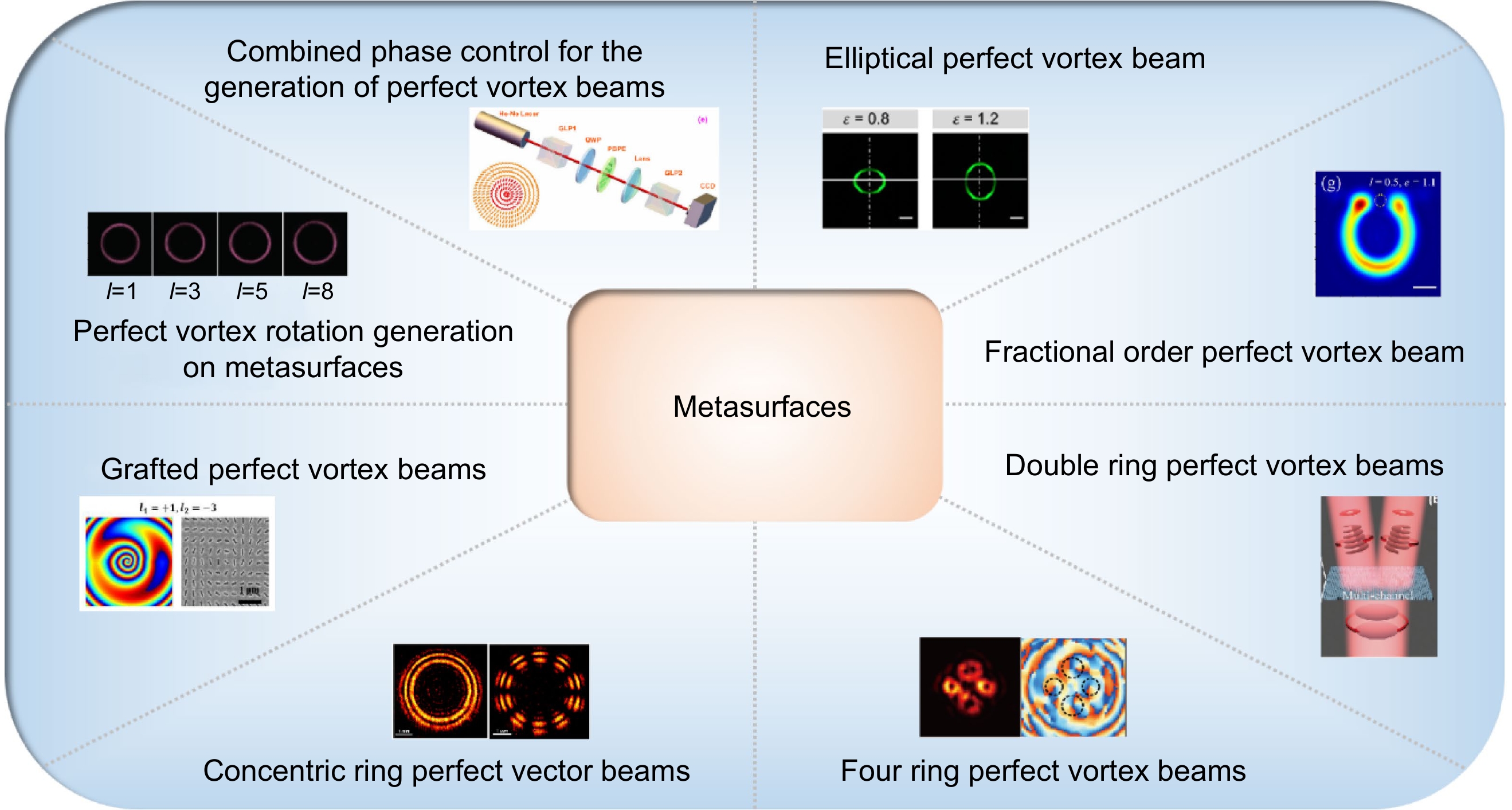
This article reviews the latest advances in the generation and control of perfect vector beams using metasurfaces. In recent years, metasurfaces have garnered increasing interest due to their simple fabrication and easy integration. Perfect vortex beams (PVBs), as a type of vector beams, exhibit complex polarization states that require the superposition of multiple phases for their generation.
The use of metasurfaces provides a compact platform for the generation of perfect vortex beams and enables more complex vortex beam control tasks, which are quite challenging for traditional optics. This paper begins by introducing the principle of perfect vortex beam generation using metasurfaces, followed by a discussion on the generation of complex perfect vortex beams, including multi-channel and grafted perfect vortex beams.
Subsequently, it explores the applications of perfect vortex beams in particle trapping and optical communication. Finally, the paper summarizes the key findings, highlights the limitations of metasurfaces in perfect vortex beam applications, and provides insights into potential future research directions and applications.
A 36 × 240 Gbps hybrid mode/wavelength division multiplexing transmitter using lithium niobate on insulator
Mingyu Zhu, Weihan Wang, Ruitao Ma, Aoyun Gao, Chun Gao, Zexu Wang, Fei Huang, Zhenyuan Bao, Dajian Liu, Jiaxuan Gan, Zejie Yu, Huan Li, Weike Zhao, Daoxin Dai
Opto-Electronic Advances
2026-08-25
Light-perception-based interactive control of an underwater digital twin hand
Jinlong Lu, Chao Zhang, Hengchang Nong, Dongying Wang, Hongyu Zhou, Junjie Weng, Yuehua Deng, Yang Yu, Qiang Bian, Jianfa Zhang, Chaofan Zhang, Zhenrong Zhang, Junbo Yang
Opto-Electronic Advances
2026-07-10
Unlocking home-based nocturnal health management: A fiber-optic approach for early detection of cardiorespiratory rhythm disorders
Hanyu Jin, Hao Li, Zhuolin Chen, Liangye Li, Zurui Wang, Kai Zhou, Weijian Hang, Zhipeng Chen, Junfeng Chen, Kai Shen, Jianfeng Wen, Chen Chen, Cunzheng Fan, Zhijun Yan, Feng Wang, Qizhen Sun
Opto-Electronic Advances
2026-07-10
A flexible wireless system for prospective photodynamic therapy applications
Rolan Mansour, Bhavani Yalagala, Vikas Vikas, Nikolas Bruce, Fawziye Tarhini, Georgios N. Arvanitakis, Mohammed Mughal, Jamie Blanche, Ahmad Taha, Jonathan Copper, Muhammad Imran, Karin Williams, Karin Oien, Mahmoud Wagih, Hadi Heidari, Robert Hadfield, David Flynn
Opto-Electronic Advances
2026-07-10
Parallel bright-field and multi-order edge imaging via wide field-of-view trichannel metalens
Xiaotong Li, Yeseul Kim, Youngsun Jeon, Junhwa Seong, Jaekyung Kim, Peng Tang, Shiqi Hu, Harit Keawmuang, Beomha Yang, Dongmin Jeon, Le Dai, Weiyan Li, Xiaodong Cai, Jinhui Shi, Yong-Sang Ryu, Trevon Badloe, Junsuk Rho
Opto-Electronic Advances
2026-07-10